🏆 BUYER-SITUATION GUIDE. General principles; always follow child seat manufacturer instructions and local regulations, which vary.
⭐ Do this before you buy anything
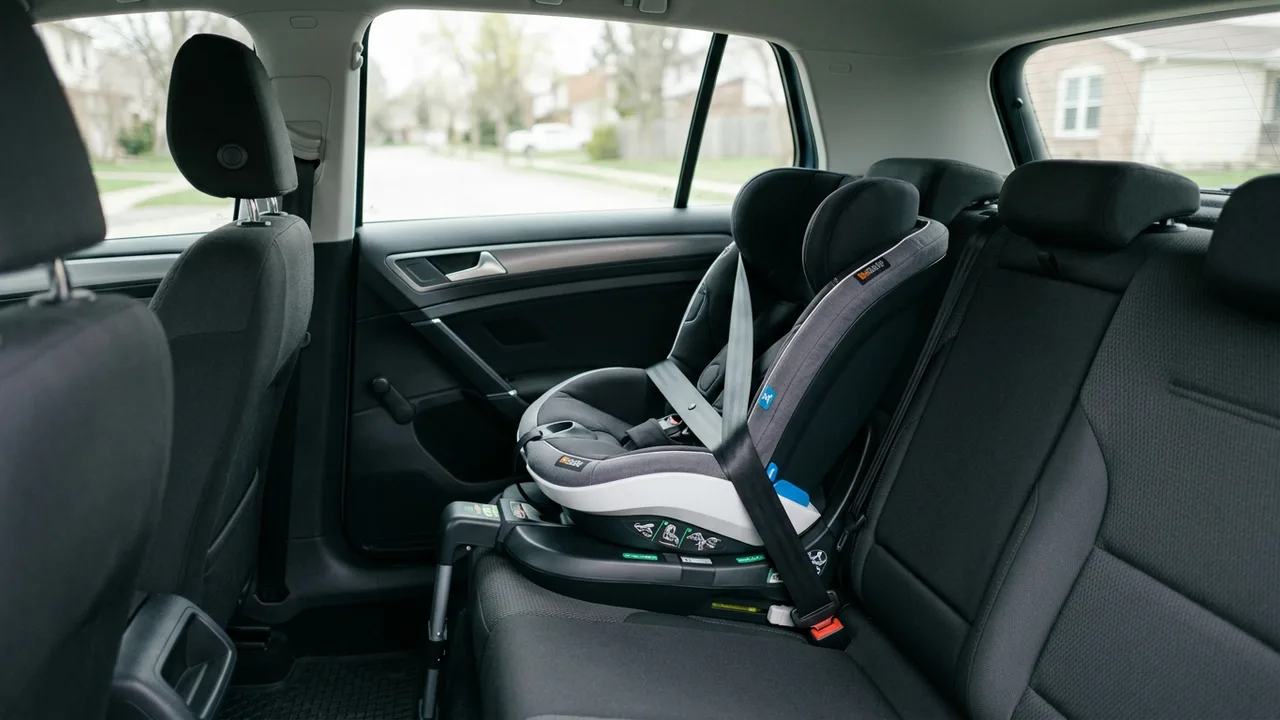
Take the child seat you'll actually use to the dealership and fit it.
Not a similar one. Not a mental estimate. The actual seat.
This single test reveals more than any specification sheet, and it routinely eliminates cars that look perfect on paper.
Then sit in the front seat with the child seat behind you, positioned where you'd actually drive. In some cars, a rear-facing seat leaves the front passenger with no legroom at all.
The specifications that genuinely matter
⭐ 1. ISOFIX / LATCH points — and where they are.
Check how many positions the car has, and — crucially — whether they're easy to access. Some cars bury the anchors deep in seat upholstery, which is a genuine daily irritation.
Check for a top tether anchor, required for many forward-facing seats.
⚠️ And follow the seat manufacturer's instructions and your local regulations — installation requirements vary, and a correctly-rated seat fitted incorrectly protects considerably less.
⭐ 2. Rear door aperture — more consequential than boot space.
You will lift a child in and out of the back of this car thousands of times.
A wide, tall, square door opening makes that dramatically easier than a narrow, sloping one.
⚠️ This is where coupe-SUVs suffer badly. As our reviews of the Mahindra BE 6 and XEV 9e noted, the sloping roofline compromises rear access and headroom — and with a child seat, that cost is paid every single day.
3. Boot space that's actually usable.
As our boot-measurement testing argued, quoted litres mislead — shape, aperture and load-lip height matter more.
With a pushchair, the specific test is: does your folded pushchair fit, with room left for anything else? Take it and try.
⭐ A low load lip matters enormously when you're lifting a pushchair while holding a baby.
4. Rear seat width, if you may have more than one child seat. Three across is genuinely difficult in most cars.
5. Climate control in the rear. As our India guides noted, rear vents are genuinely valuable — and with a child in the back, more so.
What actually helps day to day
Sliding doors. Genuinely transformative in tight car parks — no risk of a door swinging into the car alongside, and much easier access. This is the strongest argument for an MPV, and as our seven-seater guide noted, MPVs are shaped around carrying people in a way SUVs aren't.
A power tailgate, when your hands are full.
Wipe-clean surfaces. You will need them.
Sensible cupholders and storage.
A good reversing camera, because rear visibility is frequently compromised — and as our design coverage explained, modern crash structures mean thick pillars.
Air conditioning that cools the rear quickly.
⭐ Safety, which is the point
As our crash-safety history argued, the most important development is the shift from surviving crashes to avoiding them.
Automatic emergency braking is the single most valuable safety technology available — and our Learner's Permit column noted it intervenes faster than a human can.
Check both adult AND child occupant protection scores. As our India safety guide argued, a car scoring well for adults and poorly for children is not a good family vehicle — and the two are assessed separately.
⚠️ And check the rating for your exact variant, since equipment can differ across a range.
What matters less than you think
Outright size. A well-packaged smaller car frequently beats a poorly-packaged larger one — and it's easier to park, which matters when you're doing it one-handed.
Seven seats, unless you genuinely need them. As our seven-seater guide argued, occasional use rarely justifies the compromise — and a third row eats the boot exactly when you need it.
Outright power.
A panoramic roof, which costs headroom and weight.
Powertrain notes
If you're considering an EV: resolve home charging first, per our testing.
⚠️ And note our winter finding — expect 15–35% range loss in cold weather, with a heat pump the strongest predictor. Preconditioning while plugged in is genuinely valuable with a baby, because you set off with a warm car without spending range.
If you can't charge at home, a hybrid is frequently the better answer.
The bottom line
⭐ Take the actual child seat to the dealership and fit it. That test decides more than any specification.
Prioritise the rear door aperture over boot volume — you'll use it thousands of times, and coupe-SUV rooflines make it genuinely worse.
Check both adult and child occupant safety scores, and insist on automatic emergency braking.
Sliding doors are transformative in tight car parks, which is the strongest practical argument for an MPV.
And a low boot lip matters more than litres when you're lifting a pushchair with one arm.
Key takeaways
- ⭐ Take the actual child seat to the dealership and fit it — this single test eliminates cars that look perfect on paper
- The rear door aperture matters more than boot volume — you'll use it thousands of times, and coupe-SUV rooflines make it worse daily
- Check both adult AND child occupant protection scores — they're assessed separately, and a car can be strong at one and weak at the other
- Sliding doors are genuinely transformative in tight car parks — the strongest practical argument for an MPV over an SUV
- A low boot load lip matters more than quoted litres when you're lifting a pushchair one-handed