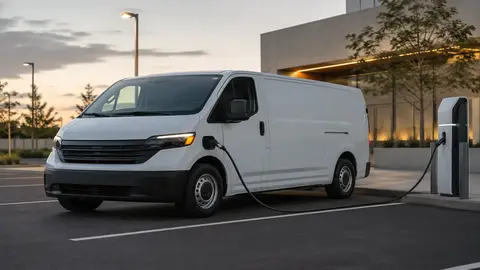
For US businesses, the big 2026 change is that the federal Commercial Clean Vehicle Credit (45W) ended for vehicles acquired after 30 September 2025 — there's no broad federal purchase credit left. The case for fleet EVs now rests on Section 179 expensing and 100% bonus depreciation (confirmed through 2026), low per-mile energy and maintenance costs, and state/utility rebates. The right move is to run a rigorous total-cost-of-ownership (TCO) model per duty cycle. In the UK, the 4% Benefit-in-Kind rate keeps company EVs and salary-sacrifice fleets highly attractive.
Fleet EV economics in 2026 at a glance
| Lever | Status / detail | Implication |
|---|---|---|
| Commercial credit (45W) | Ended 30 Sep 2025 | No broad federal purchase credit |
| Section 179 | 2026 cap $2.56M; heavy-SUV cap $32,000 | Immediate expensing for business use |
| Bonus depreciation | 100% confirmed through 2026 | Large year-1 deduction on qualifying EVs |
| Running costs | Lower energy + maintenance vs ICE | Savings compound across high-mileage fleets |
| UK company cars | 4% BiK in 2026/27 | Strong driver and employer tax case |
The 2026 reset: the commercial credit has ended
The federal credits that came from the Inflation Reduction Act have effectively ended. The Commercial Clean Vehicle Credit (45W) is not available for vehicles acquired after 30 September 2025, so by spring 2026 most businesses can no longer rely on a broad federal purchase credit for new commercial EVs. The economic case for fleet electrification therefore shifts from incentives to fundamentals: depreciation, running costs and disciplined planning.
The tools that remain for US business buyers
- Section 179 expensing: for 2026 the overall cap is $2.56M, with the heavy-SUV (over 6,000 lb GVWR) cap at $32,000. This lets businesses deduct qualifying vehicle cost immediately rather than over years.
- 100% bonus depreciation: confirmed through 2026, allowing a large first-year deduction on qualifying vehicles used for business.
- State and utility rebates: many states and utilities still offer EV and charger incentives — often the most valuable remaining buyer-facing support.
- Charger infrastructure support: some federal and state programmes help with depot charging; verify current availability.
Note that you generally cannot stack a now-defunct purchase credit with depreciation on the same vehicle — with 45W gone, depreciation tools are the primary federal lever.
Why running costs drive the fleet case
Fleets live on per-mile economics, and that's where EVs shine. With depot or home charging, energy cost per mile is typically far below petrol or diesel, and maintenance is 30–50% lower thanks to fewer moving parts, no oil changes and reduced brake wear from regeneration. Across a high-mileage fleet, those savings compound into real money each year — often the single biggest driver of the business case once the purchase credit is gone.
Build a total-cost-of-ownership model
The right answer is rarely 'electrify everything at once'. Model each duty cycle separately, because vehicles that return to a depot nightly and run predictable routes electrify far more easily than long-haul or unpredictable ones.
| TCO input | What to capture | Why it matters |
|---|---|---|
| Purchase / lease cost | Real price minus any state rebate | Sets the capital baseline |
| Energy | Depot/home vs public charging mix | Biggest variable in the saving |
| Maintenance | EV vs ICE service schedules | 30–50% lower for EVs typically |
| Depreciation / residuals | Model-specific resale outlook | Still the biggest uncertainty |
| Charging infrastructure | Depot hardware + install + grid upgrade | Often a large upfront cost |
| Downtime | Charging windows vs duty cycle | Decides operational fit |
Lean on Section 179, bonus depreciation and any state/utility rebates to offset early purchases. Electrify the easiest duty cycles first (predictable routes, depot return). Consider used commercial EVs with verified battery health to cut capital cost. And model charging infrastructure as a project in its own right — it's frequently the hidden cost that makes or breaks the business case.
The UK fleet picture
In the UK the case is even stronger, driven by tax rather than purchase grants. Pure EVs are taxed at just 4% Benefit-in-Kind in 2026/27 (rising slowly to 9% by 2029/30), which makes company EVs and salary-sacrifice schemes highly attractive to both employer and employee. Employers also save on National Insurance through salary sacrifice. Note that VED now applies to EVs and the £50,000+ expensive-car supplement bites from April 2026, so factor those in.
Common fleet mistakes
- Treating EVs as a like-for-like swap without modelling charging infrastructure and duty cycles.
- Assuming the commercial credit still exists — it ended 30 September 2025.
- Underestimating depot charging cost, grid-connection lead times and downtime.
- Ignoring residual-value uncertainty, which remains the biggest variable in fleet TCO.
Frequently asked questions
Is the commercial EV tax credit still available in 2026?
What tax tools can a business still use for EVs?
How do I decide which vehicles to electrify?
Are EVs cheaper to run for fleets?
What's different for UK fleets?
Sources & further reading
Figures, prices and policy details were current at the last-updated date above. Automotive pricing, incentives and regulations change frequently — verify time-sensitive details with the linked primary sources. Read our editorial policy and fact-checking standards.