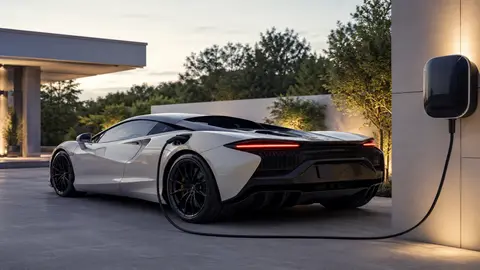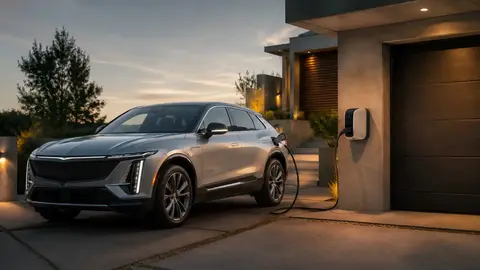
If maximum range is your priority, the Lucid Air leads every EV on sale at about 512 miles (EPA), thanks to class-leading efficiency near 4.6 miles per kWh. Other long-haul standouts include the Chevrolet Silverado EV (~493 mi), Cadillac Escalade IQ (~465 mi), Lucid Gravity SUV (~450 mi), BMW iX3 (~434 mi), Rivian R1T (~420 mi) and Tesla Model S (~410 mi). But for real road trips, charging speed and network access matter as much as range. Plan on 85–90% of the EPA figure at highway speeds, and choose a car that fast-charges 10–80% in roughly 20–30 minutes.
Longest-range EVs of 2026
| Model | Type | EPA range (approx.) | Standout trait |
|---|---|---|---|
| Lucid Air | Sedan | ~512 mi | Most range of any EV; ~4.6 mi/kWh efficiency |
| Chevrolet Silverado EV | Truck | ~493 mi | Longest-range electric pickup |
| Cadillac Escalade IQ | SUV | ~465 mi | Large luxury 3-row with big battery |
| Lucid Gravity | SUV | ~450 mi | Efficient long-range family SUV |
| BMW iX3 | SUV | ~434 mi | Efficient new-gen Neue Klasse platform |
| Tesla Model S | Sedan | ~410 mi | Strong range plus deep Supercharger network |
How far the best EVs really go
Long-range EVs have pulled away from the pack. The Lucid Air tops the field at roughly 512 miles of EPA range — the most of any EV on sale — and it gets there through efficiency rather than brute battery size, extracting close to 4.6 miles per kWh. That is nearly 100 miles more than rivals draw from a similar-sized pack. Trucks and large SUVs follow: the Chevrolet Silverado EV reaches about 493 miles and the Cadillac Escalade IQ around 465, both leaning on very large batteries.
For most travellers, anything above 300 miles already removes range from the list of road-trip worries. The cars above are for people who want to minimise stops, tow, or cover very long distances between reliable chargers.
Why range isn't the whole story
A big EPA number is reassuring, but three other factors decide how relaxed a long trip actually feels:
- Highway efficiency: EPA tests blend city and highway driving. At a steady 70–75 mph you will see roughly 85–90% of the rated figure, so plan conservatively. Consumer Reports testing puts most EVs at 85–95% of their rating on the highway.
- Charging speed: the gap between a 20-minute and a 45-minute 10–80% charge transforms a long trip. Look for high peak DC power and a flat charging curve, not just a high top number.
- Network access: Tesla's Supercharger network and the growing list of cars with native NACS access make charging stops simpler. Coverage still varies sharply by region and country.
Matching the car to the journey
| Your trips | What to prioritise | Example picks |
|---|---|---|
| Occasional 300+ mile drives | Any 300-mile EV with fast charging | Tesla Model 3/Y, Hyundai Ioniq 6, BMW i4 |
| Frequent very long hauls | 450+ mi range + fast charging | Lucid Air, Lucid Gravity, BMW iX3 |
| Towing or hauling far | Large battery, truck/SUV platform | Chevrolet Silverado EV, Rivian R1T |
| Luxury long-distance | Range plus comfort and quietness | Lucid Air, Tesla Model S, BMW i7 |
Planning a long EV trip
- Use a route planner (built-in nav, A Better Route Planner or PlugShare) that accounts for elevation, weather and your car's charging curve.
- Charge to 100% only at the start; on the road, top up to 80% and drive on — the last 20% is the slowest.
- Precondition the battery before fast-charging in cold weather so you get full charging speed.
- Arrive at chargers with a low state of charge (10–20%) to sit in the fastest part of the curve.
- Build in margin: plan around 85% of EPA range and keep a buffer for detours and headwinds.
UK and European long-distance EVs increasingly use the 800V architecture and high-power chargers (Ionity, Gridserve, Tesla Superchargers now open to other brands) for sub-20-minute top-ups. In India, intercity rapid-charging corridors are expanding but remain patchy outside major routes — long-range models and careful planning matter more there. Always verify current network coverage for your route before relying on it.
Mistakes to avoid
- Buying maximum range when fast charging would solve the problem more cheaply.
- Trusting the EPA number at 80 mph — real highway range is meaningfully lower.
- Ignoring the charging curve: a car that peaks high but tapers fast can be slower overall than one with a flatter curve.
- Forgetting that cold weather can cut usable range by 20–30% before preconditioning.
Frequently asked questions
Which EV has the longest range in 2026?
How much range do I lose on the highway?
Is range or charging speed more important for road trips?
Do I need a 500-mile EV?
How should I plan charging stops on a long trip?
Sources & further reading
- U.S. News — Electric Cars With the Longest Range in 2026
- Cars.com — Electric Cars With the Longest Range
Figures, prices and policy details were current at the last-updated date above. Automotive pricing, incentives and regulations change frequently — verify time-sensitive details with the linked primary sources. Read our editorial policy and fact-checking standards.