True Motion Auto has not independently road-tested this vehicle. Specifications, pricing and performance figures are compiled from manufacturer technical data and published independent tests, and are attributed where quoted. Read how we review cars.
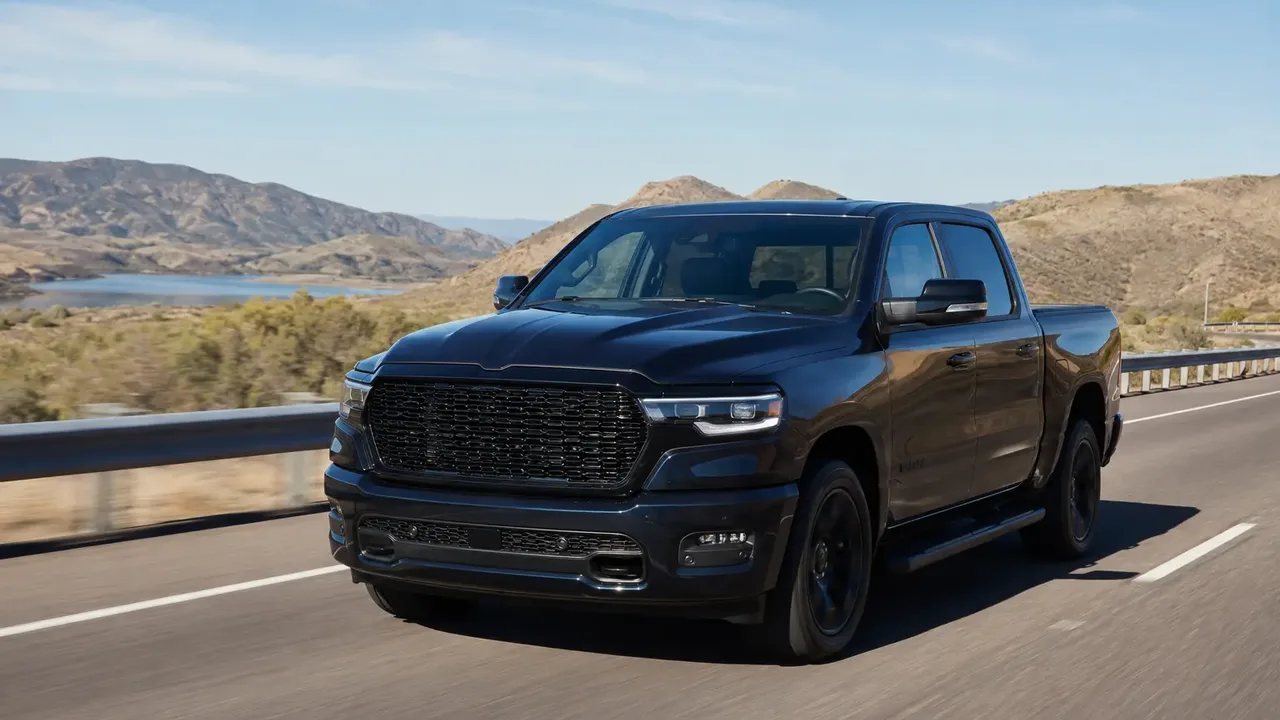
Research verdict: The Ramcharger might be the smartest answer yet to the electric-pickup problem. 145 miles of pure electric range covers virtually all daily truck use; when it runs out, a V6 generator (never connected to the wheels) extends total range to 690 miles with no charging stop. It tows 14,000 lb without range collapse. Ram believed in it so completely that it cancelled its all-electric truck. On the published specification, genuinely convincing.
The truck that killed Ram's electric truck
Here's the most telling fact about the Ramcharger, and it's a remarkable one.
Ram originally planned two electrified pickups: the 1500 REV, a pure battery-electric truck to fight the F-150 Lightning and Silverado EV, and the Ramcharger, an unusual extended-range electric vehicle (EREV) with a gas generator. After repeated delays and a hard look at what truck buyers actually wanted, Stellantis made its choice: the all-electric Ram was cancelled entirely. The EREV survived — and confusingly, inherited the 1500 REV name (though most people, including us, still say Ramcharger).
That's an extraordinary vote of confidence. A major manufacturer looked at pure-electric pickups and concluded the range-extended format was the better answer for truck buyers. On the engineering, it is not hard to see why. This may be the smartest solution yet to the electric-pickup problem — and pickups are where electrification has struggled most.
How it actually works
The Ramcharger is a series hybrid, and the crucial detail is often misunderstood:
The 3.6-litre Pentastar V6 never connects to the wheels. Not through a transmission, not through a clutch — never. It exists solely to spin a 130 kW generator that either feeds the electric motors directly or recharges the battery. The truck is always electrically driven; the engine is just an onboard power station.
That means you get pure EV driving character all the time — instant torque, silence, smoothness — with a gas safety net that eliminates range anxiety entirely. In daily use, with a charged battery, it's simply an electric truck. On a long tow or a remote job, the V6 fires up and you keep going.
Three EV modes (Electric+, E-Save, Eco) let you control when the engine intervenes, plus separate drive modes (Off-Road, Snow, Sport, Tow).
The numbers
| Spec | Ram 1500 Ramcharger / 1500 REV |
|---|---|
| Battery | 92 kWh gross (~70.8 kWh usable), 400-volt |
| Electric range | ~145 miles |
| Total range | ~690 miles (with 27-gal tank) |
| Motors | Front 335 hp / rear 333 hp — 647–663 hp combined, 610–615 lb-ft |
| Generator | 3.6L Pentastar V6 (271 hp) driving a 130 kW generator — no mechanical link to wheels |
| 0–60 mph | ~4.4–4.5 sec |
| Top speed | 114 mph |
| Towing | 14,000 lb (Class 5 hitch) |
| Payload | 2,625 lb |
| DC charging | up to ~145–177 kW (adds ~50 mi in 10 min) |
| Home charging | 11 kW Level 2 |
| Platform | STLA Frame (body-on-frame, designed for full-size EVs) |
| Production | H2 2026 as a 2027 model |
145 miles of electric range is the number that matters. The average American drives roughly 30 miles a day — meaning most owners could run on electricity for weeks between fill-ups, using gas only for the long hauls and heavy tows where it actually matters.
Why this solves the electric-pickup problem
Pure electric pickups have struggled for reasons that are genuinely structural, not merely psychological:
Towing destroys EV range. Hitch a heavy trailer to a battery-electric truck and range can halve. For a work truck, that's not an inconvenience — it's a dealbreaker. The Ramcharger tows 14,000 lb and simply runs the generator; your range doesn't collapse.
Truck buyers travel to places without chargers. Job sites, ranches, remote work. A gas generator means infrastructure ceases to matter.
Charging time versus work time. A tradesperson can't wait 45 minutes mid-shift. Refuelling takes five minutes.
Cold weather. Battery range drops in the cold; the generator doesn't care.
The Ramcharger addresses every one of these while still delivering a genuinely electric daily driving experience for the 90%+ of use that's short-range. That's not a compromise — it's arguably the correct engineering answer for this specific vehicle type.
What the specification suggests
It will drive like an EV, because it is one. The wheels are only ever turned by electric motors, so the driving character — instant torque, quiet running, strong regeneration — is electric whatever the engine is doing. 647 hp in a full-size pickup gives a claimed 0–60 mph of around 4.5 seconds, sports-car territory for a truck this size.
The generator's intervention should be undramatic. Because the V6 is decoupled from the wheels it can hold steady, efficient speeds rather than revving with road speed — no gearchanges, no kickdown. A series-hybrid engine is audible under sustained load, but it does not change how the vehicle drives.
The capability figures are work-truck numbers. 14,000 lb towing and 2,625 lb payload on the purpose-built STLA Frame platform mean this is a real work truck, not a lifestyle statement.
Range confidence is the point. A quoted 690 miles of combined range fundamentally alters how an electrified truck can be used: you stop planning around the battery.
The honest caveats
It's a hybrid, not a zero-emissions vehicle. If your goal is fully electric motoring, the Ramcharger burns gas on long trips. Environmental purists will note this; pragmatists will note it burns far less than a conventional truck for typical use.
Complexity. Two powertrains means more components than either a pure EV or a conventional truck. Long-term reliability is unproven.
Timing has slipped repeatedly. Announced for 2024, then 2025, now production in H2 2026 as a 2027 model. Ram's execution record here warrants some caution.
Incentive eligibility differs from a pure EV. Check current rules for your situation.
Weight and efficiency. Carrying both a large battery and an engine means significant mass.
The competition
Ford F-150 Lightning / Chevrolet Silverado EV: the pure-electric rivals — cleaner in principle, but exposed to exactly the towing-range and infrastructure problems the Ramcharger sidesteps.
Scout Terra (2027): the closest philosophical rival — also offering an EREV option (see our Scout Traveler analysis). Ram beats it to market.
Conventional and hybrid full-size pickups: the incumbent competition, cheaper but without the electric daily-driving experience.
The bottom line
The Ram 1500 Ramcharger may be the smartest answer yet to a problem the industry has struggled with: how to electrify a pickup without breaking what makes a pickup useful. By making the V6 a pure generator that never touches the wheels, Ram delivers genuine EV driving character for the 145 miles that cover nearly all daily use, plus 690 total miles and 14,000 lb of towing without the range collapse that hobbles battery-electric trucks. Ram believed in the format so completely it cancelled its pure-electric truck — and on the engineering case, that decision looks less like retreat than clear-sightedness. It's complex, it burns gas on long hauls, and the timeline has slipped repeatedly. But as a truck, it makes more sense than any pure-electric pickup yet. Genuinely convincing. Full rated review to follow.
Key takeaways
- The Ramcharger is an EREV: a 3.6L V6 spins a 130 kW generator but never connects to the wheels — it's always electrically driven
- 145 miles of pure electric range (covering most daily truck use) plus ~690 miles total, 647–663 hp, and 14,000 lb towing
- It solves pure-electric pickups' structural problems: towing range collapse, remote charging gaps, refuelling time and cold-weather losses
- Ram believed in it so completely that it cancelled its all-electric 1500 REV — the EREV inherited the name
- Caveats: it burns gas on long trips, adds powertrain complexity, and the timeline has slipped to H2 2026 production (2027 model year)
Sources & further reading
- Car and Driver
- Road & Track
- InsideEVs
- TechCrunch
- TopElectricSUV
- Ram/Stellantis materials. Research preview — full rated review to follow. Verified July 2026.
Figures, prices and policy details were current at the last-updated date above. Automotive pricing, incentives and regulations change frequently — verify time-sensitive details with the linked primary sources. Read our editorial policy and fact-checking standards.