A single car, carrying a company
In July 2026, JSW MG Motor India confirmed that the MG Windsor EV had crossed 75,000 cumulative sales in less than two years since its October 2024 launch. More than 19,000 of those came in the first half of calendar 2026 alone.
To understand how unusual that is, consider the internal arithmetic. From October 2024 to September 2025, the Windsor sold 44,352 wholesale units — accounting for 61% of MG's total volumes across that twelve-month window.
Most carmakers have a best-seller. MG has a load-bearing wall.
What the Windsor actually is
The proposition is a deliberate segment violation, and that is the whole trick.
MG's stated strategy was to combine an A-segment entry price, B-segment exterior dimensions for easy city driving, and C-segment cabin space. In a market obsessed with value-per-rupee and constrained by narrow urban roads, that is an extremely well-aimed product brief.
The specification:
- 100 kW (136 PS) and 200 Nm
- Two battery options, up to 449 km claimed range
- Priced roughly ₹14–18.5 lakh conventionally
The pricing innovation: a Battery-as-a-Service entry point at ₹9.99 lakh, which decouples the battery's upfront cost from the vehicle and charges a usage fee starting at ₹3.9 per kilometre.
That BaaS number is the real weapon. It brings an electric CUV with a genuine 400km-plus claimed range into the psychological price bracket of a mid-spec petrol hatchback. Whatever one thinks of the long-run economics of per-kilometre battery leasing, it demolishes the single biggest barrier to Indian EV adoption: the sticker.
The distribution surprise
Here is the statistic that should reframe how the industry thinks about Indian EV demand.
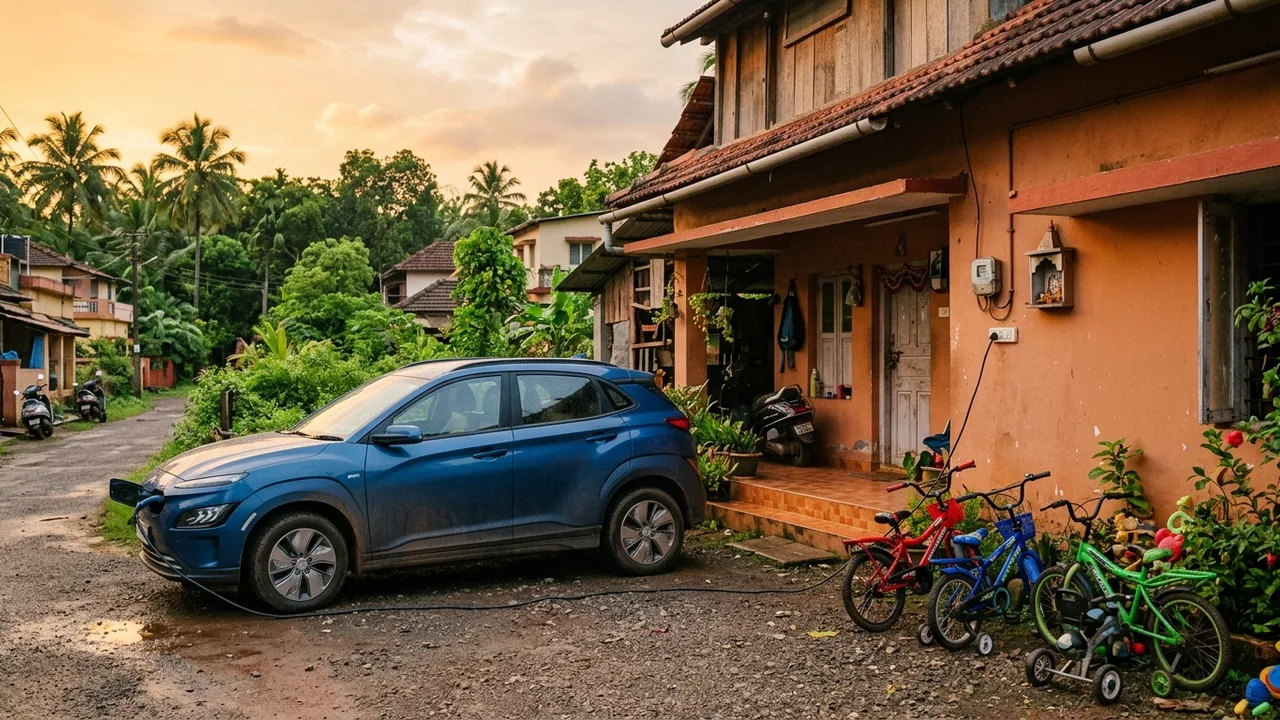
About 70% of Windsor sales come from outside India's four biggest metros. Only 30% come from Delhi, Mumbai, Kolkata and Chennai combined.
The received wisdom for a decade has been that Indian EV demand is a metro phenomenon — constrained by charging infrastructure, apartment-block politics and range anxiety on intercity routes. The Windsor's Tier-II and Tier-III performance says otherwise. It says that when you price an EV correctly and size it for Indian roads, the demand is national.
That is a more important finding than the 75,000 number itself.
What it did to MG
MG entered India in 2019 as a curiosity — a Chinese-owned company wearing a British badge, with the Hector SUV as its opening move. It was a moderate success and then a plateau. The JSW joint venture, formed in 2023, needed a reason for the market to re-evaluate the brand.
The Windsor was that reason. Consider what has followed:
- MG became India's No. 1 EV player on volume, ahead of Tata in the segment
- Total 2025 sales reached 70,554 units across the range
- 13% year-on-year overall growth in H1 CY2026
- The company now targets 75–80% of its business coming from new-energy vehicles
- A premium retail channel, MG Select, launched to carry the Cyberster electric roadster and M9 electric MPV
- The Majestor full-size SUV arrived in 2026 at ₹40.99–44.99 lakh, taking on the Toyota Fortuner
None of that is possible without the Windsor establishing that MG can sell an EV to mainstream India in volume. Halo products only work if you have a base.
The vulnerability
Being a one-product company is a strength right up until it isn't.
Monthly Windsor volumes have been drifting: 4,741 units in September 2025, then 4,445, 4,025, 3,596, 2,567 in January 2026, 2,599 in February, and around 4,056 in June. That is not collapse — it reads as the natural cooling of launch-period demand — but it is a reminder that a single nameplate carrying 60% of a company's volume is a concentrated risk.
MG's own leadership appears to understand this. Managing Director Anurag Mehrotra has framed the new-energy market as a supply-side problem rather than a demand-side one: more products, more brands and more segments will bring more consumers. The company plans roughly six new models across 2026–27, weighted toward EVs and plug-in hybrids, including at least one PHEV, built on a flexible architecture that can support EV, PHEV and ICE configurations.
MG is also moving to raise Windsor localisation above 70% to reduce supply-chain risk — a sensible move in a period of geopolitical freight volatility, and one that should protect margin.
The lesson for everyone else
The Windsor's success was not about technology. Its 100kW motor and 449km range are competent, not exceptional. It succeeded on product definition and price architecture.
MG identified an unoccupied sweet spot between ₹13–18 lakh, built a car precisely for it, and then removed the price barrier entirely with BaaS. Mehrotra's framing — that strategy is about saying no to things — is the least fashionable and most useful thing any Indian auto executive has said recently.
Tata built India's EV market. MG proved it could be sold to the whole country.
Key takeaways
- MG Windsor crossed 75,000 sales in under two years; 19,000+ in H1 2026 alone
- It accounted for 61% of MG's total volume in its first twelve months
- 70% of Windsor sales come from outside India's four largest metros
- Battery-as-a-Service pricing from ₹9.99 lakh removed the EV sticker barrier
- MG targets 75–80% of its business from new-energy vehicles, with ~6 new models in 2026–27
Sources & further reading
- JSW MG Motor India statements and sales data
- Autocar Professional interview with MD Anurag Mehrotra (February 2026)
- Business Standard/PTI (July 2026)
- Rushlane, CarToq, GaadiKey monthly sales reporting
Figures, prices and policy details were current at the last-updated date above. Automotive pricing, incentives and regulations change frequently — verify time-sensitive details with the linked primary sources. Read our editorial policy and fact-checking standards.