What PM E-DRIVE is
PM E-DRIVE — Electric Drive Revolution in Innovative Vehicle Enhancement — is India's flagship electric mobility scheme, notified on 29 September 2024 by the Ministry of Heavy Industries and running from 1 October 2024. It replaced FAME-II.
Total outlay: ₹10,900 crore (roughly US$1.3 billion). It breaks down across four pillars:
| Pillar | Allocation | Target |
|---|---|---|
| Electric two-wheelers | — | ~24.79 lakh e-2Ws |
| Electric three-wheelers | — | ~3.2 lakh e-3Ws |
| Electric buses | ₹4,391 crore | 14,028 e-buses |
| Public charging (EVPCS) | ₹2,000 crore | 72,300 chargers |
The scheme has been extended piecemeal: e-2Ws through 31 July 2026; e-rickshaws and e-carts through 31 March 2028; the L5 three-wheeler category closed on 26 December 2025.
The charging target, unpacked
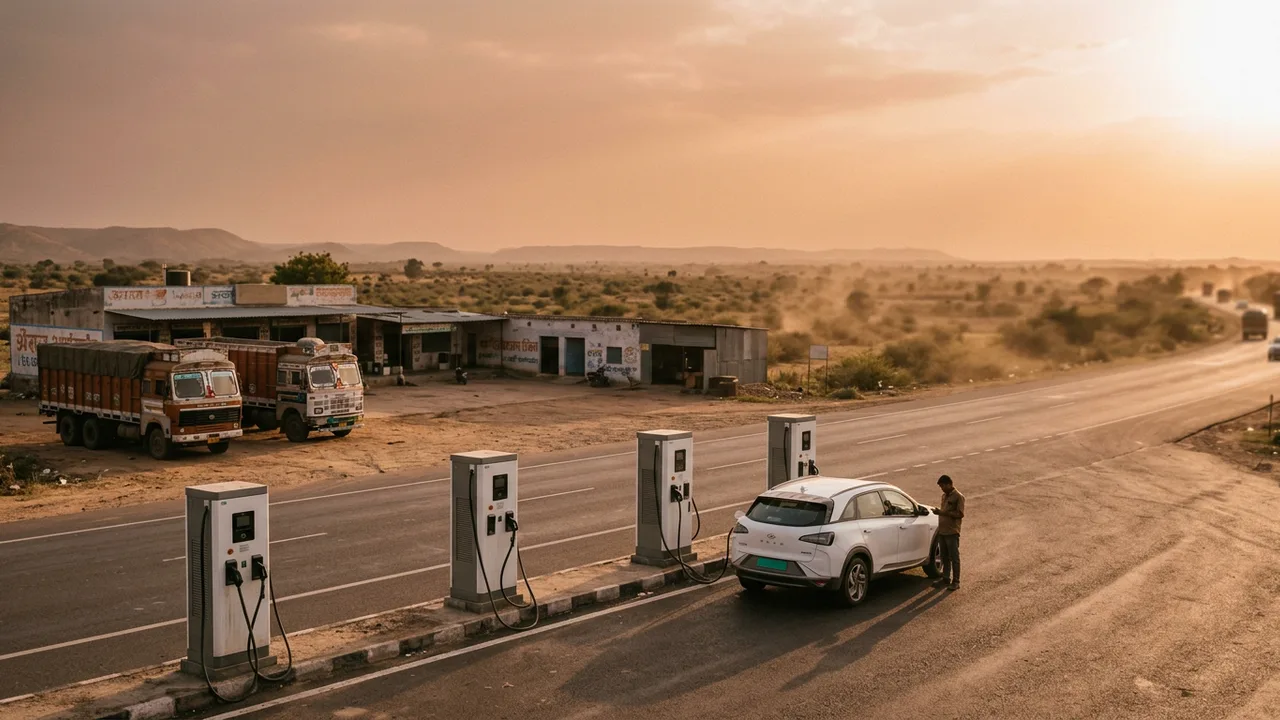
The ₹2,000 crore charging allocation is the part that will define whether India's EV transition succeeds, and it is the part that gets the least scrutiny.
The 72,300 charger target breaks down as:
- ~22,100 fast chargers for four-wheelers
- ~48,400 fast chargers for two- and three-wheelers
- ~1,800 fast chargers for e-buses
Placement is targeted at 50 national highway corridors plus high-footfall locations — metro stations, airports, bus depots and fuel stations. Operators receive up to an 80% upstream subsidy (covering the grid connection and distribution infrastructure, which is the genuinely expensive part).
Where India actually is
As of March 2026, India had 27,737 registered public charging stations. Of those, approximately 22,753 were operational.
Read that gap again. Roughly 5,000 chargers exist on paper but do not work. That is not a footnote — a dead charger on a map is arguably worse than no charger, because it creates false confidence and strands drivers.
To reach 72,300 by the March 2028 horizon, India needs to install roughly 45,000 additional chargers — around 60 per day, every day, for two years.
For scale on how far the country has already come: India had fewer than 5,000 public chargers in 2022. Under FAME-II, 8,932 were installed. The current network represents a roughly 5x increase in four years.
For scale on how far it has to go: India's charger-to-vehicle ratio is approximately 1:235, against roughly 6.5 million EVs on the road. The IEA benchmark is between 1:6 and 1:20. China operates at around 1:8; the US at around 1:15.
Both of those framings are accurate. The transition is moving fast and is nowhere near sufficient.
The state picture
Charging infrastructure in India is a state story as much as a central one.
Karnataka led with roughly 6,096 public stations as of December 2025 — a product of early policy adoption and aggressive fleet electrification in Bengaluru. Other estimates put Maharashtra ahead at 4,800+, with Delhi NCR (3,200+), Karnataka (2,900+) and Tamil Nadu (2,100+) following; the ranking depends on whether you count registered or operational stations, which is itself telling.
The largest single network is Tata Power EZ Charge with 7,000+ points. ChargeZone and Statiq are the strongest multi-brand networks; BPCL Charge+ and Jio-BP Pulse have the best fuel-station integration for highway travel.
A CII report has argued India needs at least 1.32 million charging stations by 2030 — requiring over 400,000 installations a year. Against that benchmark, 72,300 is a down payment, not a solution.
The buses
The most under-reported part of PM E-DRIVE is its bus programme, and it may be the most consequential.
₹4,391 crore for 14,028 electric buses. Of these, 13,800 have been allocated across two phases to seven cities with populations above four million: Bengaluru, Delhi, Mumbai, Hyderabad, Ahmedabad, Pune and Surat. Tenders for the 10,900 buses in Phase I have concluded via CESL; Phase II tenders for 2,900 buses were floated on 9 January 2026.
The broader national ambition — replacing around 800,000 diesel buses over seven years — is far larger than the passenger-car story and would do more for urban air quality than any number of private EVs.
Has it worked?
By the numbers on vehicle incentives: yes. As of 27 January 2026, 22.12 lakh EVs had been sold under the scheme — 19.19 lakh e-2Ws and 2.93 lakh e-3Ws.
On charging: not yet. As of May 2026, only around 4,900 chargers had been approved under the scheme's charging component. Against a 72,300 target, that is early-stage.
The honest verdict is that PM E-DRIVE has been a successful demand-side subsidy and a slow supply-side infrastructure programme. Which is a familiar Indian pattern, and a fixable one — the operational guidelines released in 2025 have clarified eligibility, subsidy disbursement and infrastructure targets, and the deployment rate has picked up since.
What to watch
- Whether the 60-chargers-a-day run rate is actually achieved through 2026–27
- Whether the operational number, not the registered number, becomes the metric the government reports
- Whether the e-2W component is extended again past 31 July 2026
- Whether states with strong policies (Karnataka, Delhi, Maharashtra) pull further ahead, entrenching a two-speed national market
Key takeaways
- PM E-DRIVE: ₹10,900 crore total, running from October 2024
- ₹2,000 crore earmarked for 72,300 public chargers by 2028; 80% upstream subsidy for operators
- India had 27,737 registered chargers in March 2026 — but only ~22,753 operational
- Reaching the target requires roughly 60 new chargers a day
- 22.12 lakh EVs sold under the scheme by January 2026; ₹4,391 crore allocated for 14,028 e-buses
Sources & further reading
- Ministry of Heavy Industries / PM E-DRIVE portal
- PIB press releases
- electrive
- IBEF
- CII
- MeraEV network analysis
Figures, prices and policy details were current at the last-updated date above. Automotive pricing, incentives and regulations change frequently — verify time-sensitive details against the primary sources listed below. Read our editorial policy and fact-checking standards.