


The thing to know before anything else
Genesis no longer sells a petrol or diesel car in Britain. Auto Express reported on 28 January 2025, under Paul Barker's byline, that the brand was scrapping pure petrol and diesel in the United Kingdom to become electric-only by that summer. The G80 saloon with a combustion engine was listed in that report as having "minimal stock remaining"; the G70 saloon and Shooting Brake were "almost sold out"; the GV70 and GV80 were given until the end of that summer. Genesis Motor UK's brand director, Jonny Miller, told Fleet World the brand was confident that "our transition to an electric range, joined by future hybrid models, is the right direction".
Genesis's own website now bears that out in four separate places, all read on 1 October 2026. Its "Build your Genesis" page offers a configurator for exactly four cars — GV60, GV60 Magma, Electrified GV70 and Electrified G80 — every one of them battery-electric. The models index gives the G80 a "View Pre-Owned Stock" button where the electric cars get "Build your Genesis". The finance-offers page carries deals on those same four EVs and none on the G80. And the one "Build Your Genesis" link still sitting on the G80's own model page is a dead button: the address behind it returns a 404.
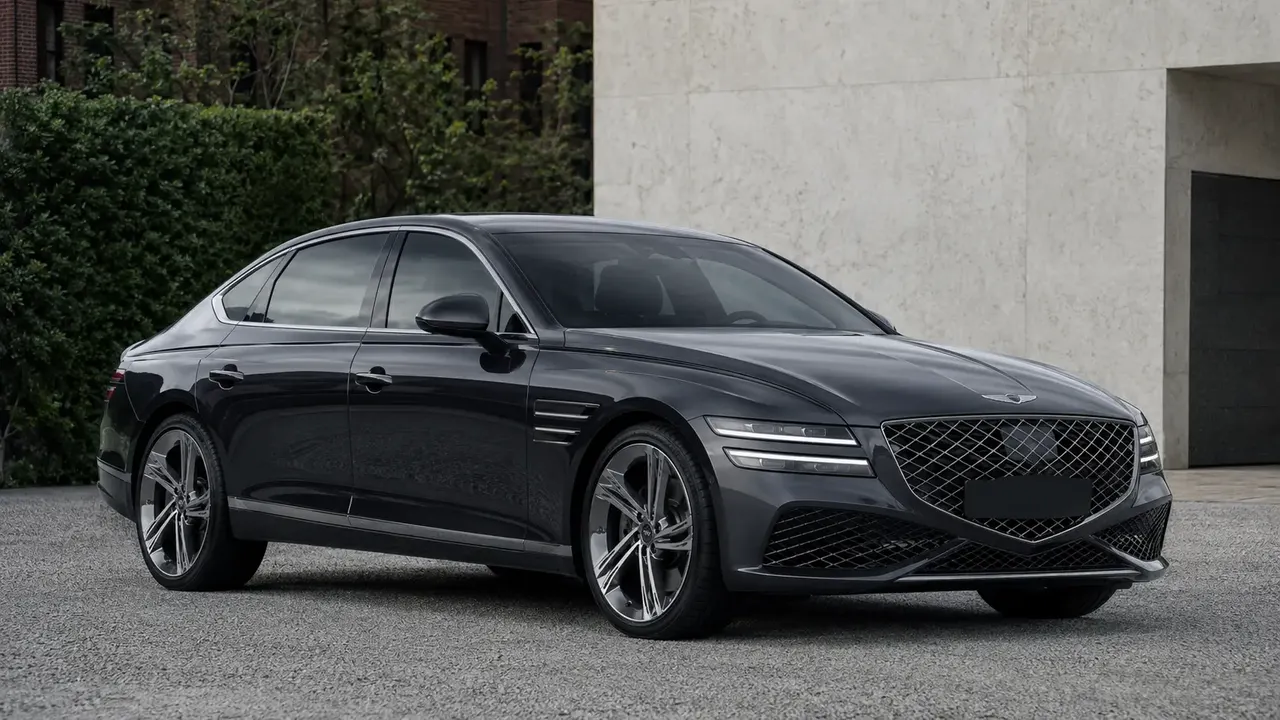
So this page is written for the person it is actually useful to — someone looking at a used or ex-demonstrator G80, not someone ordering one. Everything below is the UK car's real specification, what it costs to tax and insure, what Euro NCAP actually crashed, and what an independent tester made of it. Auto Express's review of the battery-electric Electrified G80, updated on 22 June 2026 by Shane Wilkinson and Richard Ingram, puts the position plainly: Genesis first offered the G80 with a petrol or diesel engine, and the range now comprises a single all-electric model.
The petrol G80 is a used purchase in Britain. Genesis UK went EV-only in the summer of 2025, so the 2.5-litre turbocharged petrol saloon described here has to be bought second-hand or from remaining dealer stock. Its five-year unlimited-mileage warranty transfers with the car, which is the single strongest reason to consider one.
What the UK G80 range actually was
Genesis Motor UK's published G80 price list — a document with no model-year label and no printed publication date, whose PDF metadata records 17 April 2025 — sets out six cars: three trim levels, each with the same 2.5-litre turbocharged petrol engine and eight-speed automatic, each offered with rear-wheel drive or all-wheel drive. There was no hybrid and no plug-in hybrid. A 2.2-litre diesel had been offered earlier in the car's UK life (Auto Express quoted it from £36,100 in 2021, and Carwow still lists its figures), but it is absent from the final price list.
The list prints two prices against every variant, consistently £1,650 apart. On the GV70's equivalent document the higher of the two matches the live model page exactly, so the higher figure is the later one and is used here.
| Trim | Drive | Price (OTR) | What the trim adds |
|---|---|---|---|
| Premium | RWD | £44,750 | 19-inch A-Type alloys on Michelin Pilot Sport 4, leatherette seats heated in front, 14.5-inch screen, 8-inch instrument display, two-zone climate, manual tailgate, Preview electronically controlled suspension, ten airbags |
| Premium | AWD | £47,305 | As above with all-wheel drive |
| Sport | RWD | £49,950 | Sports bumpers and dark gloss chrome, black calipers, 19-inch C-Type alloys, carbon or hybrid-weave trim, three-spoke wheel, metal pedals, suede headlining, quilted Nappa leather, electric tailgate, three-zone climate |
| Sport | AWD | £52,505 | As above with all-wheel drive |
| Luxury | RWD | £50,605 | 20-inch A-Type alloys, real wood trim, heated leather steering wheel, quilted leather seats, electric tailgate, three-zone climate, premium cabin filter |
| Luxury | AWD | £52,605 | As above with all-wheel drive |
Two oddities in that table are worth naming. The Sport sits below the Luxury on price but is not a lesser car — it swaps the Luxury's 20-inch wheels and open-pore wood for 19s, carbon or metal-weave trim and quilted Nappa, which is a taste decision rather than a downgrade. And all-wheel drive costs £2,555 on the Premium but only £2,000 on the Luxury, so the cheapest route to a four-wheel-drive G80 is not the cheapest trim plus the usual uplift.
Paint is the other thing that moves the number. Alta White is the only no-cost colour; every metallic and pearl is £750, and the two matte finishes, Bond Silver and Makalu Grey Matte, are £1,130. On a used car that matters only in that it tells you what the original list price was — which, as the tax section below explains, is the figure the DVLA cares about.
One figure on Genesis's own site does not fit any of this. The G80 model page carries a headline "starting from £54,125", which is roughly £9,000 above the dearest car on the price list and far below the £77,095 at which Auto Express starts the Electrified G80. It matches nothing else the brand publishes. Treat it as a leftover rather than a live price, and work from the price list and from what cars are actually advertised for.
Engine, performance and WLTP economy
Every UK G80 of this generation uses the same engine. Genesis quotes it as a 2.5-litre turbocharged petrol four producing 224 kW, which the brand states as 304 PS; Carwow records 304 hp and 422 Nm, with 0–60 mph in 6.0 seconds. The earlier 2.2-litre diesel, on Carwow's figures, made 210 hp and 441 Nm and took 8.0 seconds, which tells you most of what you need to know about which one suits a motorway life and which suits a brisk one.
| Engine | 2.5-litre turbocharged petrol, eight-speed automatic |
|---|---|
| Power | 224 kW (304 PS) |
| Torque | 422 Nm (Carwow) |
| 0–60 mph | 6.0 seconds (Carwow) |
| Drive | Rear-wheel drive or all-wheel drive, by variant |
| WLTP combined, 2.5T RWD | 33–34 mpg |
| WLTP CO2, 2.5T RWD | 189.2–195 g/km |
| WLTP combined, whole range | 30–34 mpg |
| WLTP CO2, whole range | 189.2–210.4 g/km |
| Boot | 424 litres (Auto Express and Carwow) |
Thirty-something miles per gallon from a two-and-a-half-litre petrol saloon is not a good number in 2026, and it is the main reason the combustion G80 reads as a car from an earlier moment. There is no mild-hybrid assistance to soften it. Against that, the suspension hardware is genuinely unusual at the price: Preview electronically controlled damping reads the road ahead through the forward camera and adjusts before the wheel reaches the bump, a system more commonly found several price brackets higher.
The cabin technology holds up better than the drivetrain. The 12.3-inch instrument display produces a three-dimensional effect by tracking where the driver is looking; navigation can overlay direction arrows and street names onto a live video feed of the road; the head-up display is projected across twelve inches of windscreen; and the Lexicon audio system uses eighteen speakers. Voice control extends past the usual media and climate commands to opening and closing the windows and the boot.
Road tax: one gram, £1,150
The G80's first-year vehicle excise duty sits exactly on a band boundary, and which side of it a particular car falls is worth more than most of the option list. Genesis quotes 189.2–195 g/km for the rear-wheel-drive 2.5T and 189.2–210.4 g/km across the whole range. GOV.UK's current table charges a petrol car £2,270 in its first year at 171 to 190 g/km and £3,420 at 191 to 225 g/km.
| CO2 (WLTP) | First-year VED, petrol | From the second licence |
|---|---|---|
| 189–190 g/km | £2,270 | £200 standard rate + £440 supplement = £640 a year |
| 191–210 g/km | £3,420 | £200 standard rate + £440 supplement = £640 a year |
For a used buyer the first-year figure is already somebody else's problem — it was paid on registration, and Genesis's price list says it was built into the on-the-road price. What survives the sale is the expensive-car supplement. Every G80 cost more than £40,000 new, so every one carries £440 a year on top of the £200 standard rate for five years counted from the second time the vehicle was taxed. In practice that means a G80 stops costing £640 a year and starts costing £200 on its sixth birthday, and a car a few months short of that date is carrying a bill the next owner inherits. Work out the registration date before you negotiate. Our explainer on the April 2026 VED changes covers how the bands moved.
Note also that the price list states the supplement as £335 a year. That was correct when the document was drawn up and is not correct now; GOV.UK gives £440 today. A manufacturer price list is a source for prices, never for tax rates.
Safety: five stars, and exactly what was crashed
Euro NCAP awarded the Genesis G80 five stars in 2021, scoring 91 per cent for adult occupant protection, 87 per cent for child occupant protection, 77 per cent for vulnerable road users and 91 per cent for safety assist. The assessment was published on 26 May 2021 and has been carried forward through annual reviews in 2022, 2023 and 2024, a variant addition in June 2023 and a facelift review on 16 March 2025. It is still recorded as a 2021 rating, and no expiry date appears on the assessment page as read today — a point worth checking rather than assuming, because Euro NCAP results do lapse. Our guide to how Euro NCAP ratings work explains why the year attached to a star count matters as much as the count.
The car Euro NCAP actually crashed was a G80 2.2 CRDi GLS in left-hand drive with a kerb weight of 1,910 kg — a diesel, and not the engine sold here. That sounds like a caveat and in this case is not one: the assessment's variants table extends the rating to the 2.5-litre T-GDI petrol in both rear-wheel and all-wheel drive, which covers every UK G80 on this page, as well as the 87.2 kWh Electrified version.
The detail behind the stars is more informative than the stars. Protection of the driver's chest was rated marginal in the frontal offset test, and the small female driver's chest was marginal again in the full-width test. The side barrier test produced maximum points. Pedestrian pelvis protection was poor, despite an active bonnet that lifts on impact to create clearance over hard engine components. Rear-seat whiplash protection was judged marginal on geometry. A centre airbag sits between the front occupants to stop them striking each other in a side impact, and it performed well. Euro NCAP also recorded that the automatic door locking did not release after the offset frontal impact — but on the electric variant only, with Genesis committing to rework existing cars and the star rating left unaffected.
Practicality, and the one number that disappoints
The boot is 424 litres, a figure both Auto Express and Carwow give. In a saloon of this size that is modest, and it was among Auto Express's criticisms when the car was new. For context, the battery-electric Electrified G80 is worse again at 334 litres — Auto Express describes that as smaller than a Volkswagen Golf's — so the petrol car is the practical one of the two, which is not a sentence you write often.
Rear-seat provision is where the G80 spends its money instead. Depending on specification the back seats can be electrically adjustable with powered slide, tilt and recline, ventilated, shaded by powered rear curtains and equipped with independent touchscreen monitors in the seatbacks. The sunroof, however, costs noticeable headroom — Auto Express flagged it specifically — so anyone tall who sits in the back should sit in the back of the actual car before agreeing a price.
What independent testers concluded
Steve Fowler reviewed the petrol G80 for Auto Express on 9 June 2021 and scored it 4.0 out of 5, testing a 2.5-litre all-wheel-drive car at £47,950. His verdict was that the G80 was already the best non-German model in the executive saloon sector, while conceding that the BMW 5 Series remained the better car to drive. He praised the styling and interior quality, the 14.5-inch touchscreen, the Ride Preview damper system, the pricing and the five-year care package, and the flexibility of buying online or through a studio. He criticised the boot, a slightly firm ride at low speeds, the headroom lost to the sunroof, a chassis tuned for comfort rather than sport, and uncertain resale values against established German brands.
Carwow, in a review credited to Jack Healy and carrying a 2026 date, scores the petrol and diesel G80 seven out of ten and reaches the same place by a different route: sharp styling inside and out, comfortable over distance, not as nice to drive as the alternatives. Its summary — that choosing one is "like choosing a Marks & Spencer suit instead of one from Savile Row" — is both a compliment and the reason the car never sold in numbers.
Both verdicts were written when the G80 was new and are assessments of the car, not of the market position it now occupies. The resale uncertainty Fowler flagged in 2021 has since resolved itself, and not in the first owner's favour: Carwow lists used G80s from £19,990.
Warranty, the Care Plan change, and servicing
The warranty is the strongest argument for a used G80 and the detail most often got wrong. Genesis covers the car for five years from first registration with unlimited mileage on passenger cars — not five years or sixty thousand miles, which is the North American arrangement that has migrated into a great many British write-ups. The mileage cap of 130,000 miles or 200,000 km applies only to cars used as taxis, for daily rental or hire, and to light commercial vehicles. Cover extends to every original component except tyres and accessories, is honoured only through the official Genesis network in Europe, and comes with five years of roadside assistance. Because it runs from first registration rather than from purchase, it transfers with the car — on a three-year-old G80 that is two years of unlimited-mileage manufacturer cover included in the price, which is worth setting against any extended warranty a dealer offers.
Servicing is where Genesis has changed its terms, and the brand's own pages now disagree with each other. The price list states that the on-the-road price includes a 5-Year Care Plan. The Care Plan page says the Genesis Care Plan is now a plan you buy — scheduled servicing plus a courtesy car, quoted through a retailer — while customers who purchased before 1 June 2026 keep the original 5-Year Care Plan on their existing terms, with vehicles produced before May 2026 possibly eligible. Both statements are on genesis.com today. We have not tried to reconcile them. On a used car, ask the seller to show you in writing what plan the car actually carries and how much of it is left, rather than assuming the price list applies.
One further practical note from the Care Plan page: Genesis cars are sold across the UK mainland only, excluding Northern Ireland. The service network is correspondingly small, which is the chief ownership drawback and something to weigh against the warranty before buying.
Buying a used G80: what to check
This is now the only way to get one, so it deserves the detail. Confirm the engine first — a 2.2 diesel and a 2.5 petrol were both sold here, and a listing that says only "G80" tells you nothing about which you are looking at or what it will cost to tax. Establish the first registration date next, because it sets both the remaining warranty and the date the £440 supplement stops. Then ask for the Care Plan paperwork rather than the brochure.
Two recall campaigns are worth raising. Genesis models of this era were subject to a seatbelt pre-tensioner manufacturing fault covering vehicles built between April 2020 and February 2023, and cars from 2021 have been reported with circuitry faults affecting the ABS. Ask for written confirmation that both have been addressed; a franchised Genesis retailer can check the vehicle identification number against outstanding campaigns in minutes.
Because the dealer network is small, a complete and verifiable service history matters more here than on a mainstream car, and so does the difference between an approved used car and an ordinary used one. Set a realistic figure before you start — Carwow lists examples from £19,990, so the depreciation is severe and there is room to negotiate.
Who the G80 suits, and who it does not
It suits a buyer who wants an executive saloon that nobody else on the road has, who values a quiet, comfortable, lavishly trimmed cabin above handling, who does enough motorway miles to appreciate the chassis but not so many that 33 mpg hurts, and who sees a transferable five-year unlimited-mileage warranty as real money. At used prices it is a lot of car for the outlay.
It does not suit a buyer who needs a big boot, who wants a hybrid or will need one soon, who lives far from one of Genesis's small number of UK locations, or who cares about residual values. If the badge is the appeal but the running costs are not, the brand's own electric saloon is the logical place to look instead; if the segment is the appeal, the BMW i4, Audi A7 Sportback, Mercedes-Benz CLS and Volvo S60 are the cars a G80 shopper tends to look at alongside it.
Buyer checkpoints
| Check | What to establish |
|---|---|
| Which engine | 2.5-litre petrol (304 PS) or the earlier 2.2-litre diesel (210 hp). They tax, fuel and accelerate differently and listings often omit it. |
| First registration date | Sets the remaining five-year warranty and the date the £440 expensive-car supplement expires — the car's sixth birthday. |
| Recorded CO2 | 189.2–210.4 g/km across the range. Confirms which VED band the car was registered in and what the V5C says. |
| Care Plan status | Genesis's price list and Care Plan page disagree. Get the actual plan and its remaining term in writing. |
| Recall history | Seatbelt pre-tensioners (built April 2020 to February 2023) and reported ABS circuitry faults on 2021 cars. Ask for VIN-checked confirmation. |
| Rear headroom with the sunroof | Auto Express flagged it when the car was new. Sit in the back of the specific car. |
| Distance to a Genesis location | UK mainland only, excluding Northern Ireland, and a small network. Warranty work must go through it. |
True Motion Auto has not independently road-tested this vehicle. Specifications, pricing and performance figures are compiled from manufacturer technical data and published independent tests, and are attributed where quoted. Our score reflects a structured research assessment of specifications, pricing, safety data and owner feedback for the segment — not an independent road test. Read how we review cars.
Frequently asked questions
Can you still buy a petrol Genesis G80 new in the UK?
What engine does the UK Genesis G80 have?
How much is road tax on a Genesis G80?
What did Euro NCAP actually crash to give the G80 five stars?
Does the Genesis warranty transfer to a second owner?
How big is the Genesis G80's boot?
Sources
All figures on this page were collected on 1 October 2026 from the following named sources. Where sources disagree, both positions are stated above rather than reconciled.
| Source | Used for |
|---|---|
| Genesis Motor UK, G80 price list (no printed date; PDF metadata records 17 April 2025) | Trim structure, drivetrains, on-the-road prices, standard and trim-specific equipment, paint prices, on-the-road price composition |
| Genesis UK, G80 model page (genesis.com/uk), read 1 October 2026 | WLTP combined economy and CO2 for the range and the 2.5T RWD, equipment and option packs, the unexplained “starting from £54,125” figure, pre-owned stock routing |
| Genesis UK, models index, “Build your Genesis” page and finance-offers page, read 1 October 2026 | Which models still have configurators and finance offers; the dead configurator link on the G80 model page |
| Genesis UK, warranty page | Five-year unlimited-mileage warranty terms, taxi/rental mileage restriction, five-year roadside assistance, European service network |
| Genesis UK, Genesis Care Plan page | Care Plan now sold as a purchasable plan; pre-1 June 2026 customers keep original terms; UK mainland only, excluding Northern Ireland |
| Euro NCAP, Genesis G80 assessment (published 26 May 2021) | Five-star rating, four category scores, tested model and kerb weight, variants table, rating-validity log, test commentary |
| GOV.UK, vehicle tax rate tables | First-year VED bands, £200 standard rate, £440 expensive-car supplement, £40,000 threshold |
| Auto Express, “Genesis scraps pure petrol and diesel in the UK”, Paul Barker, 28 January 2025 | The EV-only decision, which models were withdrawn and on what timescale, hybrids returning around 2027 |
| Auto Express, “New Genesis G80 2021 review”, Steve Fowler, 9 June 2021 | Independent 4.0/5 verdict, pros and cons, as-tested price, boot capacity, 2021 diesel pricing |
| Auto Express, Genesis Electrified G80 review, Shane Wilkinson and Richard Ingram, 22 June 2026 | Confirmation that the UK range is now a single all-electric model; Electrified G80 pricing and boot capacity |
| Carwow, Genesis G80 review, Jack Healy | 7/10 verdict, petrol and diesel outputs, torque, 0–60 mph, boot capacity, used prices from £19,990 |
| Fleet World, Natalie Middleton | Quote from Genesis Motor UK brand director Jonny Miller on the transition to an electric range |
Change log
1 October 2026 — rebuilt, and the market framing corrected. This page previously carried a United States review of a 2016 G80 under a UK heading. It described 3.8-litre V6 and 5.0-litre V8 engines Genesis has never sold in Britain, quoted outputs in horsepower and the price as a launch MSRP, claimed an IIHS award in place of the Euro NCAP result that applies here, listed a five-year or sixty-thousand-mile warranty with a separate powertrain term that is a North American arrangement, and referred to SiriusXM satellite radio. It also carried an offers heading with no link beneath it. Separately, it presented the car as one a reader could go and order: Genesis went electric-only in Britain in the summer of 2025, so the petrol G80 is a used purchase, and the page has been rewritten around that. Every specification, price and safety figure above was replaced with Genesis Motor UK, Euro NCAP, GOV.UK, Auto Express, Carwow and Fleet World data collected on the date of this note.
Specifications, prices and equipment were current at publication and vary by model year, trim and market. Verify final details with a franchised dealer before ordering. Read how we review cars and our editorial policy.