📚 Retrospective comparison. Historical figures drawn from period sources; modern figures verified against current specifications.
The most useful comparison in motoring
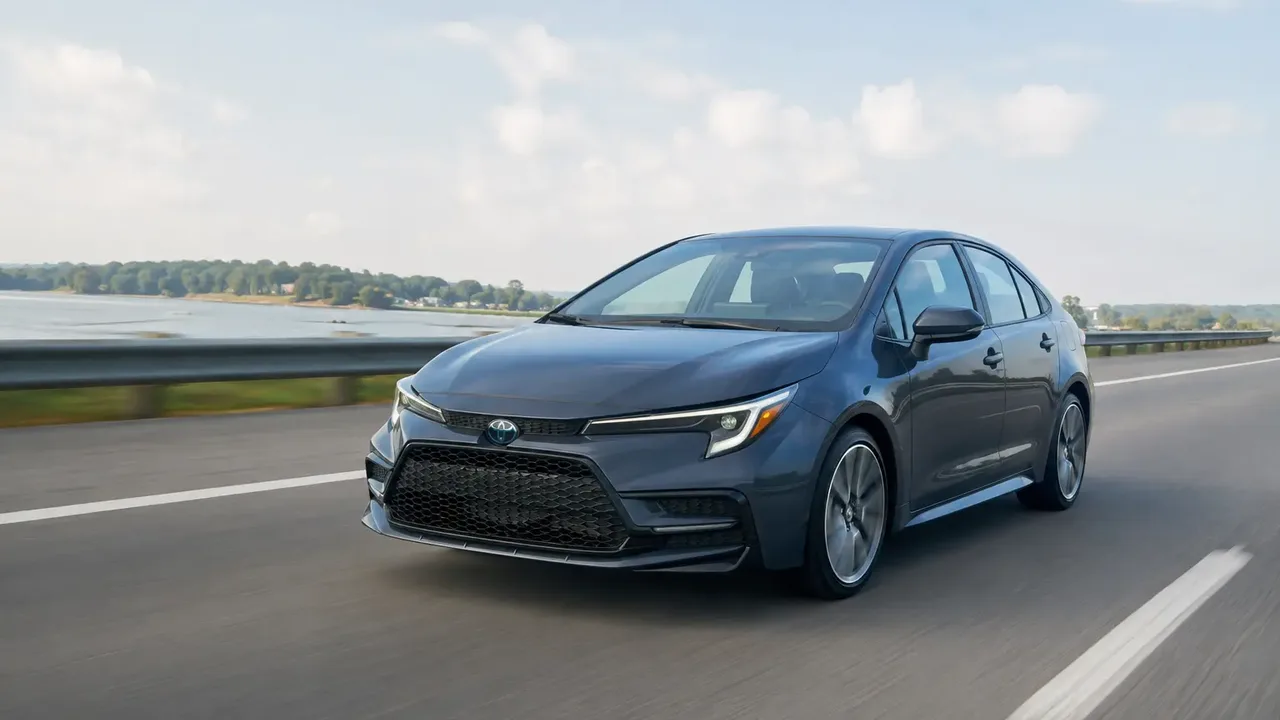
The Corolla is the best-selling car in history, and its consistency of purpose makes it an unusually clean lens on how cars have changed. Same nameplate, same brief — sensible, affordable, reliable family transport — twenty-eight years apart.
Everything that differs between them is a change the entire industry made.
What changed, and by how much
| 1998 Corolla | 2026 Corolla | |
|---|---|---|
| Safety | dual airbags typical; basic structure | multiple airbags, advanced crash structure, standard driver assistance |
| Driver assistance | essentially none | AEB, lane keeping, adaptive cruise, blind-spot monitoring |
| Powertrain | petrol | hybrid, dramatically more efficient |
| Efficiency | modest by modern standards | substantially better despite more weight and power |
| Equipment | radio, manual windows on base trims | touchscreen, connectivity, climate control, cameras |
| Refinement | acceptable | markedly quieter and smoother |
| Weight | considerably lighter | substantially heavier |
| Complexity | simple, owner-serviceable | complex, dealer-dependent |
| Real price | see our inflation analysis | see our inflation analysis |
The five genuine improvements
1. Safety is transformed, and it's the most important change by a distance. A 2026 Corolla protects its occupants incomparably better than a 1998 one — better structures, more airbags, and crucially active safety that helps avoid the crash entirely. Automatic emergency braking alone represents a step-change in real-world outcomes.
As our micro-SUV comparison argued about the Indian market, safety shouldn't be traded away to save money — and the reason that argument is winnable now is that the industry has made enormous progress since 1998.
2. Efficiency, despite everything working against it. The modern car is heavier, more powerful and better equipped, and it still uses substantially less fuel — largely thanks to hybridisation. As our hybrid economy testing found, full hybrids generally deliver close to their official figures, particularly in urban use. That's a genuine engineering achievement.
3. Refinement. The 2026 car is markedly quieter and smoother. As our cabin-noise testing notes, refinement is genuinely fatiguing when absent — and a quieter car is a less tiring one on a long journey.
4. Equipment. Features that were luxury-car preserves in 1998 — climate control, connectivity, cameras — are now standard on an affordable family car.
5. Reliability standards across the industry. Toyota was already excellent in 1998; what changed is that everyone else improved, which is largely a consequence of competition.
The problem nobody talks about
Weight, and it's the single biggest regression.
The 2026 Corolla is substantially heavier than its 1998 predecessor. Safety structures, equipment, sound insulation and hybrid components all add mass, and there is no way to have modern safety without modern weight.
But as published instrumented testing keeps demonstrating, mass punishes everything simultaneously:
- Braking distances — a heavier car carries more kinetic energy to dissipate
- Tyre wear — heavier cars destroy tyres faster
- Agility and feel — the Mini's lightness argument, still valid
- Efficiency — partly offset by hybridisation, but working against it
- Road wear and particulate emissions from tyres and brakes
Our BMW M5 test found the heavier PHEV measurably slower than its lighter predecessor despite 90 more horsepower. Our premium hatch comparison found the light Maruti Swift is simultaneously the most fun and most efficient in its class.
The weight increase is a genuine, largely unavoidable cost of modern safety and equipment — and it's the honest counterweight to an otherwise overwhelmingly positive story.
The second problem: complexity
A 1998 Corolla could be maintained by a competent owner with basic tools. A 2026 Corolla largely cannot.
Multiple ECUs, hybrid high-voltage systems, calibrated driver-assistance sensors and complex infotainment mean most work requires dealer-level equipment. As our used-versus-new comparison argued, modern complexity has widened the risk of buying older premium cars — and the same principle applies here.
The Land Rover and Ambassador retrospectives both praised repairability as a genuine virtue. That virtue has largely been lost, and it matters most exactly where support is thinnest.
What hasn't changed
The brief. The Corolla is still sensible, affordable, reliable family transport, and it's still the best-selling car in history. Toyota has resisted the temptation to make it something else, which is a large part of why it endures.
The value proposition. Buy a Corolla and you're buying low risk, low running costs and strong resale — the same argument in 1998 and 2026. As our family-sedan comparison found, Toyota's resale strength is real money over an ownership cycle.
The bottom line
Twenty-eight years transformed the Corolla in nearly every measurable way: incomparably safer, substantially more efficient despite being heavier and more powerful, far better equipped, and markedly more refined. The improvements are real and overwhelmingly positive.
Two things got worse. It's considerably heavier, and mass punishes braking, tyres, agility and road wear simultaneously. And it's far more complex, which has largely cost owners the ability to maintain their own cars.
Neither is a criticism of Toyota — both are industry-wide consequences of demanding modern safety and equipment, and the safety gains alone justify the weight.
But they're worth naming, because "cars keep getting better" is true and incomplete. The honest version is: cars have got dramatically safer, cleaner and better equipped, and heavier and less repairable in the process. Both halves are the story.
Key takeaways
- Twenty-eight years transformed the Corolla: incomparably safer, substantially more efficient, better equipped and more refined
- Safety is the most important change — better structures and airbags, plus active safety like AEB that helps avoid the crash entirely
- Efficiency improved despite the car being heavier and more powerful, largely thanks to hybridisation
- The regression nobody discusses is weight — mass punishes braking, tyre wear, agility, road wear and particulates simultaneously
- The second regression is complexity: a 1998 Corolla could be owner-maintained; a 2026 one largely cannot
Sources & further reading
- Toyota historical and current specifications
- period automotive press
- True Motion Auto instrumented testing. Retrospective comparison. Verified July 2026.
Figures, prices and policy details were current at the last-updated date above. Automotive pricing, incentives and regulations change frequently — verify time-sensitive details against the primary sources listed below. Read our editorial policy and fact-checking standards.