🏆 THE RESULT
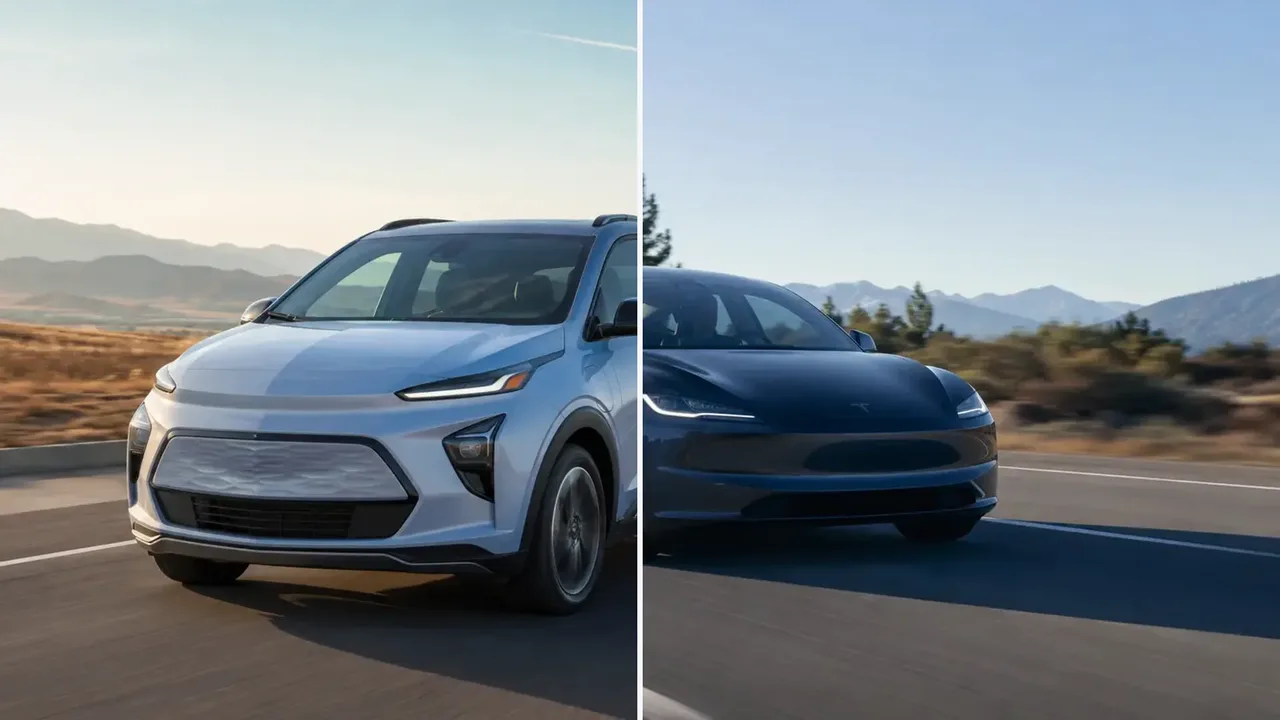
1st — Chevrolet Bolt (new) · warranty, certainty and native NACS make it the sensible answer for most buyers
2nd — Used Tesla Model 3 · more car for the money, if you can absorb the risk and do the homework
This is genuinely close, and unusually dependent on individual circumstances. The used Model 3 is the better car; the new Bolt is the better purchase for most people.
The most interesting question in affordable EVs
New versus used is a comparison we don't often run, because it's usually apples and oranges. Here it's a genuine, live decision that thousands of American buyers face: around $30,000 buys either a brand-new Chevrolet Bolt or a well-specified used Tesla Model 3.
These are fundamentally different propositions — one offers certainty, the other offers more car — and the right answer depends less on the vehicles than on the buyer's circumstances and risk tolerance.
Chevy Bolt vs. used Tesla Model 3: the numbers
| Chevrolet Bolt (new) | Used Tesla Model 3 | |
|---|---|---|
| Price | $29,990 (later LT ~$28,995) | ~$25,000–$32,000 depending on year/trim |
| Condition | Brand new | 2–4 years old, typically |
| Battery | 65 kWh LFP | NMC or LFP depending on year/trim |
| Range | ~250–255 mi | typically higher, less degradation allowance |
| Power | 210 hp, FWD | more power, RWD or AWD |
| Charging | 150 kW, native NACS | Supercharger network (native) |
| Warranty | Full new-car warranty | remaining balance only |
| Battery warranty | Full 8-year term remaining | partially consumed |
| Extras | Bidirectional (V2H), 20+ safety features | mature software, OTA updates |
| Assembly | Fairfax, Kansas | Fremont/Austin |
2nd place — Used Tesla Model 3
More car for the money, and a genuinely tempting proposition — with real risks that need managing.
What you gain:
- Substantially more performance. A used Model 3 typically offers more power and, in AWD form, all-weather traction the Bolt can't match.
- Better range, even accounting for degradation.
- A more sophisticated, more engaging car — better to drive, with a more premium feel.
- Supercharger access, mature software and continuing OTA updates.
- Someone else absorbed the steepest depreciation, which is the core argument for buying used.
What you're taking on:
- Battery health is the central unknown. Degradation varies enormously with usage history — frequent DC fast charging, extreme climates and habitual 100% charging all accelerate it. Insist on a battery health report, not just a test drive.
- Reduced warranty coverage. The Bolt arrives with everything intact; a used Model 3 offers only the remainder, and the battery warranty is partially consumed.
- Unknown history. Accident damage, deferred maintenance, and how previous owners charged and drove it.
- No manufacturer recourse for problems that predate your ownership.
- Repair costs for out-of-warranty items can be substantial.
Buy the used Model 3 if: you're comfortable with used-car risk, you'll get an independent inspection and a battery health check, you want more performance and range for the money, and you can absorb an unexpected repair without it becoming a crisis.
🏆 1st place — Chevrolet Bolt (new)
It wins on certainty, and for most buyers at this price point certainty is worth more than capability.
Our rated review scored the reborn Bolt 8.5/10, and the reasoning applies directly here.
Why it takes the win:
1. A full warranty on everything. This is the decisive factor. At $30,000, an unexpected $4,000 repair is a genuine financial problem for many buyers. The Bolt's complete new-car warranty — including the full 8-year battery term — eliminates that exposure entirely.
2. Known battery condition. No degradation, no charging history, no uncertainty. The battery's LFP chemistry is also inherently more durable and tolerant of frequent full charging than the NMC packs in many used Model 3s.
3. Native NACS. A Chevrolet first, giving direct Supercharger access — which historically was the Tesla's trump card and now isn't. This substantially narrows the practical gap between the two.
4. It's genuinely improved. The reborn Bolt fixed the original's real flaws: 150 kW charging (10–80% in about 26 minutes, transforming it from a city car into something road-trippable) and that NACS port. GM killed this car, took justified criticism for abandoning affordable EVs, and brought it back better.
5. Useful extras — bidirectional charging (vehicle-to-home) is genuinely valuable at this price, and 20+ standard safety features come included.
Its honest limitations: it isn't exciting (210 hp, FWD), range is merely adequate at ~250 miles, there's no AWD option, and GM has described it as a limited-run model — so check availability.
How to decide
Choose the new Bolt if:
- You want certainty and zero battery-health risk
- An unexpected large repair bill would be a serious problem
- You value the full warranty and known provenance
- Your driving is mostly local with occasional trips
- You're a first-time EV buyer who wants a low-stress introduction
Choose the used Model 3 if:
- You want more performance, range and sophistication for the money
- You'll commission an independent inspection and a battery health report
- You can absorb an unexpected repair
- You've bought used cars before and understand the process
- AWD matters to you
The homework that makes the used option safe
If you go used, these steps convert most of the risk into manageable uncertainty:
- Get a battery health report. Not optional. Degradation is the single largest financial variable.
- Check the charging history where available — heavy DC fast charging accelerates degradation.
- Confirm exactly what warranty remains, particularly on the battery and drive unit.
- Get an independent inspection from someone who knows EVs specifically.
- Check for outstanding recalls using the VIN.
- Verify software and connectivity features transfer to you — some are account-linked rather than car-linked.
The bottom line
The new Bolt wins because at this price point, certainty is worth more than capability. A full warranty, a known-condition LFP battery, native NACS charging and no history to worry about make it the sensible purchase for most buyers — particularly first-time EV owners who don't want their introduction to electric motoring to involve a degradation argument.
The used Model 3 is the better car, and for a confident buyer who does the homework, it delivers more performance, range and sophistication for the same money. That's a genuinely good deal if you can manage the risk.
The honest framing: if an unexpected $4,000 bill would hurt, buy the Bolt. If it wouldn't, and you'll do the inspection properly, the Model 3 gives you more. Both answers are right, for different people.
Key takeaways
- Winner: new Chevrolet Bolt — a full warranty, known-condition LFP battery and native NACS make certainty the deciding factor at this price
- The reborn Bolt fixed its predecessor's real flaws: 150 kW charging (10–80% in ~26 min) and Supercharger access, which narrows the Tesla's historic advantage
- Used Model 3 (2nd) is the better car — more performance, range and sophistication — but carries real battery-health and warranty risk
- If you buy used, a battery health report is non-negotiable, alongside an EV-specific independent inspection and a VIN recall check
- Decide on risk tolerance: if an unexpected $4,000 repair would hurt, buy the Bolt; if not, the Model 3 offers more
Sources & further reading
- used EV market analysis
- battery degradation principles
- manufacturer warranty terms. Verified July 2026.
Figures, prices and policy details were current at the last-updated date above. Automotive pricing, incentives and regulations change frequently — verify time-sensitive details against the primary sources listed below. Read our editorial policy and fact-checking standards.