🏆 THE RESULT
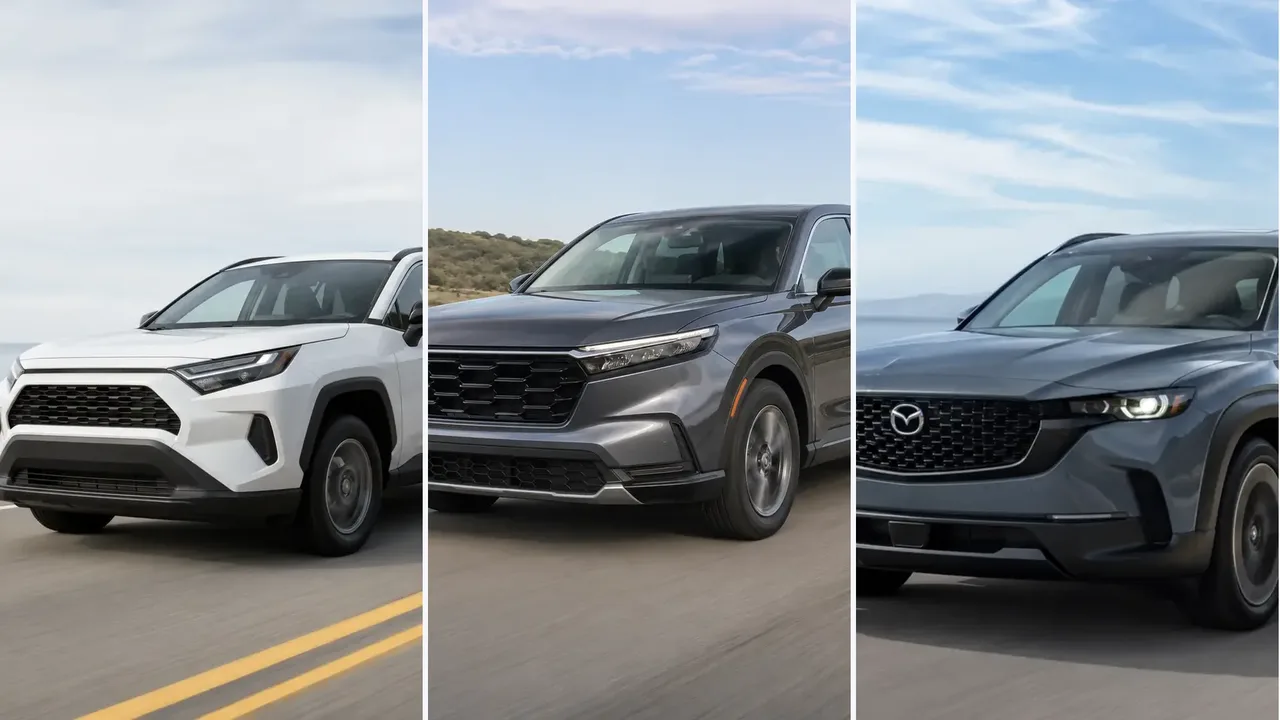
1st — Toyota RAV4 · hybrid efficiency, resale strength and reliability make it the default for good reason
2nd — Honda CR-V · the best interior and the most space, and a genuinely close second
3rd — Mazda CX-5 · the best to drive by a distance, and the one enthusiasts should buy
The tightest segment in America. Third place here is not an insult — the CX-5 wins on the criterion many readers care about most.
The segment that matters most
The compact SUV is the default American family vehicle, and these three are the cars most buyers genuinely cross-shop. It's also arguably the most competitive segment in the world — the cars are all genuinely good, the differences are real but narrow, and the decision usually comes down to which strengths you personally weight.
That makes it a segment where a ranking without explanation is useless. So we've been explicit about what each does best.
Toyota RAV4 vs. Honda CR-V vs. Mazda CX-5: the numbers
| Toyota RAV4 | Honda CR-V | Mazda CX-5 | |
|---|---|---|---|
| Hybrid option | excellent, class-leading | very good | limited/none by comparison |
| Fuel economy | best (hybrid) | very good (hybrid) | weakest |
| Interior space | very good | best in class | smallest |
| Interior quality | good | excellent | most premium-feeling |
| Driving dynamics | competent | competent, refined | clearly best |
| Resale value | strongest | strong | good |
| Reliability reputation | strongest | strong | good |
| Value | strong | strong | often the best-equipped for the money |
3rd place — Mazda CX-5
Third on points, first on driving — and for a meaningful group of readers, that makes it the right answer.
What it does better than either rival:
- It's genuinely enjoyable to drive. Steering feel, body control, chassis balance and throttle response are all a clear step above the segment norm. In a category defined by competence, the CX-5 has actual character.
- The most premium-feeling interior. Mazda's materials, design restraint and finish punch well above the price — it feels like a more expensive car inside than either rival.
- Handsome. Mazda's design language has aged better than almost anything in the segment.
- Strong equipment for the money — often the best-specified at a given price point.
Why it finishes third:
- Hybrid options lag badly. In a segment increasingly decided on efficiency, the CX-5's weaker electrified offering is a substantial competitive disadvantage against the RAV4 and CR-V hybrids.
- Fuel economy trails, which compounds over years of family use.
- It's the smallest inside — rear space and cargo capacity are noticeably tighter than the CR-V's.
- Resale is good but not class-leading.
Buy the CX-5 if: you actually enjoy driving, you value interior quality and design, and your space needs are moderate. If you'd rather have the nicest car than the most sensible one, this is your pick — and it's a legitimate choice, not a compromise.
2nd place — Honda CR-V
The best interior, the most space, and an uncomfortably close second.
Its case:
- Class-leading interior space. Rear legroom and cargo capacity lead the segment — for families, this is the most consequential practical advantage available here.
- Excellent interior quality and ergonomics. Honda's cabins are consistently well-judged, with sensible controls and genuinely good materials.
- A strong hybrid that delivers real efficiency, if narrowly behind Toyota's.
- Refined and comfortable, with composed ride quality.
- Strong resale and reliability, close behind Toyota.
Why it finishes second:
- The RAV4 hybrid remains the efficiency benchmark, and in this segment that increasingly decides purchases.
- Toyota's resale and reliability reputation is marginally stronger, which affects total cost of ownership.
- Less engaging to drive than the CX-5 — competent and refined, but not involving.
Buy the CR-V if: interior space and quality matter most, you want a strong hybrid, and you value refinement. It's a genuinely excellent car and the margin to first place is small — if the deal is better, take it without hesitation.
🏆 1st place — Toyota RAV4
It's the default for good reasons, and they hold up under scrutiny.
Why it wins:
1. The hybrid is the segment benchmark. Toyota's hybrid system remains the best in this class — smoother, more efficient and more proven than any rival's. In a segment where running costs increasingly decide purchases, that's the single most valuable advantage available.
2. Resale value leads the class. This is under-appreciated: strong resale is real money. A RAV4 that holds its value better costs less to own over five years even if it costs more to buy. Total cost of ownership favours it consistently.
3. Reliability reputation is the strongest here. Toyota's record is genuinely earned, and for a family vehicle expected to run for a decade with minimal drama, it's the most reassuring choice available.
4. Breadth of range. From efficient hybrids to more rugged trims, the RAV4 covers more use cases than either rival.
5. It does everything well enough. It isn't the best to drive, the roomiest or the nicest inside — but it's competitive on all of those while leading on efficiency, resale and reliability. That completeness is why it's the default.
Where it's beatable:
- The CX-5 is clearly better to drive, and it's not close.
- The CR-V has more space and a nicer interior.
- It's competent rather than characterful — a rational purchase rather than an emotional one.
The bottom line
The RAV4 wins on the criteria that determine long-term satisfaction for most family buyers: class-leading hybrid efficiency, the strongest resale, and the best reliability reputation. It's the default because the default is genuinely sound.
The CR-V is a very close second with the best interior and most space — take it if the deal is better or if space is your priority.
The CX-5 finishes third and is the best car to drive by a clear margin. If that matters to you more than fuel economy and resale, buy it and enjoy it. Just go in knowing you're paying for the pleasure in running costs.
None of these is a bad choice. The gap between first and third in this segment is smaller than in almost any other we test — which is precisely why it's so competitive.
Key takeaways
- Winner: Toyota RAV4 — class-leading hybrid efficiency, strongest resale value and best reliability reputation make it the sound default
- Honda CR-V (2nd) offers the most interior space and best interior quality in the segment; the margin to first is small
- Mazda CX-5 (3rd) is clearly the best to drive and has the most premium-feeling cabin, but weaker hybrid options and less space cost it
- Resale value is real money — a RAV4 can cost less to own over five years even at a higher purchase price
- The gap between first and third is narrower than almost any segment we test; choose on your priority, not the ranking
Sources & further reading
- Manufacturer specifications
- compact SUV segment analysis
- resale and reliability data. Verified July 2026.
Figures, prices and policy details were current at the last-updated date above. Automotive pricing, incentives and regulations change frequently — verify time-sensitive details against the primary sources listed below. Read our editorial policy and fact-checking standards.