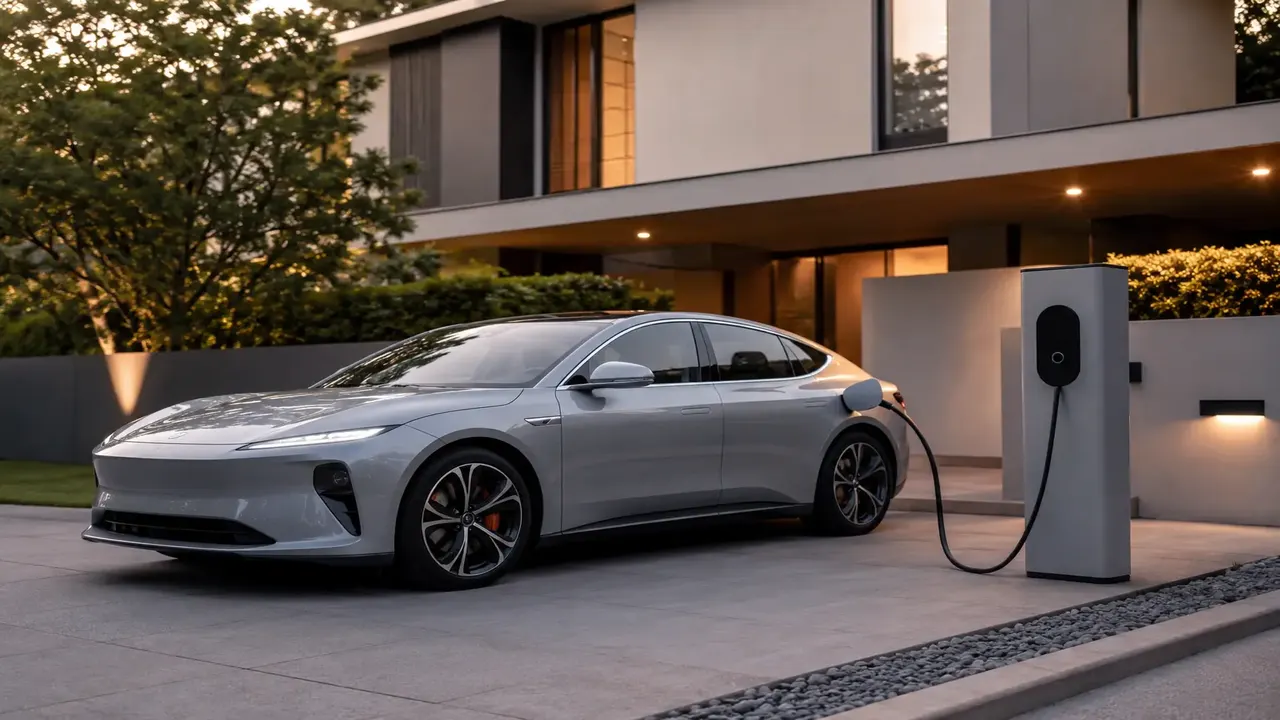
A 7.4 kW home AC wallbox costs ₹40,000–₹1,20,000 installed (unit plus wiring and a dedicated MCB) and takes a 40–60 kWh EV from near-empty to full in roughly 5–8 hours. A basic 15A wall socket needs no extra spend but takes 10–14 hours for the same charge and is only meant as a backup. Charging at home on a domestic tariff typically costs ₹1–₹2.50 per km, well below petrol.
At a glance
| Setup | Typical cost/time |
|---|---|
| 15A socket (Level 1) | No install cost; 10–14 hrs for 40–60 kWh battery |
| 3.3 kW wallbox | ₹35,000–₹70,000 installed; 8–12 hrs |
| 7.4 kW wallbox | ₹50,000–₹1,20,000 installed; 5–8 hrs |
| 11 kW wallbox (3-phase) | ₹80,000–₹1,50,000+; 4–6 hrs (needs 3-phase supply) |
| Running cost | ₹1–₹2.50/km on domestic tariff vs ₹6–₹8/km petrol |
What a home charging setup involves
Every EV sold in India today ships with a portable 15A charging cable that plugs into a standard three-pin household socket. It works, but it is slow — think of it as a phone charger, not a fast top-up. Most owners who charge daily upgrade to a dedicated AC wallbox, which is really three things bundled together: the wallbox unit itself, a separate MCB/circuit from your meter, and the labour to run the wiring from your meter board to your parking spot.
The three practical charging speeds
- 15A socket (2.2 kW): free if you already have the point, but adds only about 10–15 km of range per hour. Fine as an emergency backup, not a daily solution.
- 3.3 kW–7.4 kW wallbox: the sweet spot for apartments and independent houses on a single-phase connection. Adds 20–45 km of range per hour and fully charges most mass-market EVs overnight.
- 11 kW+ wallbox: needs a 3-phase electricity connection, which many Indian homes don't have by default. Worth it only if you have a large battery (60 kWh+) and drive high daily distances.
What it actually costs
Installed cost varies by brand (Tata Power, Ather, ChargeZone, Exicom and others all sell home wallboxes), cable run length, and whether your electrical panel needs upgrading. Budget ₹15,000–₹40,000 for the wallbox hardware and ₹10,000–₹40,000+ for civil and electrical work, more if your DISCOM connection needs a load enhancement. Many EV manufacturers bundle a free or discounted wallbox with the car for the first year — always ask before buying one separately.
A 7.4 kW charger alone can nearly double a typical home's electricity load. If your sanctioned load is too low, the DISCOM (BESCOM, Tata Power, MSEDCL, BSES etc.) may need to upgrade it before you can run a wallbox safely — this can take a few weeks and carries its own fee.
Apartment and housing society charging
If you live in a flat, you need the housing society's written no-objection before running a cable from the common meter room or your own meter to your parking slot. Some newer societies in Bengaluru, Mumbai, Pune, Gurugram and Delhi NCR have started reserving EV-ready slots, but most older buildings still handle this case by case. Bring your RWA a simple written request naming the wallbox model, the cable route and the electrician's safety certificate — it speeds up approval considerably.
EV-specific electricity tariffs
A handful of states — including Delhi, Maharashtra, Karnataka, Uttar Pradesh and Kerala — offer a discounted per-unit EV charging tariff (roughly ₹5–₹9/kWh versus regular domestic slabs that can run higher after the first block). To access it you generally need a separate sub-meter for the charger, applied for through your DISCOM. It's optional — most owners just charge on their normal domestic connection — but worth checking if you drive high monthly distances, since the saving compounds.
Running cost versus petrol
At an average domestic tariff of ₹7–₹9/unit and an EV efficiency of roughly 6–7 km/kWh, home charging works out to ₹1–₹2.50 per km. A comparable petrol hatchback or compact SUV averaging 15–18 km/l at ₹100/litre petrol costs roughly ₹5.50–₹6.70 per km — four to five times more per kilometre. The gap narrows if you rely mainly on paid public charging, which is priced closer to ₹15–₹25/kWh.
Frequently asked questions
Can I charge an EV with a normal home socket in India?
Do I need permission from my housing society to install an EV charger?
How much does a home EV charger cost to install in India?
Is there a special electricity tariff for EV charging at home?
How long does it take to fully charge an EV at home in India?
Sources & further reading
- Ministry of Power — Charging Infrastructure Guidelines
- Bureau of Energy Efficiency — EV charging norms
- PM E-DRIVE Scheme, Ministry of Heavy Industries
Figures, prices and policy details were current at the last-updated date above. Automotive pricing, incentives and regulations change frequently — verify time-sensitive details with the linked primary sources. Read our editorial policy and fact-checking standards.