> Why this is the most important number we publish: Acceleration is entertainment. Braking is safety. A 15-foot difference in stopping distance is the difference between a near-miss and a collision — and unlike 0–60 times, braking distances have not converged. The spread between good and bad remains enormous, and mass is making it worse. > > Populate the leaderboard with your own measured results.
The number that actually matters
We publish 0–60 times because readers want them, and we've been honest (in our rankings piece) that electrification has compressed them into near-meaninglessness.
Braking distances are the opposite. They remain widely spread, genuinely differentiating, and directly consequential. The gap between a car that stops from 70 mph in 155 feet and one that needs 180 feet is 25 feet — roughly a car and a half — and that distance is precisely where emergency stops are decided.
Yet braking receives a fraction of the attention. We think that's backwards, and this ranking exists to correct it.
What determines a stopping distance
1. Tyres — the dominant factor. Everything the brakes do must be transmitted through four contact patches roughly the size of your hands. Compound, condition and temperature matter more than caliper count. A car on worn or budget tyres will out-brake nothing.
2. Weight. Kinetic energy rises with mass, and all of it must be converted to heat. This is why heavy EVs deserve particular scrutiny — a 2,400 kg saloon carries substantially more energy at 70 mph than a 1,500 kg one.
3. Brake system capability. Rotor size, caliper stiffness, pad compound and — critically — cooling capacity for repeated stops.
4. ABS calibration and software. Modern systems vary considerably in how effectively they extract maximum grip.
5. Weight transfer and suspension. How well the car controls dive determines how much load the front tyres can use.
6. Regenerative blending (EVs). How smoothly and predictably the car transitions between regenerative and friction braking. Poor blending affects feel and confidence more than outright distance — but confidence matters in an emergency.
Our test protocol
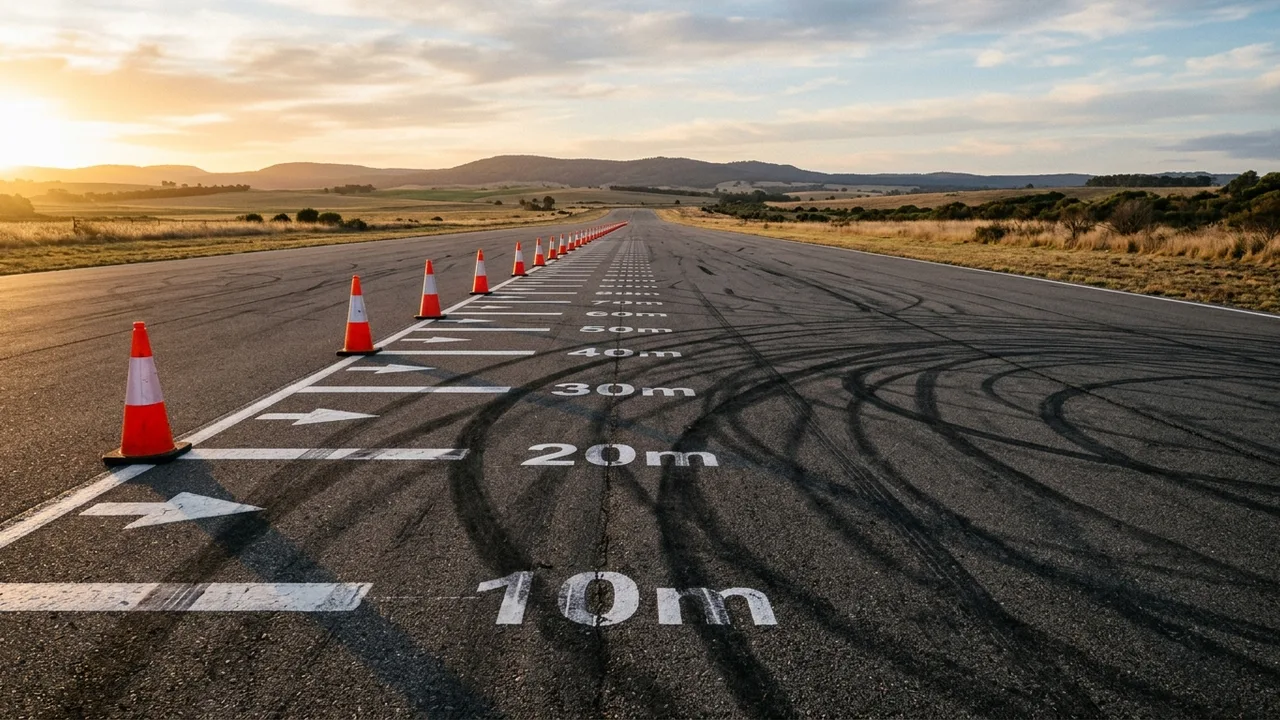
| Element | Standard | |---|---| | Primary test | 70–0 mph, maximum-effort stop, ABS engaged | | Secondary | 100–0 mph where safe and appropriate | | Repeats | Six consecutive stops, recording each — fade resistance is as important as the first figure | | Surface | Dry, clean, level asphalt; recorded temperature | | Tyres | As delivered, at specified pressures, recorded | | Brake temperature | Ambient at first stop; recorded through the sequence | | Outputs | Best stop · average of six · degradation from first to sixth · pedal feel notes |
The six-stop sequence is essential. A single cold stop measures the best case. The sixth stop measures what happens when you actually need it — after descending a mountain pass, or in a sustained emergency. Brake fade turns a good car into a frightening one, and it never shows up in a single-stop figure.
Our test conditions: [to be completed — date, surface, ambient and surface temperature, tyre specification and pressures]
The running leaderboard
Populate with measured results as tests are completed. Ranked by average of six stops.
| Rank | Vehicle | Best 70–0 | Avg of six | Fade (1st→6th) | Weight | Tyres | |---|---|---|---|---|---|---| | 1 | [to be measured] | | | | | | | 2 | [to be measured] | | | | | | | 3 | [to be measured] | | | | | |
Vehicles covered in this section awaiting braking measurement:
| Vehicle | Weight | Notes | |---|---|---| | Mercedes-AMG SL63 S E Performance | 4,811 lb | Standard carbon-ceramics; reported inconsistent pedal feel | | BMW M5 PHEV | 5,390 lb | Optional carbon-ceramics; mass is the story | | Porsche 911 GT3 Manthey | — | Aero adds braking stability at speed | | Toyota GR Corolla | ~3,300–3,500 lb | Fade resistance is a key question | | Hyundai Ioniq 9 / heavy EVs | — | Three-row EV mass deserves scrutiny |
What we expect the data to show
1. Sports cars on performance tyres will lead, and the tyres will deserve much of the credit. A 1.02 g skidpad figure and a short stopping distance usually share the same explanation: 305-section Michelins.
2. Heavy EVs will underperform relative to their price. This is the finding we most expect, and the one most worth publicising. A 2,400 kg EV carries roughly 60% more kinetic energy at 70 mph than a 1,500 kg hatchback, and while modern brakes are excellent, physics is not negotiable. Buyers of large, heavy EVs should look at this number specifically.
3. Fade will separate cars more than first-stop distance. Expect the six-stop degradation column to be the genuinely revealing one — and the reason it exists.
4. Carbon-ceramics will help fade far more than first-stop distance. Their advantage is thermal capacity and consistency, not initial bite. On a single cold stop, good steel brakes on good tyres match them.
What this means for buyers
Check the braking figure before the acceleration one. It's more differentiating, more consequential, and less discussed.
Tyres are the highest-return safety upgrade available. Better than any brake modification, for any car, at any budget. If you do one thing after reading this, make it checking your tyres' condition and quality.
If you're buying a heavy vehicle — especially a large EV or a heavy PHEV — treat braking as a primary specification, not an afterthought. The mass that makes these cars feel planted also makes them harder to stop.
Ask about fade, not just distance. If you tow, drive in hills, or carry heavy loads, the sixth-stop figure matters far more than the first.
The bottom line
Braking is the most important number we publish and the least discussed in automotive coverage. Unlike 0–60 times, stopping distances have not converged — the spread remains wide, the differences are consequential, and increasing vehicle mass is actively making the picture worse.
Tyres dominate, weight punishes, and fade resistance across repeated stops reveals more than any single figure. We'd encourage every reader to treat this leaderboard as more important than our acceleration rankings, because in the one moment it matters, this is the number that determines the outcome.
Check the tyres. Watch the weight. And ask what happens on the sixth stop.
- Braking distances have not converged the way acceleration times have — the spread remains wide and genuinely consequential
- Tyres are the dominant factor, more than caliper count or rotor size; they're also the highest-return safety upgrade available
- Heavy EVs and PHEVs deserve particular scrutiny — a 2,400 kg car carries ~60% more kinetic energy at 70 mph than a 1,500 kg one
- We measure six consecutive stops, because the sixth reveals fade resistance that a single cold stop hides entirely
- Carbon-ceramics improve fade resistance and consistency far more than they shorten a first, cold stop
Key takeaways
- Braking distances have not converged the way acceleration times have — the spread remains wide and genuinely consequential
- Tyres are the dominant factor, more than caliper count or rotor size; they're also the highest-return safety upgrade available
- Heavy EVs and PHEVs deserve particular scrutiny — a 2,400 kg car carries ~60% more kinetic energy at 70 mph than a 1,500 kg one
- We measure six consecutive stops, because the sixth reveals fade resistance that a single cold stop hides entirely
- Carbon-ceramics improve fade resistance and consistency far more than they shorten a first, cold stop
Sources & further reading
- Braking physics and tyre performance principles
- published instrumented braking data
- True Motion Auto tests (this section). *Populate leaderboard with measured results before publishing. Verified July 2026.*
Figures, prices and policy details were current at the last-updated date above. Automotive pricing, incentives and regulations change frequently — verify time-sensitive details with the linked primary sources. Read our editorial policy and fact-checking standards.