> The finding: The question that decides Indian EV ownership isn't range or price — it's whether you can charge where you park. For apartment dwellers, the practical answer usually comes down to a 3.3 kW socket versus a 7.4 kW wallbox, and the difference between them is the difference between an EV that works and one that frustrates. Here's what each actually delivers overnight. > > Complete the measured-results block with your own test data before publishing.
The question that actually decides Indian EV ownership
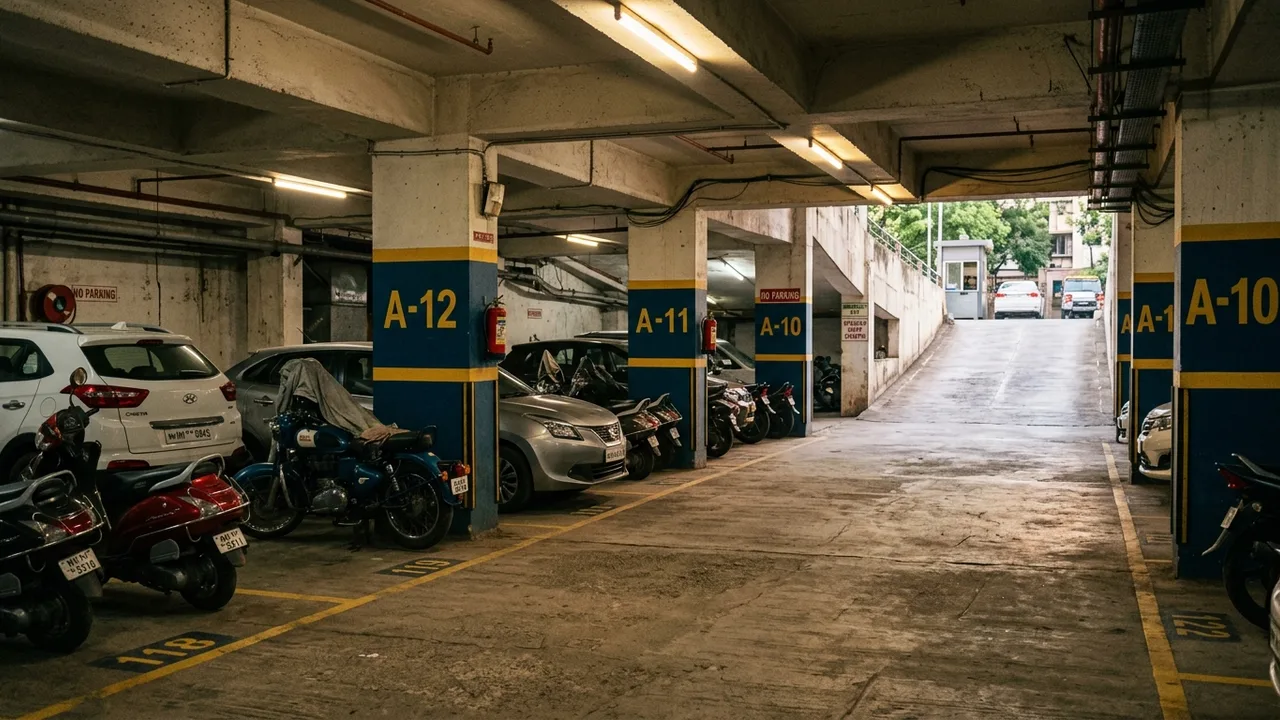
Western EV coverage assumes a house with a driveway and a wallbox. That assumption doesn't hold in urban India, where a large share of car buyers live in apartment blocks with shared, stacked or allocated parking — and where installing a personal charge point involves the housing society, the electrical supply, and often a genuinely complicated negotiation.
This is, we'd argue, the single most under-covered issue in Indian EV journalism. Range figures, battery sizes and 0–100 times get exhaustive coverage. Whether you can actually plug the car in overnight — the thing that determines whether EV ownership is convenient or miserable — gets almost none.
So this test measures the thing that matters: what do the realistic Indian apartment charging options actually deliver by morning?
The three realistic scenarios
1. Standard 15A domestic socket (~2.5–3.3 kW). The portable cable supplied with most EVs. Requires only an ordinary socket near the parking space — which is itself often the obstacle.
2. Dedicated 7.4 kW AC wallbox. The proper solution, and what most manufacturers supply or offer. Requires a dedicated circuit, adequate supply capacity and — crucially — housing society permission. The Maruti e Vitara includes a complimentary 7.4 kW home charger, which is a genuinely meaningful part of its value proposition.
3. No home charging at all — public/workplace dependent. The scenario nobody plans for and many end up in. Entirely dependent on public infrastructure or workplace provision.
What we measure
| Element | Standard | |---|---| | Charging window | 10 hours (a realistic overnight period, ~10pm–8am) | | Start SoC | 20% (representing a typical day's use) | | Scenarios | 15A socket (~2.5–3.3 kW) · 7.4 kW wallbox | | Recorded | Actual power drawn, SoC gained, kWh delivered, charging losses | | Ambient | Recorded — Indian heat affects charging efficiency and cooling load | | Voltage stability | Recorded — genuinely relevant given supply variability | | Outputs | % gained overnight · km of range added · effective cost per km |
Charging losses deserve attention. AC charging is not 100% efficient — energy is lost in the onboard converter and in battery thermal management, and in Indian heat the cooling load adds further. Expect roughly 10–15% losses, meaning the electricity you're billed for exceeds what reaches the battery. Most range calculators ignore this.
Our test conditions: [to be completed — date, location, ambient temperature, supply voltage, socket/wallbox specification, starting SoC]
Measured results: [to be completed — SoC gained and km added per scenario, kWh consumed, measured losses]
What each scenario realistically delivers
Illustrative arithmetic while you complete measurements — using a 61 kWh pack (as in the e Vitara Zeta) over a 10-hour window:
15A socket at ~2.5 kW effective:
- ~25 kWh delivered over 10 hours, less ~12% losses ≈ ~22 kWh to the battery
- Roughly 35–40% of a 61 kWh pack
- Perhaps 150–200 km of range added overnight
7.4 kW wallbox:
- ~74 kWh theoretical over 10 hours — more than the pack holds
- In practice: a full charge from 20% comfortably within the window, typically in 5–7 hours
- Complete flexibility — you wake to a full battery regardless of the previous day
The practical conclusion is stark and worth stating plainly: a 15A socket adds enough for typical daily urban commuting but cannot recover a heavy driving day overnight. A 7.4 kW wallbox always can. For most Indian buyers, that difference determines whether an EV is genuinely convenient or a source of ongoing anxiety.
The housing society question
This is the real obstacle, and it deserves honest treatment because it stops more Indian EV purchases than range anxiety does.
Common obstacles:
- Society approval for installing a charge point in shared or stacked parking
- Metering and billing — whose electricity, and how is it accounted for?
- Building supply capacity, particularly in older complexes
- Allocated versus floating parking, which makes a fixed charger impractical
- Cable routing and safety concerns from the management committee
What genuinely helps:
- Government policy is increasingly supportive — several states and municipal bodies now mandate or encourage EV charging provision in residential buildings. Check your local rules; they may be stronger than your society realises.
- Individual sub-metering resolves most billing objections cleanly
- Approaching the society collectively with other EV owners or prospective buyers is far more effective than a lone request
- Manufacturer installation support — several brands, including Maruti, assist with home charger installation
Our strong practical advice: resolve the charging question before you buy the car, not after. We'd go further — treat it as the first step, ahead of test drives. A buyer who purchases an EV assuming they'll "sort out charging later" and then encounters a resistant housing committee has a genuine problem, and it's an avoidable one.
What about relying on public charging?
We'd advise against it as a primary strategy in most Indian cities. Public infrastructure is expanding but remains uneven, and depending on it means:
- Time spent waiting rather than charging while you sleep
- Higher per-unit costs than domestic tariffs
- Uncertainty about availability and working condition
- Losing the core convenience advantage of EV ownership
Public charging works well as a supplement — for long trips and occasional top-ups. As a substitute for home charging, it turns a convenience into a chore.
The bottom line
For Indian EV buyers, the charging question matters more than the range question, and it's the one the coverage neglects. A 15A domestic socket adds roughly 150–200 km overnight — enough for typical urban commuting but unable to recover a heavy driving day. A 7.4 kW wallbox charges essentially any mainstream EV fully overnight, and transforms the ownership experience.
The obstacle is rarely the technology; it's the housing society, the supply capacity and the metering arrangement. Resolve those before you buy, check whether local policy already supports your case, and approach the society collectively if you can.
Get charging right and an Indian EV is genuinely excellent — cheap to run, well-suited to congested city driving (as our e Vitara range test showed), and convenient in a way petrol never is. Get it wrong and no amount of claimed range will compensate.
- The decisive question for Indian EV ownership is whether you can charge where you park — not range or price
- A 15A domestic socket delivers roughly 150–200 km overnight; a 7.4 kW wallbox fully charges most EVs within the window
- Expect 10–15% AC charging losses — the electricity you're billed for exceeds what reaches the battery
- The real obstacle is usually the housing society: approval, metering, supply capacity and allocated parking
- Resolve charging before you buy, check supportive local policy, and treat public charging as a supplement rather than a substitute
Key takeaways
- The decisive question for Indian EV ownership is whether you can charge where you park — not range or price
- A 15A domestic socket delivers roughly 150–200 km overnight; a 7.4 kW wallbox fully charges most EVs within the window
- Expect 10–15% AC charging losses — the electricity you're billed for exceeds what reaches the battery
- The real obstacle is usually the housing society: approval, metering, supply capacity and allocated parking
- Resolve charging before you buy, check supportive local policy, and treat public charging as a supplement rather than a substitute
Sources & further reading
- Indian EV charging infrastructure analysis
- AC charging efficiency principles
- Maruti Suzuki home charger provision
- state EV policy frameworks. *Complete measured results before publishing. Verified July 2026.*
Figures, prices and policy details were current at the last-updated date above. Automotive pricing, incentives and regulations change frequently — verify time-sensitive details with the linked primary sources. Read our editorial policy and fact-checking standards.