> The finding: Indian EV range testing faces a variable Western testing largely ignores — extreme heat with continuous air conditioning. In 42°C conditions with the AC working hard, range behaves very differently from any laboratory cycle. But there's a genuine counterintuitive finding here: Indian city traffic can actually help EV range, for reasons that surprise most buyers. > > Complete the measured-results block with your own test data before publishing.
The variable Western tests ignore
Range testing in Europe and America obsesses over cold weather, and rightly — winter is their hardest case. India's hardest case is the opposite, and it's badly under-tested.
At 42°C ambient, an EV faces:
- Continuous, heavy air-conditioning load — not an occasional draw but a constant, substantial one
- Battery thermal management working hard to keep cells in their optimal window
- Reduced battery efficiency at temperature extremes — heat degrades performance as surely as cold
- Cabin pre-cooling demand — a car parked in Indian sun needs enormous energy to become habitable
None of this appears meaningfully in the MIDC or ARAI cycles that produce India's official figures, which — like WLTP — are laboratory comparison standards rather than predictions.
The counterintuitive finding
Here's what surprises most buyers, and it's genuinely important for Indian EV ownership:
Heavy city traffic often helps EV range rather than hurting it.
This is the opposite of combustion behaviour, where stop-start traffic destroys fuel economy. For an EV:
- No idling consumption. A stationary EV uses almost nothing beyond ancillaries. A petrol car burns fuel doing nothing.
- Regenerative braking recovers energy. Every deceleration in stop-start traffic returns energy to the battery. More stopping means more recovery.
- Low speeds mean minimal aerodynamic drag — the dominant energy consumer at highway speed is almost absent.
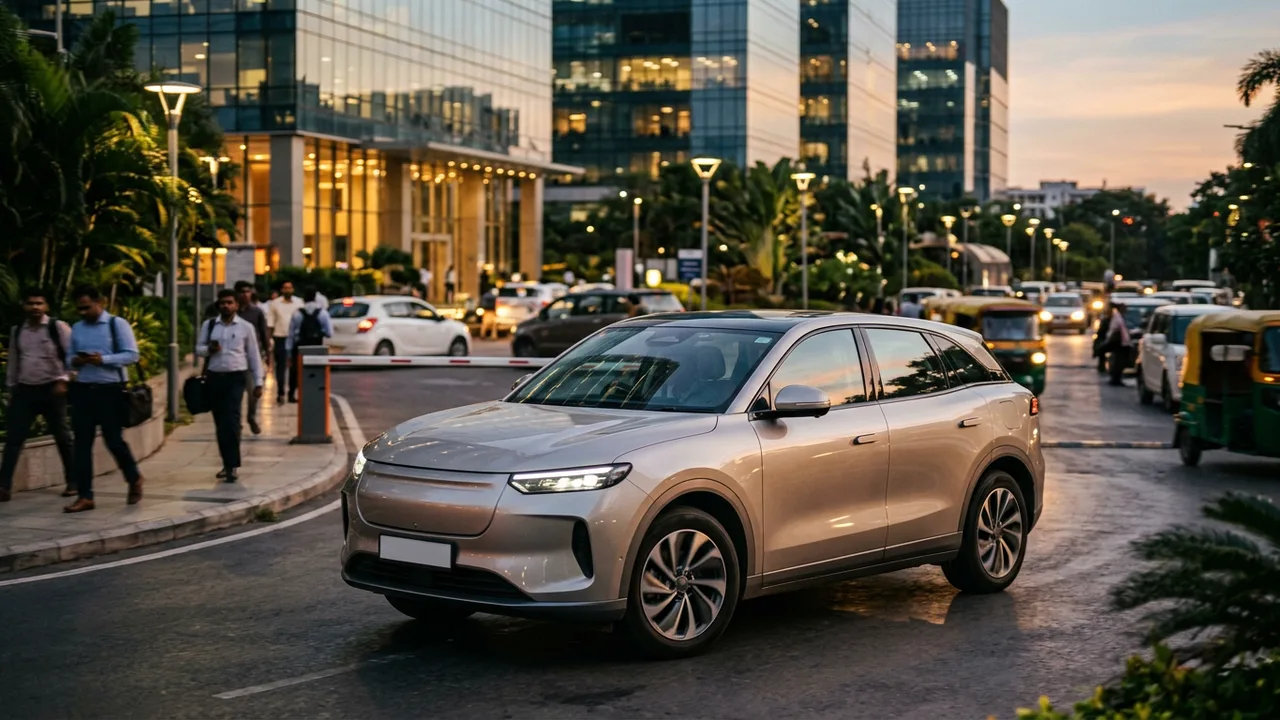
The practical consequence for Indian buyers is significant: an EV used primarily in congested urban conditions — Delhi, Mumbai, Bengaluru traffic — may deliver range at or near its claimed figure, while the same car on a sustained highway run at 100 km/h will fall well short.
The AC caveat. This advantage is partially offset in Indian summer, because sitting in traffic means running the air conditioning continuously with no airflow assistance. The two effects compete — and measuring which wins, in genuine conditions, is exactly what this test is for.
Our methodology, adapted for India
| Element | Standard | |---|---| | Summer test | Peak Indian summer conditions — record ambient temperature (target 40°C+) | | AC setting | Set to 24°C and left running — because no Indian driver switches it off | | Urban cycle | Genuine congested city traffic, not a simulated loop | | Highway cycle | Sustained 100 km/h — the hardest realistic case | | Mixed cycle | Representative real-world combination | | Pre-cooling | Recorded separately — the energy cost of cooling a sun-baked cabin | | Recorded | Ambient temperature, cabin temperature, AC load, traffic density, state of charge | | Repeat | Winter/monsoon comparison where possible |
The AC point is non-negotiable. A range figure recorded with the air conditioning off, in Indian summer, is not merely optimistic — it's useless. Nobody drives that way, and publishing such a number misleads buyers.
The car
| Spec | Maruti e Vitara | |---|---| | Price | ₹15.99–19.99 lakh (ex-showroom); from ₹10.99 lakh with BaaS + ₹3.99/km | | Batteries | 49 kWh (Delta) / 61 kWh (Zeta, Alpha) | | Claimed range | up to ~543 km; ARAI ~517 km | | Platform | Heartect-e (born-electric, Toyota co-developed) | | Safety | 5-star Bharat NCAP | | Charger | Complimentary 7.4 kW AC home charger | | Our pick | Zeta 61 kWh (~₹17.49 lakh) |
Measured results: [to be completed — urban range, highway range, mixed range, kWh/100km, ambient temperature, AC load]
Our test conditions: [to be completed — date, city, route, ambient temperature, humidity, traffic conditions, occupants, state of charge]
What Indian buyers should realistically expect
While you complete your own measurements, here's honest guidance based on established EV behaviour:
Congested city driving, AC running, summer: potentially close to the claimed figure, as regenerative recovery and zero idling offset the air-conditioning load. This is the e Vitara's best case, and it's the use case most Indian urban buyers actually have.
Sustained highway at 100 km/h, AC running: expect a substantial reduction — likely in the region of 25–35% below the claimed figure. High-speed aerodynamic drag plus continuous AC is the worst combination.
Mixed real-world use: expect somewhere between, weighted toward whichever dominates your driving.
The planning rule for India: if you're primarily an urban driver, the claimed range is a more reasonable guide than Western EV owners are used to. If you regularly drive long highway distances, discount heavily — perhaps 30% — and plan charging accordingly.
What the e Vitara brings to this
The claimed 543 km provides genuine margin. Even discounted substantially for highway running and heat, the e Vitara retains usable range for most Indian driving patterns. That margin is precisely what makes a first EV purchase feel safe.
Maruti's service network is the contextual advantage. As our rated review found, 1,500+ EV-ready service touchpoints matter enormously in a market where support infrastructure is the real anxiety. Range is only half the ownership equation.
The complimentary 7.4 kW home charger addresses the other half — overnight home charging is what makes urban EV ownership genuinely practical, and Maruti including it removes a real barrier.
The bottom line
Indian EV range testing needs to measure Indian conditions, and the defining one is extreme heat with continuous air conditioning — a variable Western cold-weather-focused testing largely ignores. Any range figure recorded with the AC off is worthless to an Indian buyer.
The genuinely useful finding is counterintuitive: congested Indian city traffic can help EV range rather than hurting it, because there's no idling consumption, regenerative braking recovers energy at every stop, and aerodynamic drag is negligible at low speed. For the large number of Indian buyers whose driving is predominantly urban, that means claimed figures are a more reasonable guide than Western owners have come to expect — while sustained highway running at 100 km/h in summer heat remains the genuinely hard case.
For the Maruti e Vitara specifically, the ~543 km claim provides real margin, and Maruti's vast service network plus the included home charger address the parts of EV ownership that range figures never capture. Test in real heat, keep the AC on, and plan on a heavy discount only if your driving is highway-dominated.
- India's hardest EV range case is extreme heat with continuous AC, not cold — a variable Western testing largely ignores
- Counterintuitively, congested Indian city traffic can help EV range: no idling draw, regenerative recovery at every stop, minimal aerodynamic drag
- Sustained highway running at 100 km/h with AC is the genuinely hard case — expect roughly 25–35% below claimed figures
- Any Indian range test conducted with the air conditioning switched off is useless; we test with the cabin at 24°C
- The e Vitara's ~543 km claim provides real margin, and Maruti's 1,500+ service points plus an included 7.4 kW home charger address what range figures don't
END OF BATCH 15
Section 6 (Instrumented Tests) underway — Performance Testing complete; Real-World EV Range & Charging opened.
Next up (Batch 16): topic 151 (BMW i3's 559-mile claim vs. the motorway) continues the Real-World EV Range & Charging pipeline.
Say "next batch" to continue.
Key takeaways
- India's hardest EV range case is extreme heat with continuous AC, not cold — a variable Western testing largely ignores
- Counterintuitively, congested Indian city traffic can help EV range: no idling draw, regenerative recovery at every stop, minimal aerodynamic drag
- Sustained highway running at 100 km/h with AC is the genuinely hard case — expect roughly 25–35% below claimed figures
- Any Indian range test conducted with the air conditioning switched off is useless; we test with the cabin at 24°C
- The e Vitara's ~543 km claim provides real margin, and Maruti's 1,500+ service points plus an included 7.4 kW home charger address what range figures don't
Sources & further reading
- Maruti Suzuki specifications
- MIDC/ARAI methodology
- EV efficiency principles
- True Motion Auto e Vitara rated review (Batch 11). *Complete measured results before publishing. Verified July 2026.*
Figures, prices and policy details were current at the last-updated date above. Automotive pricing, incentives and regulations change frequently — verify time-sensitive details with the linked primary sources. Read our editorial policy and fact-checking standards.