> The finding: Official WLTP figures are not lies, but they are laboratory measurements under idealised conditions — and British reality subtracts from them consistently and predictably. Understanding why the gap exists, and roughly how large it is, is more useful than any single number. Here's our real-range methodology and what UK drivers should genuinely expect. > > Complete the measured-results block with your own test data before publishing.
Why official figures and reality diverge
Every EV sold in Britain quotes a WLTP range figure, and every EV owner discovers it's optimistic. That's not fraud — WLTP is a standardised laboratory procedure designed to allow comparison between cars, not to predict your commute. It's a useful relative measure and a poor absolute one.
The gap between WLTP and reality has consistent, explicable causes:
1. Temperature. This is the single largest factor in Britain. Batteries are chemically less efficient when cold, and cabin heating draws significant energy — a heat pump helps enormously, resistive heating far less. A British winter can reduce usable range by 20–30% versus a mild day.
2. Speed. Aerodynamic drag rises with the square of velocity. Motorway cruising at 70 mph consumes dramatically more energy per mile than 50 mph driving — and WLTP's cycle includes a great deal of low-speed running that flatters the figure relative to a motorway commute.
3. Terrain and load. Hills, passengers and luggage all cost energy.
4. Driving style. Hard acceleration costs range, though regenerative braking recovers more than combustion drivers expect.
5. Ancillaries. Heating, air conditioning, lights and wipers all draw power — and in a British winter you're using most of them at once.
Our real-range methodology
For consistency across every EV we test, we use a fixed protocol:
| Element | Standard | |---|---| | Route | Fixed mixed route: motorway, A-road and urban, reflecting real UK use | | Motorway test | Separate constant-70-mph run — the hardest realistic case | | Start state | 100% charge, ambient-soaked overnight | | End point | To a genuine 0% or manufacturer-defined buffer, then extrapolated | | Climate | Cabin set to 21°C — not switched off, because real drivers don't | | Load | Driver plus standard test equipment | | Recorded | Ambient temperature, wind, precipitation, tyre pressures, efficiency (mi/kWh) | | Repeats | Summer and winter runs where possible, because seasonality is the story |
The climate-control point matters. Some published range tests switch off heating to maximise the figure. That produces a number nobody can use. We test with the cabin at a comfortable temperature, because that's how the car will actually be driven in January.
The car
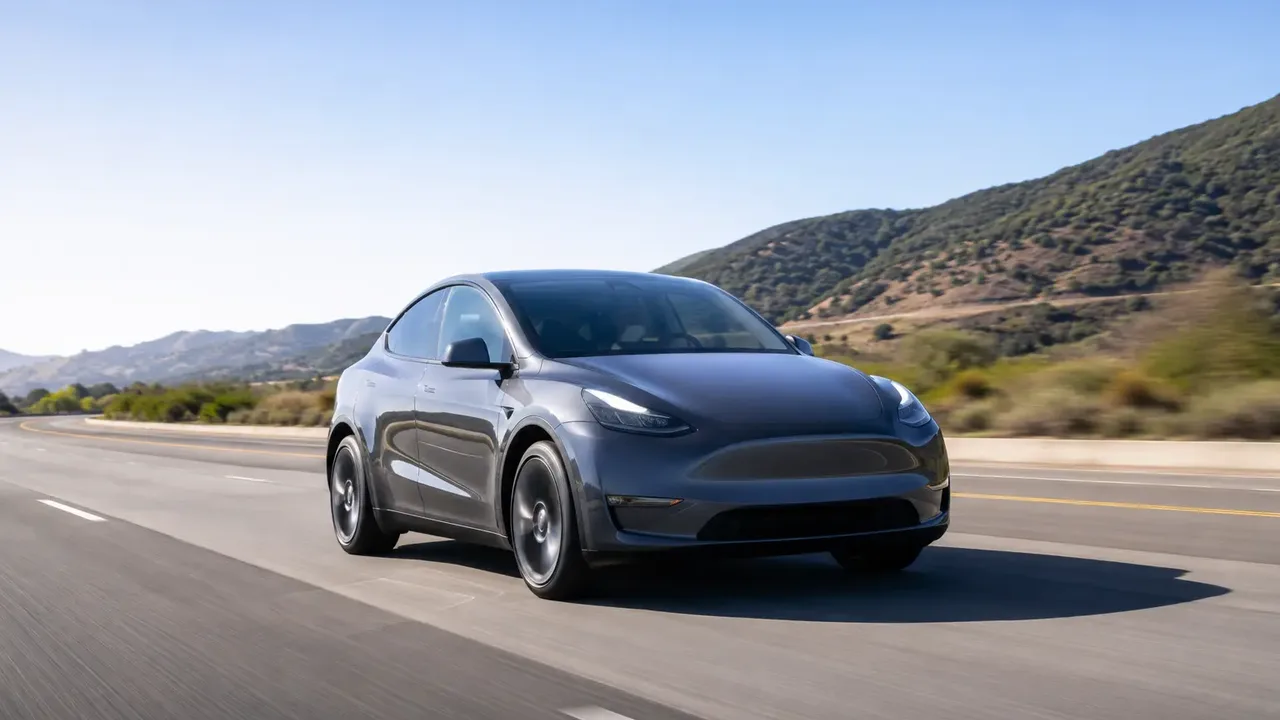
| Spec | Tesla Model Y (2026 "Juniper") | |---|---| | RWD | 299 PS, 57.5 kWh, 311 mi WLTP, from £44,990 | | Long Range RWD | 340 PS, 75 kWh, 387 mi WLTP, from £48,990 | | Long Range AWD | 514 PS, 0–62 in <5 sec, from ~£51,990 | | Claimed efficiency | ~4.4 mi/kWh (Long Range RWD) | | Charging | Supercharger network access |
Measured results: [to be completed — mixed-route range, motorway-only range, mi/kWh, ambient temperature, season]
Our test conditions: [to be completed — date, route, ambient temperature, wind speed, precipitation, tyre pressures, occupants]
What UK drivers should realistically expect
Based on established patterns across EV testing, here's honest guidance while you complete your own measurements:
Mild conditions (15–20°C), mixed driving: expect roughly 85–95% of WLTP. The Model Y is genuinely efficient, and its claimed ~4.4 mi/kWh is achievable in good conditions.
Motorway at a constant 70 mph: expect a meaningful reduction — sustained high speed is the hardest case for any EV, and this is where WLTP flatters most.
Winter (0–5°C), with heating: expect 20–30% below WLTP, potentially more in genuinely cold conditions. This is the number that surprises new EV owners, and it's the one worth planning around.
The practical planning rule: take the WLTP figure, subtract 25% for winter motorway use, and treat that as your realistic worst-case planning range. If that number still comfortably covers your regular journeys, you'll be happy.
What the Model Y does well here
Efficiency is a genuine strength. Tesla's efficiency engineering is legitimately class-leading, and the Model Y's real-world mi/kWh consistently ranks among the best in its class. It loses less to reality than many rivals.
The Supercharger network changes the calculation. This is the crucial contextual point. Real range matters less when charging is fast, reliable and abundant. A car with slightly less range but access to the most dependable charging network can be more practical than one with more range and worse charging access. For the Model Y, the network is arguably worth more than the last 20 miles of range.
The Juniper update improved efficiency. Reworked energy systems delivered real gains, with the Long Range RWD now claiming 387 miles.
The honest framing
WLTP is not useless. It's a consistent, comparable, standardised measure — genuinely valuable for ranking cars against each other. A 387-mile WLTP car will go further than a 300-mile WLTP car in the same conditions.
But it is not a prediction of your range, and treating it as one causes the disappointment that gives EVs an undeserved reputation.
The number to ask for is real-world efficiency in mi/kWh, because it lets you calculate range for your conditions: multiply by usable battery capacity, then discount for winter. That's a far more useful piece of information than any single headline range figure.
The bottom line
Official WLTP figures are laboratory measurements designed for comparison, not prediction, and British conditions — cold winters, motorway commuting, heating in use — subtract from them consistently. For the Tesla Model Y, expect roughly 85–95% of WLTP in mild mixed driving and 20–30% less in winter, with sustained motorway running the hardest case.
The Model Y handles this better than most, because Tesla's efficiency engineering is genuinely class-leading and the Supercharger network makes the remaining gap far less consequential. Fast, reliable charging is worth more than the last few miles of range — a point worth remembering when comparing spec sheets.
Plan on WLTP minus 25% for winter motorway use. If that still covers your journeys comfortably, the Model Y will not disappoint you.
- WLTP is a laboratory comparison standard, not a prediction — British conditions subtract from it consistently and predictably
- The largest UK factor is temperature: winter with cabin heating typically costs 20–30% of range, with motorway speed the hardest case
- Our methodology tests with the cabin at 21°C, because switching off heating produces a figure nobody can actually use
- The Model Y's efficiency is genuinely class-leading, and the Supercharger network makes the remaining range gap far less consequential
- Practical rule: take WLTP, subtract 25% for winter motorway use, and check that still covers your regular journeys
Key takeaways
- WLTP is a laboratory comparison standard, not a prediction — British conditions subtract from it consistently and predictably
- The largest UK factor is temperature: winter with cabin heating typically costs 20–30% of range, with motorway speed the hardest case
- Our methodology tests with the cabin at 21°C, because switching off heating produces a figure nobody can actually use
- The Model Y's efficiency is genuinely class-leading, and the Supercharger network makes the remaining range gap far less consequential
- Practical rule: take WLTP, subtract 25% for winter motorway use, and check that still covers your regular journeys
Sources & further reading
- Tesla UK specifications
- WLTP methodology
- EV efficiency testing principles
- True Motion Auto Model Y rated review (Batch 10). *Complete measured results before publishing. Verified July 2026.*
Figures, prices and policy details were current at the last-updated date above. Automotive pricing, incentives and regulations change frequently — verify time-sensitive details with the linked primary sources. Read our editorial policy and fact-checking standards.