The scoreboard
Americans bought 2.2% fewer new cars in the first half of 2026. They bought 9% more hybrids.
That is the whole story in one line, but the details are worth having:
- Hybrid market share: around 14.1%, up 83% since 2023 in volume terms
- EV market share: 5.8% in Q2 2026 — roughly half its September 2025 peak
- Used hybrid sales: up 34% year to date, with list prices at an all-time high, averaging $38,800 in mid-June
- 49 hybrid models now on sale in the US, from 12 brands — up seven models and two brands since 2023
Hybrids are outselling EVs by a wide margin, and the gap is widening. The narrative that hybrids were a "bridge technology" — a temporary staging post on the inevitable road to battery-electric — is being falsified in real time by American buyers.
Why buyers are choosing them
Three reasons, in descending order of importance.
1. Price. The average transaction-price gap between an EV and a comparable petrol car was around $6,200 in early 2026, per Cox Automotive. With the $7,500 federal credit gone, that gap is now fully borne by the buyer. A hybrid closes most of the fuel-cost benefit at a fraction of the premium.
2. Fuel prices. Petrol prices have been elevated through 2026, and buyers have noticed. A Cox Automotive survey in May found 56% of in-market new-vehicle shoppers said rising fuel prices made them more likely to consider a hybrid or plug-in hybrid.
Note what that finding does not say. High fuel prices are not driving people to EVs at anything like the same rate. They are driving people to hybrids.
3. Zero friction. This is the one the industry keeps underrating. A hybrid requires the buyer to change nothing. No home charger installation, no route planning, no apartment-block negotiation about a socket, no anxiety about a road trip through rural Nevada. As one marketing chief put it, a hybrid works the way people expect a car to work, only with much better fuel economy.
Dealers describe hybrids as a "no-friction" purchase. That phrase is doing an enormous amount of work in explaining the last three years of the American market.
The automakers made the decision for you
Here is the part most coverage misses, and it is important.
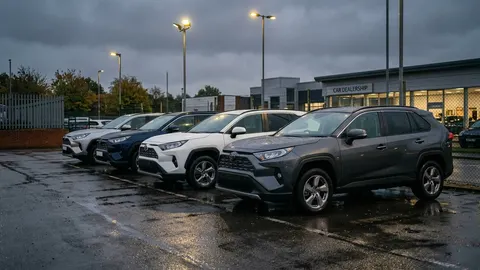
Some of America's biggest-selling vehicles are now hybrid-only for the 2026 model year — including the Toyota RAV4, the Toyota Camry, and the reborn Jeep Cherokee.
If you walk into a Toyota dealership in 2026 wanting a RAV4, you are buying a hybrid. There is no petrol-only version to choose. A meaningful slice of the hybrid "surge" is therefore not consumer preference at all — it is product planning. Manufacturers made hybrid the default powertrain in the highest-volume segments in America, and the sales data followed.
That is not a criticism. It is arguably the smartest thing Toyota has done this decade. But it does mean that "Americans are choosing hybrids" is only two-thirds true. Americans are choosing RAV4s, and RAV4s are now hybrids.
Residuals: the quiet advantage
Hybrids have held their value considerably better than EVs in recent years — which compounds the value case at both ends of ownership.
Used EVs, by contrast, have been through a bruising few years, with most pricing indices showing values 20–30% below peak. That has created genuine bargains for used buyers (44% of used EVs sold in March 2026 went for under $25,000, and used EV sales jumped 27.7% year on year), but it has punished anyone who bought new in 2022 or 2023.
For a buyer thinking about total cost of ownership rather than sticker price, a hybrid currently offers most of the fuel savings, none of the infrastructure friction, and materially better residuals. That is a hard combination to argue with.
The counter-argument, honestly stated
Three things should temper the hybrid triumphalism.
This is a US story, not a global one. The IEA estimates at least one in four new cars sold globally is now electric. In China, in Europe, in the UK — where BEVs took 30% of June registrations — the transition is proceeding. The American divergence is a product of American policy, not of hybrid technology winning on merit worldwide.
The policy could reverse. The US eliminated the EV tax credit and rolled back fuel-economy standards. Both are reversible. The hybrid surge is partly a policy artefact, and policy artefacts are unstable.
Hybrids are not a climate solution. They are a fuel-efficiency improvement on a combustion vehicle. If your interest in this question is emissions rather than running costs, a hybrid is a smaller step, not a different destination. Most industry analysts — including those at Cox — still hold that the long-term endpoint is electric, and that hybrids are meeting a present-tense consumer need while charging infrastructure and battery costs catch up.
That is probably right. But "probably right eventually" is not a car-buying strategy for someone who needs a vehicle in 2026.
Our practical read
Buy a hybrid if: you cannot charge at home, you drive long or unpredictable distances, you want the lowest-friction path to lower fuel bills, or you plan to sell within five years.
Buy an EV if: you can charge at home, your annual mileage is high (which is where the running-cost advantage compounds), and you are buying used — where the depreciation that hurt the first owner is now working entirely in your favour.
Buy a plug-in hybrid if: you have home charging and a short commute but occasionally drive long distances. It is the most expensive and mechanically complex option, and it only pays off if you actually plug it in. Most PHEV owners don't.
Key takeaways
- Hybrid sales up 9% in H1 2026, in a market down 2.2%
- Hybrid share around 14.1%; EV share 5.8%
- 56% of shoppers say high fuel prices make them more likely to consider a hybrid
- RAV4, Camry and the new Jeep Cherokee are hybrid-only for 2026 — much of the "surge" is product planning
- Used hybrid list prices hit an all-time high of ~$38,800 in June 2026
Sources & further reading
- Kelley Blue Book H1 2026 data
- Cox Automotive media briefing (24 June 2026) and May 2026 consumer survey
- Forbes
- CNBC
- US EIA
- Bureau of Transportation Statistics
Figures, prices and policy details were current at the last-updated date above. Automotive pricing, incentives and regulations change frequently — verify time-sensitive details with the linked primary sources. Read our editorial policy and fact-checking standards.