Note: costs mentioned below are given in US dollars as a general point of reference — actual prices vary by country, currency, and local market.
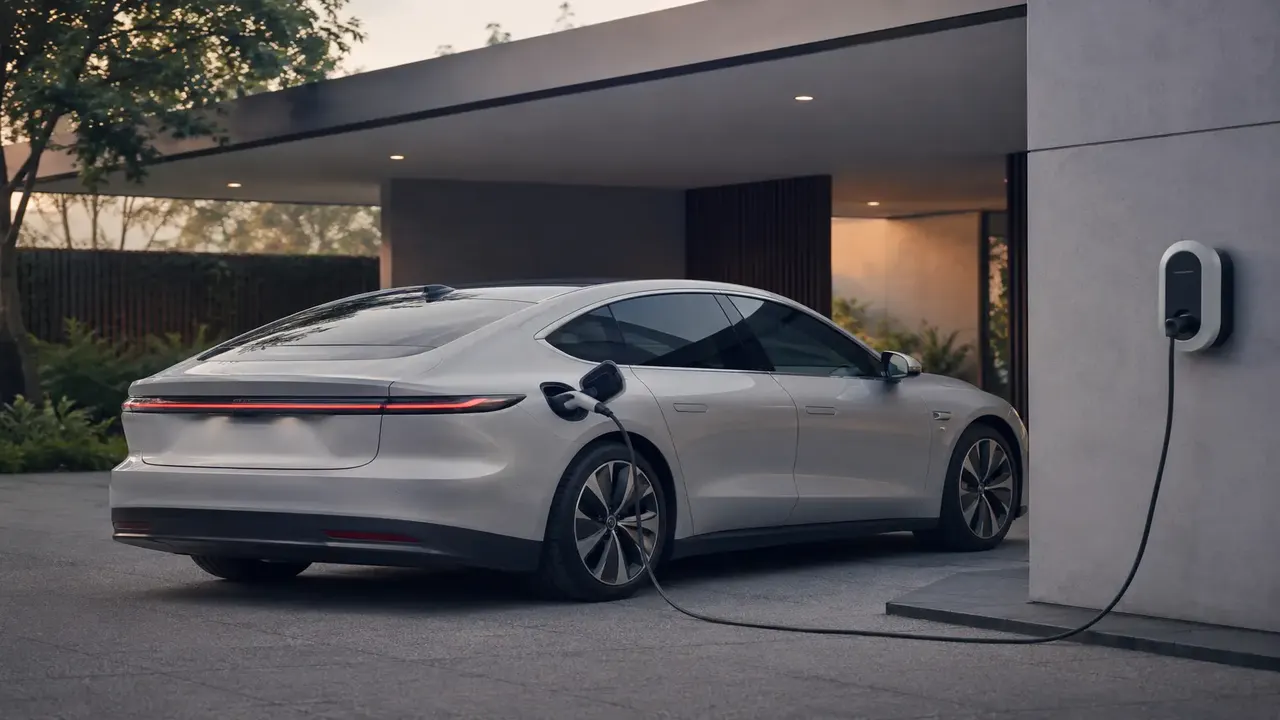
Charging a typical 60 kWh EV battery at home costs roughly $7-$11 depending on electricity rates, and takes 8-11 hours on a Level 2 home charger. The same charge at a public DC fast charger can cost $18-$30 but takes only 25-40 minutes to reach 80%. Home charging is typically 2-3x cheaper per mile than relying on public fast chargers.
At a glance
| Charging type | Typical speed | Typical cost (60 kWh battery) |
|---|---|---|
| Level 1 (household outlet) | 3-5 miles of range/hour | Lowest cost, slowest |
| Level 2 (home/public) | 20-30 miles of range/hour | $7-$11 full charge at home |
| DC fast charging | 150-250+ miles in 20-30 min | $18-$30 for similar energy |
What this estimator does
The calculator on this page takes your usable battery size in kWh, your electricity rate (or the price posted at a public charger), the charger's power output, and a charging-efficiency allowance for the energy lost as heat. It returns the cost and the time for a charge from a given starting percentage to a target percentage, plus the energy that actually reaches the battery and the larger amount drawn from the supply to deliver it. It's built to answer the two questions every EV driver asks before a trip or a top-up: how long will this take, and what will it cost?
The math behind the estimate
Cost is simple: kWh added × price per kWh = total cost. Time is a little more nuanced because charging speed isn't constant — most EV batteries charge fastest between roughly 20% and 80%, then slow down considerably above 80% to protect battery health, especially on DC fast chargers. That's why fast-charging stops on road trips are usually planned to top up to about 80%, not 100%.
Worked example: 60 kWh battery, 20% to 80%
| Charger type | Energy added | Time | Estimated cost |
|---|---|---|---|
| Level 1 (120V) | ~36 kWh | 20-30 hours | $4-$6 (home rate) |
| Level 2 (240V, 7kW) | ~36 kWh | 5-6 hours | $4-$6 (home rate) |
| DC fast (150kW) | ~36 kWh | ~20-30 min | $11-$18 (public rate) |
Home charging vs public charging cost gap
Home electricity is almost always cheaper per kWh than public charging, and many utilities offer discounted overnight "time-of-use" rates specifically aimed at EV owners — charging overnight can cut the effective cost further. Public DC fast chargers charge a premium for speed and convenience, similar to paying more for a gas station near a highway versus filling up at a cheaper station off the beaten path. For drivers who can charge at home most nights, public fast charging becomes an occasional convenience rather than the primary charging method.
What changes the numbers
- Electricity rate — varies by utility, time of day, and region; overnight off-peak rates can be significantly cheaper than daytime rates.
- Charger power output — a 240V Level 2 home charger (7-11 kW) charges roughly 5-7x faster than a standard household outlet (Level 1).
- Battery size — larger batteries take proportionally longer and cost more per full charge, though cost per mile is often similar across battery sizes.
- Charging curve/temperature — cold weather slows charging speed, and charging above 80% on a fast charger takes disproportionately longer than the 20-80% window.
- Network pricing model — some public networks charge per kWh, others per minute, which changes the incentive to charge quickly versus topping off slowly.
How to use the estimate
- Enter your battery's usable capacity in kWh (found in the owner's manual or manufacturer spec sheet).
- Enter your starting and target charge percentage.
- Enter your electricity rate (home) or the posted per-kWh/per-minute rate (public charger).
- Compare the cost-per-mile result against a petrol/diesel equivalent using a fuel cost estimator for an apples-to-apples comparison.
Charging speed drops sharply above 80% on most fast chargers — planning a road trip stop to "always top up to 100%" wastes time compared to stopping more briefly, more often. Some public networks bill by the minute rather than by the kWh, which can make a slow-charging cold battery unexpectedly expensive.
Frequently asked questions
How much does it cost to fully charge an EV at home?
How long does it take to charge an EV at home?
Why is public fast charging more expensive than home charging?
Should I always charge to 100%?
Does cold weather affect charging cost and time?
Sources & further reading
- U.S. Department of Energy — Charging at Home
- U.S. DOE Alternative Fuels Data Center — EV charging speeds
Figures, prices and policy details were current at the last-updated date above. Automotive pricing, incentives and regulations change frequently — verify time-sensitive details with the linked primary sources. Read our editorial policy and fact-checking standards.