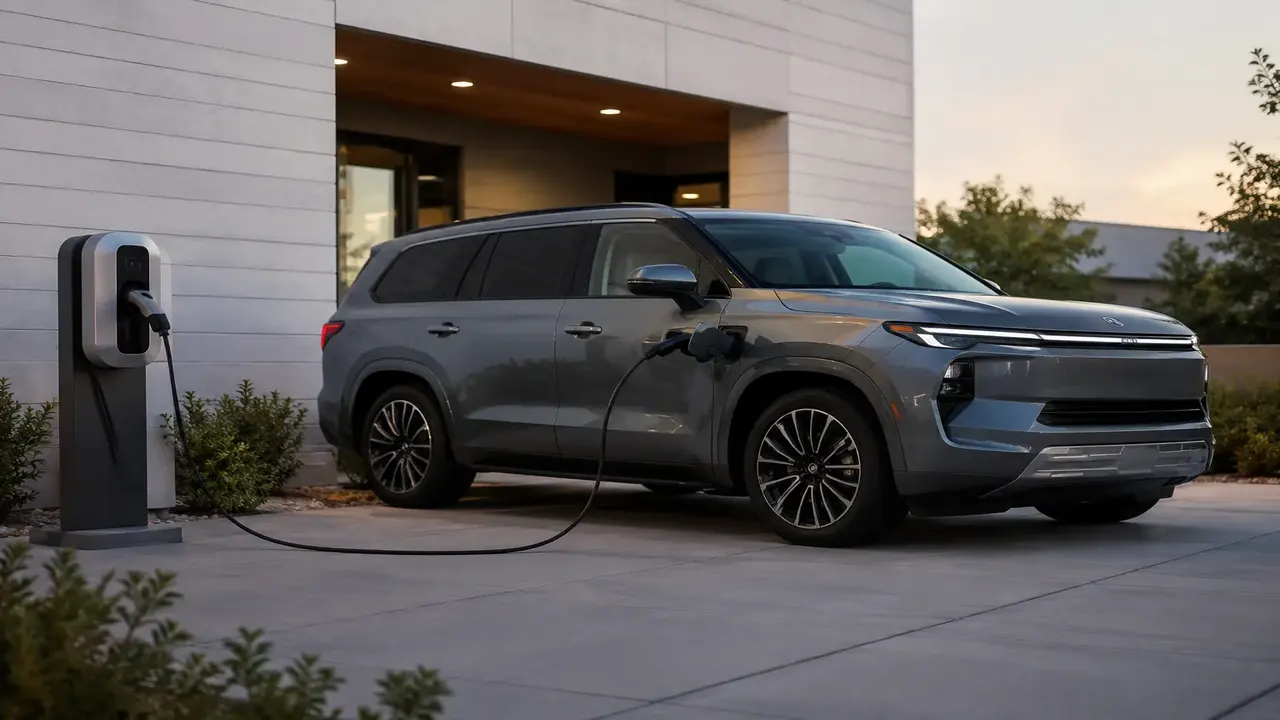
Five terms explain most of an EV's daily behavior: SOC (State of Charge) is the battery's fuel-gauge equivalent; regenerative braking (regen) recovers energy while slowing down, recovering roughly 10-20% of total range in typical mixed driving; the BMS (Battery Management System) protects the pack from damage; kWh (kilowatt-hour) measures battery capacity, the EV equivalent of a fuel tank's gallons/liters; and DC fast charging can take a battery from 10% to 80% in roughly 20-40 minutes on a capable charger and vehicle.
At a glance: five terms to know first
| Term | Plain-English meaning |
|---|---|
| SOC | State of Charge — the battery's current charge level, shown as a percentage |
| kWh | Kilowatt-hour — the unit measuring total battery capacity (bigger number = bigger 'tank') |
| Regen (regenerative braking) | Recovering energy back into the battery while slowing down instead of losing it as heat |
| BMS | Battery Management System — the software/hardware that protects and balances the battery pack |
| DC fast charging | High-power charging (typically at public stations) that adds range in minutes, not hours |
How this glossary is organized
EV-specific terms cluster into three groups: battery and charging vocabulary, driving-experience terms, and efficiency measurements. Understanding these lets you read a spec sheet or the vehicle's own app without guessing.
Battery and charging terms
| Term | Definition |
|---|---|
| SOC (State of Charge) | The battery's current charge level as a percentage of full capacity — the EV equivalent of a fuel gauge |
| kWh (kilowatt-hour) | The unit of battery capacity; a 60 kWh battery stores twice the energy of a 30 kWh battery, roughly translating to more range |
| BMS (Battery Management System) | The onboard system that monitors cell temperature, voltage and balance to protect the pack from damage and extend its lifespan |
| DC fast charging (DCFC) | High-power public charging (commonly 50-350 kW) that can take a battery from about 10% to 80% in roughly 20-40 minutes, depending on the vehicle and charger |
| Level 1 / Level 2 charging | Level 1 uses a standard household outlet (slow, ~3-5 miles of range per hour); Level 2 uses a 240V circuit (faster, commonly 20-40+ miles per hour) |
| Charging curve | How charging speed changes as the battery fills — most EVs charge fastest between roughly 10-50% SOC and slow down noticeably above 80% |
| Battery degradation | The gradual, normal loss of maximum battery capacity over years of use and charge cycles |
Driving-experience and efficiency terms
| Term | Definition |
|---|---|
| Regenerative braking (regen) | Using the electric motor as a generator to slow the car, feeding recovered energy back into the battery instead of losing it as brake heat |
| One-pedal driving | A regen mode strong enough that lifting off the accelerator alone slows the car to a stop in most situations, without touching the brake pedal |
| Range (EPA/WLTP estimated) | The manufacturer or regulator's estimated distance on a full charge under standardized test conditions — real-world range varies with speed, weather and terrain |
| Miles/kWh or kWh/100 miles (or km) | The EV efficiency measurement, equivalent to miles-per-gallon for gasoline cars — higher miles/kWh means better efficiency |
| Preconditioning | Warming or cooling the battery and cabin, often while still plugged in, to improve charging speed or range in extreme temperatures |
A larger kWh number doesn't automatically mean more real-world range — vehicle weight, aerodynamics and efficiency (miles/kWh) matter just as much as raw battery size, so compare efficiency figures, not just battery capacity.
Worked example: reading an EV's charging screen
An EV's dashboard shows 62% SOC, a 75 kWh battery, and estimates 41 minutes to 80% on the current DC fast charger. That means the car is a little over half full, has a mid-size battery by current market standards, and is charging on the steeper, faster part of its charging curve — which is why the estimate to 80% (not 100%) is used, since the last 20% charges much more slowly on almost every EV.
Frequently asked questions
What does SOC mean on an EV?
How much range does regenerative braking actually add back?
Why does DC fast charging slow down above 80%?
What's the difference between range and efficiency?
Sources & further reading
Figures, prices and policy details were current at the last-updated date above. Automotive pricing, incentives and regulations change frequently — verify time-sensitive details with the linked primary sources. Read our editorial policy and fact-checking standards.