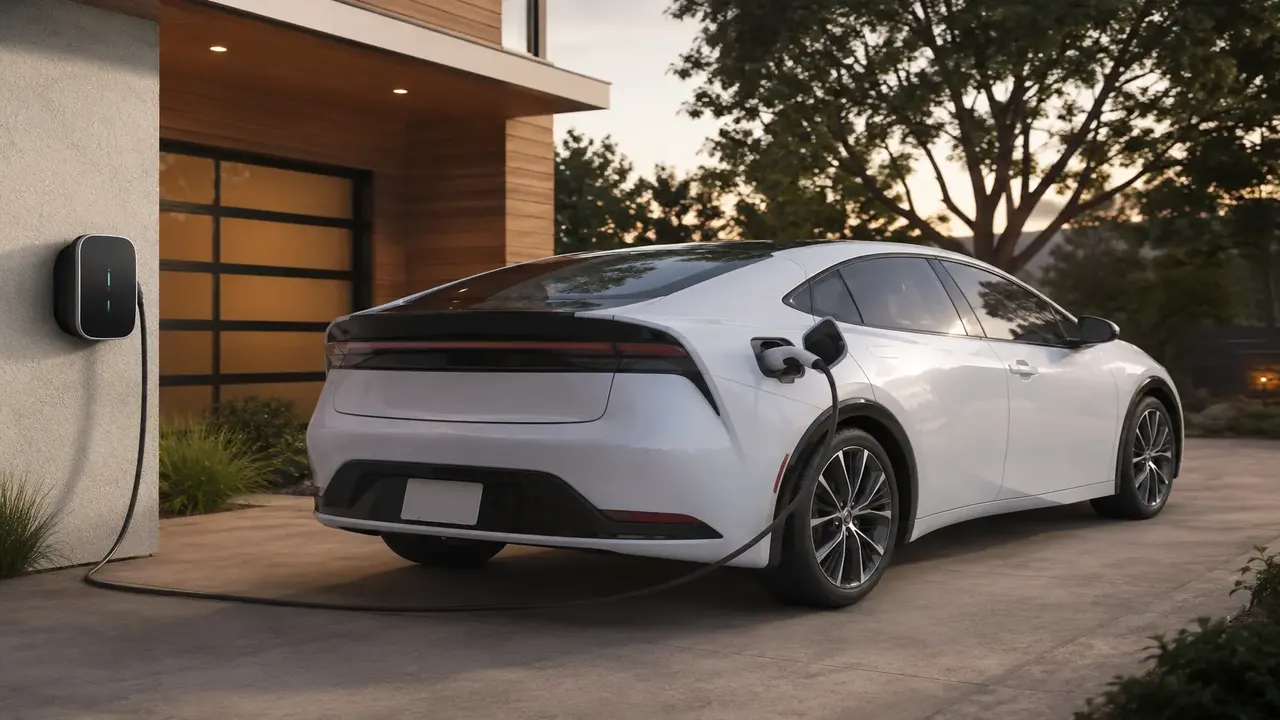
A V2L (vehicle-to-load) adapter plugs into an EV's charging port and outputs standard 120V/240V AC power, turning the car's battery into a generator — most systems support 1.5kW-3.6kW of continuous output, enough for power tools, a mini-fridge, a projector, or emergency home essentials. Adapters typically cost $150-$500 depending on brand and output capacity, though the feature must be supported by the vehicle itself; not all EVs offer V2L.
At a glance
| Spec | Typical range |
|---|---|
| Continuous output power | 1.5kW-3.6kW |
| Adapter price | $150-$500 |
| Usable battery for V2L (varies by automaker) | Often limited to protect a reserve, e.g. down to 20% |
How V2L works
V2L draws power from the EV's high-voltage traction battery and inverts it to standard household AC through an adapter connected at the charge port (or, on some models, a dedicated 120V outlet inside the cabin or truck bed). Because an EV battery is many times larger than a portable power station, a V2L-capable EV can run appliances for hours or days rather than minutes — a useful backup during power outages or on job sites and campsites.
Vehicle support is the real limiting factor
Not every EV supports V2L, and support varies significantly by automaker and model year. Before buying an adapter, confirm your specific vehicle and trim officially supports V2L output — plugging an unsupported adapter into a charge port that isn't designed for bidirectional flow will simply not work, and in some cases could trip a fault code.
What a V2L adapter can realistically power
- Power tools, work lights and job-site equipment.
- A mini-fridge, CPAP machine or medical device during an outage.
- Camping gear: induction cooktop, lights, fans, device charging.
- Limited home circuits during a blackout, when paired with a manual transfer switch (never a direct household plug-in without one).
What drives the price
- Maximum continuous output wattage and surge capacity.
- Number and type of outlets (household 3-prong, 240V, USB-C PD).
- Weatherproofing for outdoor/job-site use.
- OEM-branded adapters vs. third-party — OEM units often cost more but guarantee compatibility.
Common mistakes to avoid
- Plugging a V2L adapter directly into a home's electrical system without a properly installed transfer switch — this risks backfeeding the grid and is dangerous to utility workers.
- Overloading the adapter's continuous wattage rating with multiple high-draw devices at once.
- Assuming V2L will fully power a house — output is typically enough for select circuits or portable devices, not a whole home.
- Draining the battery too low for V2L use and getting stranded — most automakers cap usable V2L capacity to protect a driving reserve, but always check your own buffer.
Never use a V2L adapter to backfeed household wiring without a licensed electrician installing an interlock or transfer switch — doing so can endanger utility line workers and violates electrical code in most areas.
Frequently asked questions
Does every EV support V2L?
Can V2L power my whole house during an outage?
How much does a V2L adapter cost?
Will using V2L hurt my EV's battery?
Sources & further reading
- U.S. Department of Energy — vehicle-to-everything (V2X) technology overview
- National Fire Protection Association — generator and backfeed safety
Figures, prices and policy details were current at the last-updated date above. Automotive pricing, incentives and regulations change frequently — verify time-sensitive details with the linked primary sources. Read our editorial policy and fact-checking standards.