🏆 THE RESULT
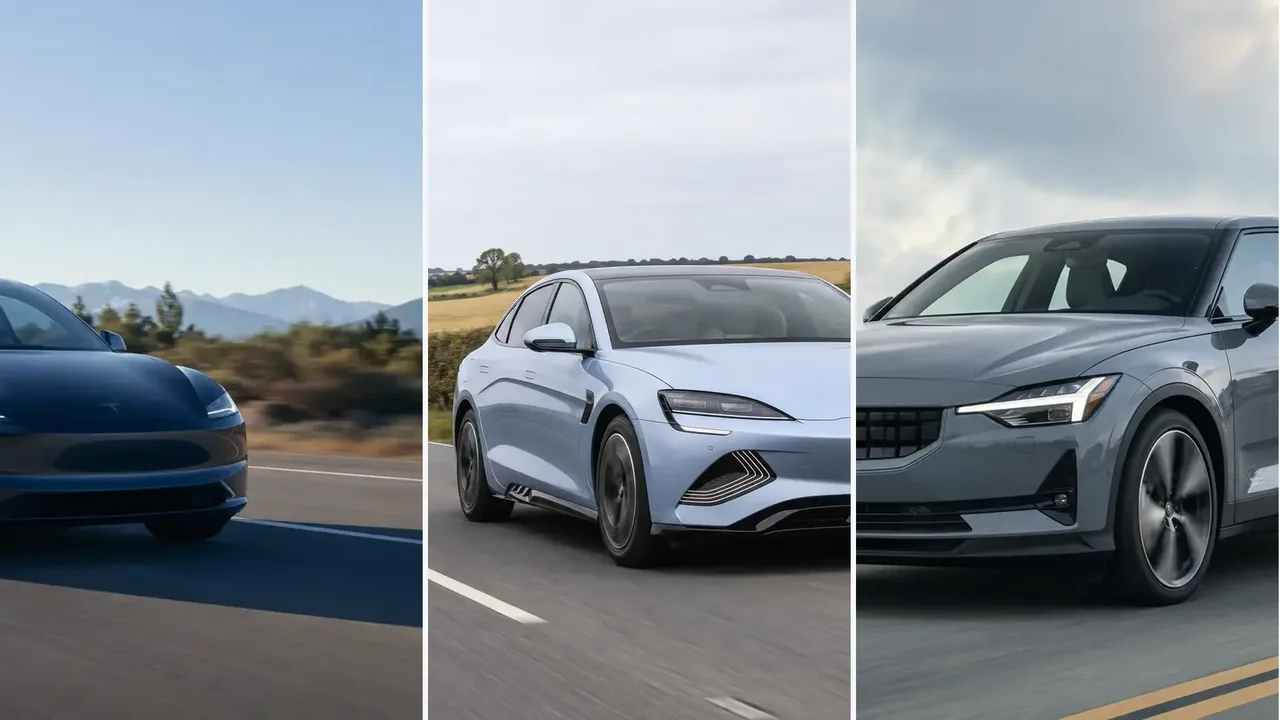
1st — Tesla Model 3 · the ecosystem still decides it, and the software gap remains real
2nd — BYD Seal · more kit and a keener price, and genuinely close on substance
3rd — Polestar 2 · the best-built and most tasteful, and the one to buy if you're tired of screens
A close and improving field. The Model 3's margin is narrower than it was, and the reasons it still wins are increasingly specific.
The £40K electric saloon question
This is where Britain's mainstream EV buyers with real budgets end up, and it's become a genuinely interesting fight. Three cars, three completely different philosophies:
- Tesla Model 3 — the ecosystem play: software, charging network, efficiency
- BYD Seal — the value play: more equipment, keener price, strong battery technology
- Polestar 2 — the design play: build quality, restraint, taste
Britain's lack of a Chinese-EV tariff (unlike the EU's up-to-45% or the US's 100%) makes it the most open Western market for BYD's proposition — which is why this comparison plays out differently here than it would in Munich or Michigan.
BYD Seal vs. Tesla Model 3 vs. Polestar 2: the numbers
| Tesla Model 3 | BYD Seal | Polestar 2 | |
|---|---|---|---|
| Positioning | ecosystem and efficiency | value and equipment | design and build |
| Battery tech | strong efficiency | Blade (LFP) — safety and durability | competitive |
| Charging | Supercharger network | competitive DC speeds | competitive |
| Software | most mature, OTA updates | improving fast | Google-based, well-executed |
| Standard kit | competitive | most generous | good |
| Interior | minimalist, divisive | tech-heavy, well-made | best-built, most tasteful |
| Driving | efficient, brisk, competent | competent, improving | composed, well-judged |
| Residuals | strongest | unproven | good |
3rd place — Polestar 2
The best-built and most tasteful car here — and the antidote if you're tired of screens.
What it does best:
- Build quality and material honesty. The Polestar 2 feels genuinely well-made in a way that reads as Scandinavian rather than showy. Materials are chosen with restraint and taste.
- Design that has aged extremely well. Where rivals chase drama, the Polestar's understated confidence looks better every year.
- Google-based infotainment that's genuinely well-implemented — native Maps and Assistant work properly rather than approximately.
- Quiet and composed, with notably good refinement (as our Cayenne comparison noted, it's quieter than the Model Y on tyre noise).
- A more conventional, less screen-dominated cabin than the Tesla — which for many buyers is a substantial relief rather than a limitation.
Why it finishes third:
- It's less efficient than the Model 3, which compounds into running costs and real-world range.
- No charging network of its own, relying on public infrastructure.
- Less standard equipment than the BYD at comparable money.
- Software, while good, doesn't match Tesla's maturity or update cadence.
Buy the Polestar 2 if: you value build quality, tasteful design and a conventional cabin, and you're actively tired of everything living in a touchscreen. It's the connoisseur's choice here.
2nd place — BYD Seal
More car for the money, and genuinely close on substance — closer than most people expect.
Its case:
- Value. More equipment for less money, and in tariff-free Britain that advantage is at its maximum. The kit list at a given price is the most generous here.
- The Blade battery is a genuine technical strength. BYD's LFP-based Blade design is well-regarded for safety, durability and thermal stability — and LFP chemistry tolerates frequent full charging better than NMC.
- Sharp styling with real presence.
- Comprehensive standard technology — big screens, extensive features, modern connectivity.
- It's improving rapidly. BYD's software and dynamics have advanced faster than most Western manufacturers anticipated.
Why it doesn't win:
- Software maturity still trails Tesla's, and the OTA update cadence isn't comparable.
- Charging ecosystem. Competitive DC speeds, but no Supercharger equivalent — and network access matters as much as charging speed.
- Residual values are unproven, which at this price is a genuine financial consideration over an ownership cycle.
- Chassis polish, while much improved, isn't quite at the Model 3's level.
Buy the Seal if: you want maximum equipment and battery technology for your money, you're comfortable with an emerging brand, and you'll keep the car long enough that residual uncertainty matters less.
🏆 1st place — Tesla Model 3
The ecosystem still decides it — but the margin has narrowed considerably.
Why it wins:
1. The Supercharger network. We keep returning to this because it keeps being decisive: reliable, abundant, seamless charging is worth more than a longer spec sheet. Rivals now match or beat the Model 3 on many individual metrics; none matches the ownership experience of charging that simply works.
2. Software maturity and OTA updates. Tesla's software is more polished and more frequently improved than anything here, and the car genuinely gets better after purchase — a real, ongoing value that a one-time spec comparison misses.
3. Efficiency leadership. The Model 3's real-world efficiency is class-leading, which means more usable range from a given battery and lower running costs.
4. Residual strength. Strongest here, which materially affects total cost of ownership.
5. It's a genuinely good car, not merely a well-supported one — brisk, efficient, spacious and competent.
Where it's beatable:
- The BYD offers more equipment for less money.
- The Polestar is better built and more tasteful inside.
- The minimalist, touchscreen-dependent interior divides opinion sharply — and the Model 3's removal of the indicator stalk (unlike the Model Y, which kept it) irritates many UK drivers.
- Rivals have genuinely closed the product gap. This is now an ecosystem win, not a product win.
The bottom line
The Model 3 wins on ecosystem completeness — Supercharger access, mature software, efficiency and residuals — rather than on outright product superiority. That distinction matters, because it tells you exactly when to choose something else.
The BYD Seal finishes a close second and is the value choice by a clear margin. If equipment-per-pound is your priority and you're relaxed about an emerging brand, it makes a strong case.
The Polestar 2 is the best-built and most tasteful, and the right answer for anyone who wants a calm, well-made, conventionally-controlled electric saloon.
The honest summary: if you road-trip regularly, the Model 3's charging advantage is decisive. If you charge at home and rarely travel far, that advantage largely evaporates — and the BYD's value or the Polestar's quality become far more compelling. Buy on your charging reality, not on the badge.
Key takeaways
- Winner: Tesla Model 3 — the Supercharger network, mature software, efficiency leadership and strongest residuals decide it
- It now wins on ecosystem completeness rather than product superiority — rivals have genuinely closed the gap on the car itself
- BYD Seal (2nd) offers the most equipment for the money plus the well-regarded Blade LFP battery; residuals are the main unknown
- Polestar 2 (3rd) is the best-built and most tasteful, with a conventional cabin — the pick if you're tired of touchscreen-everything
- Buy on your charging reality: if you road-trip, the Tesla's network is decisive; if you charge at home, the others become far more compelling
Sources & further reading
- manufacturer specifications
- UK EV market analysis. Verified July 2026.
Figures, prices and policy details were current at the last-updated date above. Automotive pricing, incentives and regulations change frequently — verify time-sensitive details against the primary sources listed below. Read our editorial policy and fact-checking standards.