True Motion Auto has not independently road-tested this vehicle. Specifications, pricing and performance figures are compiled from manufacturer technical data and published independent tests, and are attributed where quoted. Read how we review cars.
Research verdict: The Tekton is the credible mid-size SUV Nissan India has needed for years — bold Patrol-inspired styling, a genuinely competitive ₹10.49 lakh entry price, 5-star Bharat NCAP safety, Level 2 ADAS and a huge 700-litre boot. The missing strong-hybrid option is its clearest weakness against efficiency-focused rivals. On the published figures, a strong and well-timed comeback.
📅 Just launched: 9 July 2026. Deliveries began 20 July 2026. Prices are ex-showroom and move frequently — confirm current figures with Nissan India.
The car Nissan India has needed for years
Nissan's Indian story has been frustrating to watch. A brand with genuine global engineering credibility and a storied SUV heritage, it has spent years leaning almost entirely on the Magnite for domestic volume while the mid-size SUV segment — India's most important and most fiercely contested — exploded without it.
The Tekton ends that absence. Launched on 9 July 2026 at ₹10.49 lakh, with deliveries beginning 20 July, it's Nissan's most consequential Indian product in years: a proper mid-size SUV aimed directly at the Hyundai Creta, Kia Seltos and Maruti Grand Vitara, and undercutting almost every rival on entry price.
On the specification, pricing and safety data published so far, Nissan has built something genuinely competitive — with one notable omission that will cost it some buyers.
The Duster relationship, honestly
Let's address this directly, because it's central. The Tekton is a badge-engineered sibling of the Renault Duster (see our separate Duster review), sharing the Renault-Nissan Alliance platform and powertrains. That's a long-standing arrangement between the two brands.
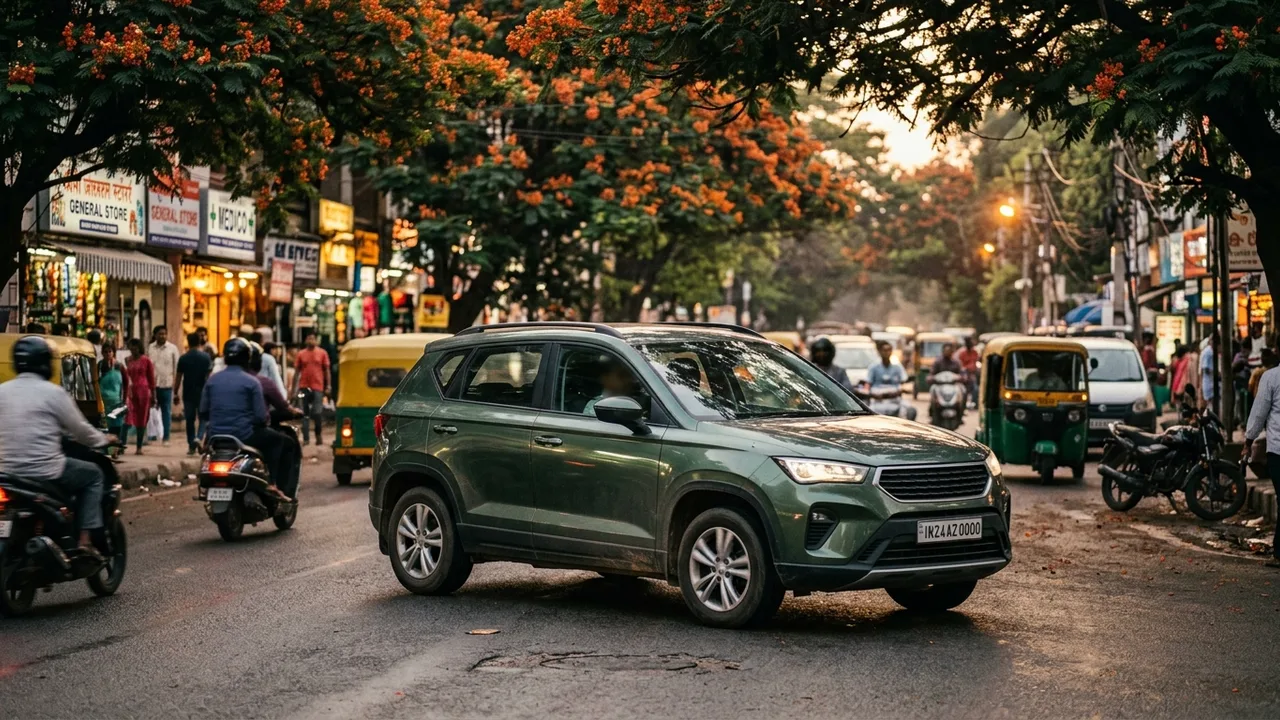
But — and this matters more than usual — the two look completely different. Nissan has given the Tekton its own design identity, drawing explicitly on the Nissan Patrol: a Patrol-inspired chrome grille, C-shaped LED headlamps, connected C-shaped tail lamps, sculpted body lines, flush roof rails and contrast skid plates. Nissan calls it the "baby Patrol," and the resemblance is genuine rather than marketing spin.
The result is that these feel like different vehicles despite shared bones. One meaningful mechanical difference: the Duster offers a strong-hybrid option; the Tekton does not. That's a real distinction, and we'll return to it.
The numbers
| Spec | Nissan Tekton |
|---|---|
| Price | ₹10.49 lakh – ₹18.59 lakh (ex-showroom); on-road from ~₹12.17 lakh |
| Variants | Six — Visia, Visia Plus, Acenta, N-Connecta, Tekna, Tekna Plus |
| Engines | 1.0L 3-cyl turbo-petrol (100 hp, 6-speed manual only) · 1.3L turbo-petrol (160.77 hp, 280 Nm) |
| Transmissions | 6-speed manual, automatic, DCT (top trim) |
| Mileage (ARAI) | 17.8 – 19.4 kmpl (1.3 DCT ~18.5 kmpl) |
| Dimensions | 4,349 mm L · 1,815 mm W · 1,674 mm H · 2,657 mm wheelbase |
| Boot | 700 litres |
| Safety | 5-star Bharat NCAP (full marks in both parameters) |
| Key features | Level 2 ADAS, panoramic sunroof, ventilated seats, built-in Google (200+ apps), connected tech |
| Launched | 9 July 2026 · deliveries from 20 July |
| Rivals | Hyundai Creta, Kia Seltos, Maruti Grand Vitara, Honda Elevate, Renault Duster |
Note the 1.3-litre's 280 Nm — more torque than the Creta's 1.5 turbo, which is a genuine competitive point rather than a marketing one.
What the specification tells us
The styling works. The Patrol-inspired design gives the Tekton real road presence and a distinct identity in a segment where many rivals blur together. It looks substantial and confident, and the "baby Patrol" framing lands — this reads as a proper Nissan SUV, not a rebadge.
The 1.3 turbo is the engine to have. At 160.77 hp and 280 Nm, it is genuinely strong for the segment on paper — more torque than a Creta 1.5 turbo, and enough on the numbers for loaded highway work. The 1.0-litre (100 hp, manual only) exists to hold the entry price; the 1.3 is the one worth having.
Space and practicality look strong on the numbers. The 2,657 mm wheelbase is generous for the class, and the 700-litre boot is a standout figure — a real, quantifiable advantage for family buyers that rivals struggle to match.
The equipment level is competitive. Level 2 ADAS, a panoramic sunroof, ventilated seats, and built-in Google with 200+ Android apps — this is a properly modern, well-equipped SUV, not a stripped-out value play.
The safety credentials are excellent. A 5-star Bharat NCAP rating with full marks in both parameters is a serious achievement and a genuine selling point for Indian families, who increasingly (and rightly) prioritise crash safety.
The clear weakness
There's no strong-hybrid option, and in 2026 India that's a real gap.
The segment's efficiency leaders — the Maruti Grand Vitara and Toyota Hyryder — offer strong hybrids delivering substantially better fuel economy than the Tekton's 17.8–19.4 kmpl. For the significant cohort of Indian buyers who prioritise running costs above all (and with fuel prices as they are, that's many), the Tekton simply isn't in the conversation.
It's a strategically odd omission given the Duster it shares bones with does offer a strong hybrid. Nissan has chosen to compete on price, styling, torque and equipment instead. That's a coherent strategy — just not one that serves efficiency-focused buyers.
Who it's for
Buy the Tekton if: you want a well-equipped, spacious, safe mid-size SUV with genuine road presence at a competitive price, you value the strong 1.3 turbo's torque and the enormous 700-litre boot, and 5-star safety with Level 2 ADAS matters to you. Get the 1.3 turbo — it's the engine that makes the car.
Look elsewhere if: maximum fuel efficiency is your priority (Grand Vitara or Hyryder strong hybrids), you want the largest service network (Maruti, Hyundai), or you prefer the Duster's styling and hybrid option from the same platform.
The bottom line
The Nissan Tekton is a genuinely credible comeback — the mid-size SUV Nissan India has needed for years, arriving with bold Patrol-inspired styling that gives it real identity, a competitive ₹10.49 lakh entry price that undercuts almost every rival, a strong 160 hp turbo option with class-leading torque, an enormous 700-litre boot, Level 2 ADAS and a 5-star Bharat NCAP rating. Its clearest weakness is the missing strong-hybrid option, which cedes the efficiency-focused buyer to the Grand Vitara and Hyryder entirely. But for buyers weighing styling, space, safety, equipment and price, the Tekton makes a strong case. Whether it changes Nissan's Indian fortunes remains to be seen — but it is unquestionably the right step, and the first genuinely competitive product the brand has brought to this segment in years.
Key takeaways
- The Tekton launched 9 July 2026 at ₹10.49–18.59 lakh — Nissan's most important Indian product in years, deliveries from 20 July
- It's a Renault Duster sibling but looks completely different, with genuinely Patrol-inspired styling Nissan calls the "baby Patrol"
- Strengths: 160.77 hp/280 Nm 1.3 turbo (more torque than the Creta's 1.5), a huge 700-litre boot, Level 2 ADAS and 5-star Bharat NCAP
- The clear weakness: no strong-hybrid option, ceding efficiency-focused buyers to the Grand Vitara and Hyryder (the Duster does offer one)
- Get the 1.3 turbo — it's the engine that makes the car. A credible, well-timed comeback for Nissan India
Sources & further reading
- Autocar India
- CarWale
- CarDekho
- ZigWheels
- Cars24
- CarBlogIndia
- Bharat NCAP
- Nissan India. Launched 9 July 2026 — confirm current pricing with Nissan India. Verified July 2026.
Figures, prices and policy details were current at the last-updated date above. Automotive pricing, incentives and regulations change frequently — verify time-sensitive details with the linked primary sources. Read our editorial policy and fact-checking standards.