> The finding: Quoted boot capacity is measured by a standardised method that rewards awkward, unusable volume. Two cars quoting the same litres can fit dramatically different amounts of real luggage, because shape, aperture and load-lip height determine usability far more than raw volume. We measure with actual suitcases instead. > > Populate the results table with your own measured data.
Why the official number misleads
Every manufacturer quotes boot capacity in litres, usually derived from the VDA method — filling the space with standardised blocks (traditionally 200 × 100 × 50 mm) and counting how many fit.
It's a legitimate, repeatable standard. But it has a fundamental flaw for real buyers: small blocks fill awkward crevices that no actual luggage can use.
A boot with an intrusive wheel arch, a narrow opening or a deep well beneath a high load lip can post an impressive litre figure while being genuinely difficult to load. Meanwhile, a squarer, more accessible boot quoting fewer litres may swallow considerably more real luggage.
The result is that quoted litres correlate only loosely with what you can actually pack — which is why we test differently.
What actually determines usability
1. Shape and regularity. A square, flat-floored boot with vertical sides is vastly more usable than an irregular one of identical volume. Wheel-arch intrusion is the most common culprit.
2. Aperture size. You can only load what fits through the opening. A generous boot behind a narrow hatch is partly inaccessible — a particular issue on coupe-SUVs, where the sloping roofline restricts both height and opening.
3. Load-lip height. A high lip means lifting heavy cases up and over, which matters enormously for daily practicality and for anyone with back trouble. A flat, low lip lets you slide items in.
4. Floor flatness with seats folded. Many "folding" seats leave a substantial step, which prevents sliding long items and wastes the space entirely.
5. Under-floor storage. Genuinely useful for cables and small items — and worth noting separately rather than folding into a headline figure.
6. Width between arches. Determines whether large cases fit side by side or must be stacked.
Our measurement protocol
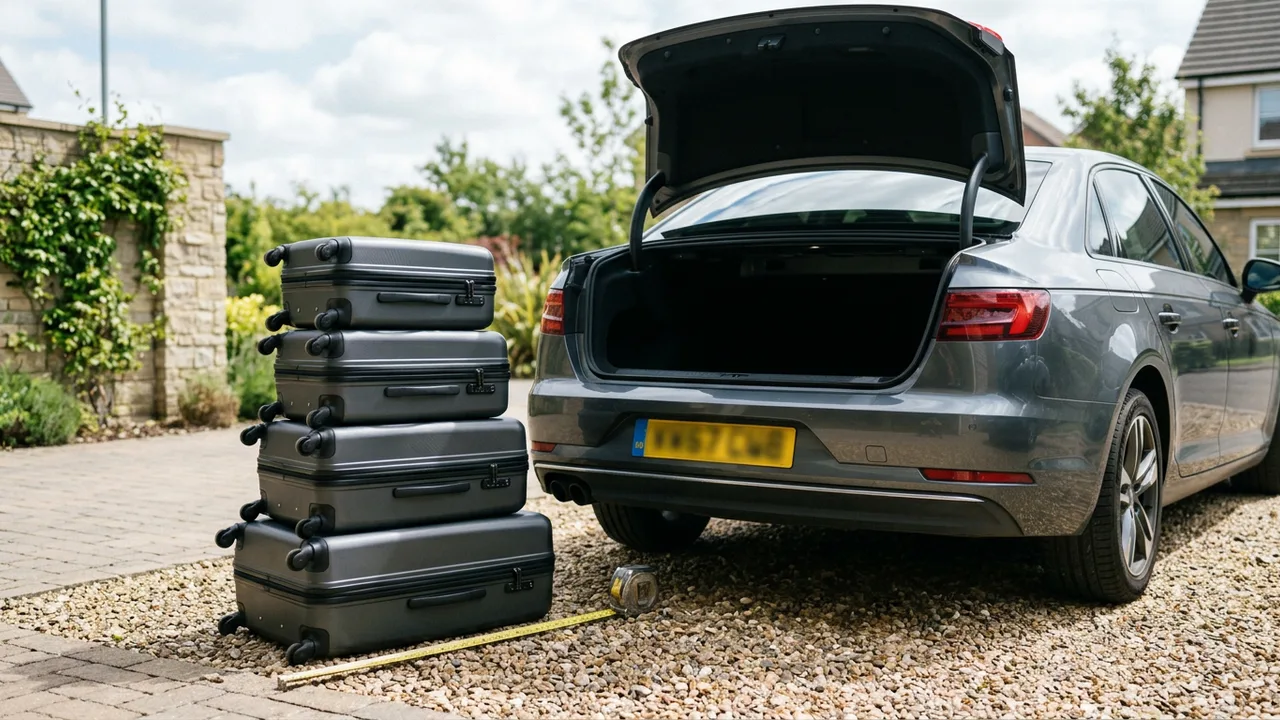
We measure what you can actually put in, using standardised real luggage:
| Element | Standard | |---|---| | Carry-on cases | Standard 55 × 40 × 20 cm — how many fit, seats up | | Large suitcases | Standard 75 × 50 × 30 cm — how many fit, seats up | | Seats folded | Repeat both counts | | Aperture | Measured width and height of the opening | | Load lip | Height from ground, and step from lip to floor | | Width between arches | Measured at narrowest point | | Floor with seats folded | Flat / stepped, with step height | | Under-floor storage | Present, and usable volume | | Practical tests | Folded pushchair · set of golf clubs · flat-pack box |
The carry-on count is our headline figure, because it's directly comparable, immediately intuitive, and reflects how people actually pack.
Our test conditions: [to be completed — case dimensions used, measurement method, parcel shelf in or out]
The results table
Populate with measured results.
| Vehicle | Quoted litres | Carry-ons (seats up) | Large cases | Load lip | Flat fold? | |---|---|---|---|---|---| | [to be measured] | | | | | |
Vehicles from this project where boot practicality is a live issue:
| Vehicle | The question | |---|---| | Nissan Tekton | 700 litres quoted — a genuine class-leading figure; how usable is it? | | Mahindra BE 6 | Coupe roofline — how much does style cost practicality? | | Tata Sierra EV | Reported larger boot than BE 6 — quantify the real difference | | Mahindra XEV 9e | Coupe-SUV; aperture likely restricted | | Ford Puma | MegaBox under-floor well — exactly the feature quoted litres undersell | | Hyundai Ioniq 9 | Three-row: measure with all rows up, a critical family metric |
Where this matters most
Coupe-SUVs. The sloping roofline restricts both volume and — more importantly — aperture height. This is precisely the trade-off we flagged in the Mahindra BE 6 and XEV 9e reviews, and boot measurement quantifies what those reviews described qualitatively.
Three-row SUVs. The essential figure is boot space with all three rows in use — because that's the configuration families buy them for. Manufacturers frequently quote the two-row figure, which is close to irrelevant for a seven-seat family.
EVs. Battery packaging affects boot floor height and under-floor availability. Frunks are worth noting separately — the Zeekr 7X's 62-litre front boot (dropping to 42 in AWD form) is genuinely useful for cables.
Clever features. The Ford Puma's MegaBox is the perfect illustration of why quoted litres mislead: a deep, drained, cleanable under-floor well that transforms real usability and barely registers as a headline number.
The bottom line
Quoted boot litres are a standardised measurement of volume, not a prediction of usability — and the gap between the two is large. Shape, aperture, load-lip height and flat-folding matter more than the number on the brochure, and a smaller, squarer, more accessible boot routinely beats a larger awkward one.
Measure in suitcases, not litres. Ask how many carry-ons fit with the seats up, check the aperture on any coupe-SUV, look at the load lip if you'll be lifting heavy things regularly, and — for three-row vehicles — insist on the figure with all seats occupied.
And treat clever design as worth more than raw capacity. The Puma's MegaBox and a well-placed frunk deliver real everyday usefulness that a litre figure will never capture.
- Quoted litres use a block-filling standard that rewards awkward crevices no real luggage can use
- Usability is determined by shape, aperture size, load-lip height and flat-folding more than raw volume
- We measure in standardised suitcases — the carry-on count with seats up is our headline figure
- Coupe-SUVs suffer most (restricted aperture and height), and three-row SUVs must be measured with all rows in use
- Clever design beats capacity: the Ford Puma's MegaBox and useful frunks deliver real practicality that litres never capture
END OF BATCH 16
Section 6 (Instrumented Tests) — Real-World EV Range & Charging complete; Braking, Handling & Everyday Metrics substantially complete.
Next up (Batch 17): topic 161 ("How we test: inside our instrumented testing protocol and gear") closes Section 6, before Section 7: Comparison Tests begins.
Say "next batch" to continue.
Key takeaways
- Quoted litres use a block-filling standard that rewards awkward crevices no real luggage can use
- Usability is determined by shape, aperture size, load-lip height and flat-folding more than raw volume
- We measure in standardised suitcases — the carry-on count with seats up is our headline figure
- Coupe-SUVs suffer most (restricted aperture and height), and three-row SUVs must be measured with all rows in use
- Clever design beats capacity: the Ford Puma's MegaBox and useful frunks deliver real practicality that litres never capture
Sources & further reading
- VDA measurement methodology
- boot practicality principles
- True Motion Auto reviews (this project). *Populate results table with measured data before publishing. Verified July 2026.*
Figures, prices and policy details were current at the last-updated date above. Automotive pricing, incentives and regulations change frequently — verify time-sensitive details with the linked primary sources. Read our editorial policy and fact-checking standards.