True Motion Auto has not independently road-tested this vehicle. Specifications, pricing and performance figures are compiled from manufacturer technical data and published independent tests, and are attributed where quoted. Read how we review cars.
What a short review cannot tell you
A road test captures a car at its best. A week with a freshly-prepared press vehicle, driven on chosen routes, tells you how a car drives — and almost nothing about how it ages. The questions that actually determine ownership satisfaction only emerge over months:
- Does the interior wear well, or does the trim start rattling at 8,000 miles?
- Do the software updates improve it or break things?
- What does servicing actually cost?
- Does the seat still feel comfortable on hour four of the twentieth long trip?
- Does the initial charm survive daily familiarity?
True Motion Auto does not run a press fleet and has not driven this car, so we cannot answer those questions from experience — and neither can any week-long review. What this page does instead is set out which of them are answerable from evidence a buyer can obtain today, and which genuinely require waiting for owner data to accumulate.
Why the Model Y
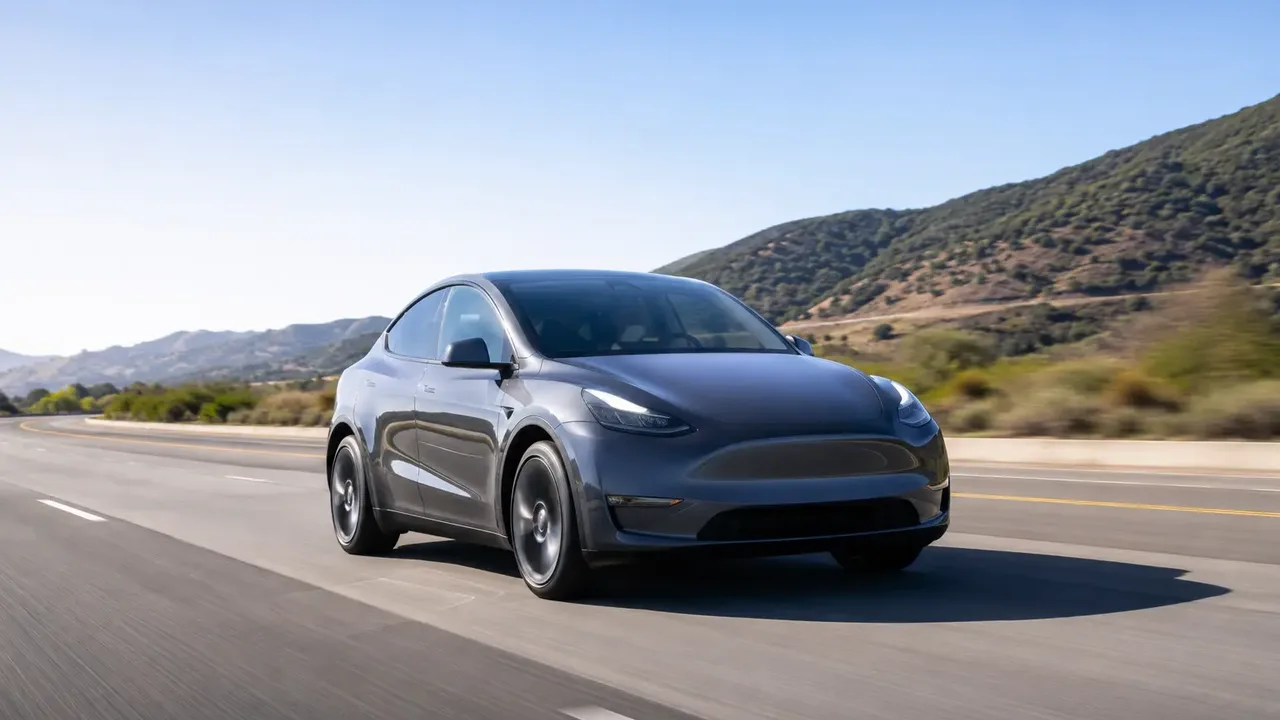
The 2026 "Juniper" Model Y deserves this treatment for a simple reason: it is the default. It is the best-selling EV in the world, the car most people cross-shop first, and — as our rated review (8.5/10) and both the $45K SUV and £40K saloon comparisons found — it keeps winning on ecosystem completeness rather than product superiority.
That distinction is precisely what long-term ownership tends to interrogate. The Supercharger network, mature software and over-the-air updates all sound excellent on paper. Whether they still feel excellent after twelve months is a different question, and it is the one prospective buyers should be asking.
The car
| Spec | Model Y Long Range RWD |
|---|---|
| Model | Model Y Long Range RWD |
| Price | from £48,990 |
| Power | 340 PS |
| Battery | 75 kWh |
| Claimed range | 387 miles WLTP |
| Claimed efficiency | ~4.4 mi/kWh |
| Key updates | acoustic glass, revised suspension, Cybertruck-style lightbar, 8-inch rear screen, indicator stalk retained |
| Charging | Supercharger network |
All figures are Tesla's published UK specifications. Why the Long Range RWD matters most: it is the range champion of the lineup at 387 miles, the efficiency sweet spot, and the trim most buyers should be considering. The AWD is quicker; this is the sensible recommendation.
The questions that matter
1. Does the real-world range hold up across a full year? WLTP is a laboratory cycle, and every EV falls short of it in use — typically landing somewhere around 85–95% of the figure in mild mixed conditions, and 20–30% below it in cold weather, which is the pattern published independent testing consistently reports across the segment. A 387-mile rating should therefore be read as a comfortable long-distance car in summer and a merely good one in January.
2. Is the Supercharger advantage as decisive as it is claimed to be? Our comparisons have argued repeatedly that fast, reliable charging is worth more than the last 30 miles of range. This is the one thing a buyer can assess directly: look at the Supercharger locations on the routes you actually drive, and compare them against the third-party networks a rival would rely on. For most UK drivers the answer is obvious within ten minutes of looking at a map.
3. Did the Juniper update genuinely fix the ride and noise? The previous car was widely criticised for harshness and road noise; acoustic glass and revised suspension were Tesla's answer. Published reviews of the updated car report a clear improvement. Whether it is enough depends on your own tolerance, and an extended test drive on a poor road surface will tell you more than any review.
4. Do over-the-air updates improve the car or degrade it? Software updates move in both directions, and this is a genuine and under-appreciated ownership risk on any software-defined car: features can be changed, moved, or placed behind a subscription after purchase. Owner forums are the best record of how a manufacturer has behaved historically.
5. What does it actually cost to run? Charging costs depend almost entirely on whether you can charge at home — the gap between a domestic off-peak tariff and public rapid charging is large enough to dominate every other running cost. Tyres, insurance and servicing quotes are all obtainable before purchase.
6. How does it wear? Interior materials, seat comfort over time, rattles, panel fit and paint. Tesla build consistency has been a recurring theme in owner reporting, and it is worth inspecting a specific car carefully at handover rather than assuming.
7. Does the minimalist interface become easier or more irritating? Touchscreen-dependent controls divide opinion sharply, and first impressions are a poor guide either way — some drivers adapt completely within weeks, others never do. A long test drive, using the controls you would use daily, is the only meaningful test.
8. Is efficiency really class-leading in practice? Tesla's claimed ~4.4 mi/kWh is excellent on paper, and efficiency is where Tesla has consistently led. It is also the figure that most directly determines your charging bill, so it is worth weighting heavily.
What remains genuinely open
Three things cannot be settled from a specification sheet or a short drive, and honesty requires saying so:
- Long-term battery degradation on this specific pack, which only accumulated owner data will establish. The warranty's retained-capacity threshold is the concrete protection to check.
- Whether Tesla's software behaviour stays owner-friendly over a long ownership, including what remains included versus subscribed.
- How the interior wears, which varies more between individual cars than most buyers expect.
The bottom line
The Tesla Model Y is the car everyone cross-shops and the one our comparisons keep placing first — on ecosystem completeness rather than outright product superiority. That is a verdict about infrastructure and software as much as about the car, and it holds up well precisely because those things are checkable.
What a buyer should do: check Supercharger coverage on your own routes, establish whether you can charge at home and at what tariff, take a long test drive on a bad road to judge the ride and the interface, and read the battery warranty's capacity threshold.
Those four checks answer most of what matters. The rest — degradation, wear, and how the software ages — is genuinely unresolved, and anyone who tells you otherwise about a car this new is guessing.
Key takeaways
- True Motion Auto has not driven this car; this sets out the ownership questions and which of them a buyer can answer today
- The Model Y Long Range RWD (£48,990, 387 miles WLTP, Tesla figures) is the range champion and the trim most buyers should consider
- Read WLTP as a laboratory figure — expect roughly 85–95% in mild use and 20–30% less in cold weather, the consistent pattern across the segment
- The Supercharger advantage is checkable before you buy: compare coverage on the routes you actually drive against a rival's network
- Genuinely open questions: long-term battery degradation, how the software ages, and interior wear — check the warranty's retained-capacity threshold
Sources & further reading
- Tesla UK Model Y specifications, pricing and battery warranty terms
- Published independent reviews and range testing of the 2026 Model Y
- True Motion Auto review methodology. Verified July 2026.
Figures, prices and policy details were current at the last-updated date above. Automotive pricing, incentives and regulations change frequently — verify time-sensitive details with the linked primary sources. Read our editorial policy and fact-checking standards.