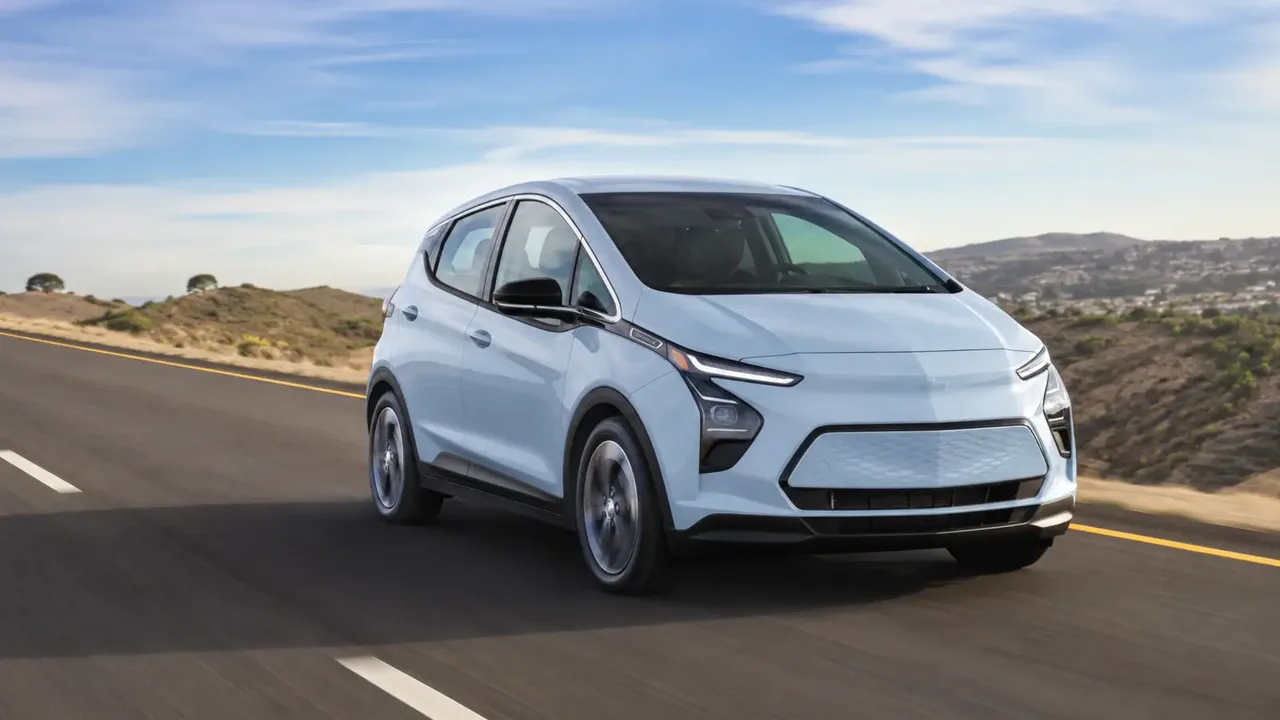
The car America has been waiting three years for
GM killed the Chevrolet Bolt at the end of 2023. It was, at that point, the only genuinely long-range EV in America that ordinary people could actually afford, and its cancellation left a crater in the sub-$30,000 segment precisely as mainstream buyers were starting to take EVs seriously.
The 2027 Bolt is back, and it arrives into a market where the $7,500 federal credit no longer exists and the average new car costs nearly $52,000. The timing could hardly be better.
The numbers
| Trim | MSRP (incl. $1,395 destination) |
|---|---|
| Bolt LT (launch) | $29,990 |
| Bolt LT (later in model year) | $28,995 |
| Bolt RS | $32,995 |
Range: 262 miles EPA. Chevrolet's claim — "the most range in an EV under $30,000" — appears to hold.
Powertrain: 65 kWh battery, 210 hp front-mounted motor, front-wheel drive. 0–60 mph in 7.1 seconds in Edmunds' testing — quicker than the average petrol hatchback.
Efficiency: rated at 28 kWh per 100 miles. Edmunds beat both the range and efficiency figures in real-world testing, recording 290 miles on a single charge in a Bolt RS.
Cargo: 16.2 cubic feet.
What's actually new under the familiar shape
The silhouette is recognisable. Everything beneath it is not.
LFP batteries. GM has swapped the original nickel-rich chemistry for lithium iron phosphate prismatic cells, rated at 65 kWh — the same headline number as the 2023 car, but a fundamentally different chemistry. LFP trades some energy density for durability and cost control. If you plan to keep the car past the warranty window, that is good news, and GM now actively recommends charging to 100% regularly.
Charging, transformed. The original Bolt peaked at a miserable ~55 kW. The new one does 150 kW+, with a 10–80% charge in around 25–26 minutes. That is more than 2.5× faster and turns the Bolt from a strictly-local car into a genuinely usable one.
A native NACS port. The Bolt is the first Chevrolet with a factory-fitted Tesla-style NACS connector, meaning direct access to Supercharger stalls with no adapter. In the messy middle of the NACS transition (see our guide), this alone puts the Bolt ahead of most of its rivals.
A new drive unit. The X76 was designed in-house at GM, with a permanent-magnet motor using minimal rare-earth material, segmented magnets to reduce heat loss, and silicon-carbide inverter components.
Super Cruise. The Bolt is now the most affordable vehicle in America to offer hands-free driving. GM says Super Cruise users collectively drive more than 40 million hands-free miles per month.
Built in Kansas at GM's Fairfax Assembly plant, with domestically and globally sourced parts — which matters for the new auto-loan interest deduction that replaced the federal credit.
The catch, and it's a big one
GM has explicitly described the Bolt as a limited-run model.
Read that alongside GM's other 2026 posture — no major EV product launches, EV sales down 32.6% year on year, the Blazer EV down 75.1% — and a picture emerges. GM is not betting the company on the Bolt. It is filling a hole while it waits for the market to recover.
Chevrolet expects the Bolt and Equinox EV together to account for most of its 2026 EV volume, which tells you both that these two cars are carrying the brand and that the brand's ambitions have contracted.
If you want one, the practical advice is: do not wait for a deal. Limited-run means limited-run.
Where it fits
Genuinely long-range EVs under $30,000 are almost extinct in America. The Bolt's realistic peers:
- Nissan Leaf — completely redesigned last year, sharper to drive, more modern EV specs, and the closest direct alternative
- Chevrolet Equinox EV — a rung up. More space, over 315 miles EPA, more money. For most families, the Equinox will be the default; the Bolt is the city car, the commuter, the second car
- Subaru Uncharted — pricier, but more range and a better cabin
Most other rivals sit at $35,000–$40,000 before incentives, which in a post-credit market means $35,000–$40,000 full stop.
Our verdict
The 2027 Bolt is the most sensible new car in America. Not exciting — Edmunds rated it 6.9/10, and the value case weakens sharply if you option it up toward $40,000, at which point you should simply buy an Equinox.
But at $29,990, with 262 miles of real range, a native NACS port, 150kW charging, an LFP pack built to last, and hands-free highway driving? That is a remarkable amount of car, and it exists in a segment that currently contains almost nothing else.
Buy the base LT. Add the Comfort package for the power driver's seat, heated seats and heated wheel. Stop there. That is the whole review.
Key takeaways
- 2027 Bolt LT from $29,990, dropping to $28,995 later in the model year
- 262 miles EPA from a 65 kWh LFP battery; 290 miles in Edmunds' real-world test
- First Chevrolet with a native NACS port — Supercharger access with no adapter
- 150kW+ DC charging, 10–80% in ~25 minutes, up from ~55kW on the old Bolt
- GM has called it a limited-run model
Sources & further reading
- GM/Chevrolet newsroom (October 2025 reveal)
- Chevrolet.com
- Edmunds testing
- Recharged
- EVChargingStations
Figures, prices and policy details were current at the last-updated date above. Automotive pricing, incentives and regulations change frequently — verify time-sensitive details with the linked primary sources. Read our editorial policy and fact-checking standards.