The scoreboard
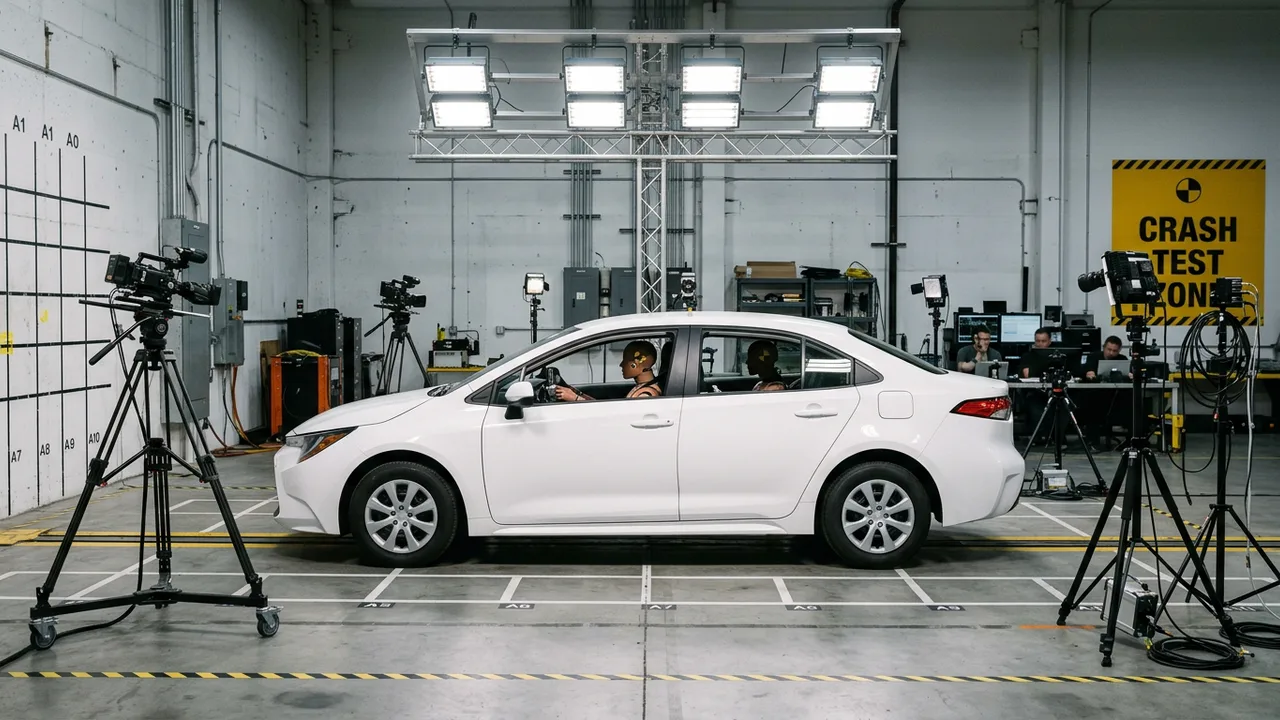
Bharat NCAP has now crash-tested more than 30 models. The top of the table looks like this:
| Model | Adult (AOP /32) | Child (COP /49) | Price from |
|---|---|---|---|
| Mahindra XEV 9e | 32.00 | ~45 | ₹21.90 lakh |
| Tata Harrier EV | 32.00 | ~45 | ₹21+ lakh |
| Mahindra BE 6 | 31.97 | ~45 | ₹18.90 lakh |
| Kia Seltos (petrol) | 31.70 | — | — |
| Maruti Victoris (petrol) | 31.66 | — | — |
| Maruti e Vitara | 31.49 | — | ₹15.99 lakh |
| Tata Punch EV | 31.46 | 45.00 | — |
| Tata Nexon EV | 29.41 | 44.95 | ₹12.49 lakh |
| Tata Punch (petrol) | 30.58 | 45.00 | ₹5.59 lakh |
The top three positions in Indian crash testing are all electric vehicles. Two of them have achieved a perfect 32/32 in adult occupant protection — the only cars in India ever to do so.
The BE 6 missed a perfect score by 0.03 points. The reason is almost comically specific: the driver's right tibia received "Adequate" rather than "Good" protection in the frontal offset test. Every other body region, for both occupants, rated "Good". The side deformable barrier and side pole tests were flawless.
Why EVs score so well — the real explanation
There is a lazy version of this story, and it is wrong. The lazy version is that "EVs are heavier, so they're safer."
The actual explanation is structural, and it is more interesting.
1. Purpose-built platforms. The XEV 9e and BE 6 sit on Mahindra's INGLO platform. It was designed from a blank sheet, around a battery. When you design a car around a large, rigid, structurally-integrated battery pack in the floor, you get a very stiff floorpan almost for free — and a stiff floorpan is the foundation of side-impact performance.
2. Battery housing forces good engineering. A battery pack must not be penetrated in a crash. That is a non-negotiable engineering requirement, and it forces manufacturers to build a heavily reinforced cage around the floor and sills. That cage protects the occupants as a side effect. Manufacturers who engineer the floor pan properly around the battery frequently see improved side-impact rigidity as a consequence.
3. Low centre of gravity. The battery sits low, dropping the centre of gravity and reducing rollover risk — a meaningful real-world safety benefit that crash tests do not directly measure.
4. They're new. This is underrated. These are 2024–2026 platforms designed against 2024–2026 expectations, by manufacturers who now know that a Bharat NCAP score sells cars. Older platforms — even with six airbags bolted on — fall short.
The crucial caveat
Being electric does not make a car safe.
The Citroën ë-C3 scored zero stars with Global NCAP. It is electric. It is not safe.
The safety comes from purpose-built platforms with fortified battery housing, not from the electric powertrain itself. Any manufacturer can build a bad EV, and some have.
Not all 5-star ratings are equal — and this matters
Here is the single most useful thing in this article.
A car scoring 27.05/32 in adult protection and a car scoring 32.00/32 both earn five stars. The 5-star threshold is just 27 points.
That is a gap of nearly five points, and in real-world crash survivability it is enormous. The star rating is a floor, not a measurement.
Always look at the raw score, not the star count.
The other trap: a rating is earned by a specific variant. It does not automatically apply to every trim. Dealership staff will tell you otherwise. Check.
What Bharat NCAP actually measures
- Adult Occupant Protection (AOP): max 32 points. 5 stars requires ≥27.
- Child Occupant Protection (COP): max 49 points. 5 stars requires ≥41.
- Safety Assist Technologies (SAT): AEB, lane assist, seatbelt reminders — assessed separately.
Introduced in 2023, Bharat NCAP has done in three years what two decades of advocacy could not: it has made safety a purchase driver in India.
The old showroom question was kitna deti hai — what mileage does it give? The new one is increasingly kitni safe hai.
The democratisation, which is the real story
The headline is that EVs top the table. The more important fact is at the other end:
The cheapest 5-star car in India is the Tata Punch, at ₹5.59 lakh, scoring 30.58/32. Even its base Smart variant gets six airbags, ESC, ISOFIX and TPMS as standard.
The Skoda Kylaq (from ₹7.59 lakh, 30.88 AOP) is arguably better equipped still at the base level, with traction control and multi-collision braking standard.
Maruti — for years the industry's safety laggard, and the manufacturer with most to lose from crash testing — now has four 5-star models, including the Victoris at 31.66 AOP and the Dzire, its first-ever 5-star car.
That is the transformation. Not that a ₹22 lakh electric SUV can score 32/32 — that was always achievable with enough money. It is that genuine 5-star safety now starts under ₹6 lakh, and that the mass-market manufacturer serving India's largest customer base has been forced to compete on it.
Our advice
Read the score, not the stars. 32/32 and 27/32 are both "5-star". They are not the same car.
Check your specific variant. Ratings are variant-specific.
Do not buy an unrated car. With tested options from ₹5.59 lakh, there is no longer a good reason to. If you must, insist on six airbags, ESC, and a modern monocoque platform from a manufacturer with a track record.
Six airbags do not fix a weak platform. If the shell collapses, the airbags are decoration. Structure first.
Key takeaways
- The Mahindra XEV 9e and Tata Harrier EV both score a perfect 32/32 in Bharat NCAP adult protection — the only cars in India to do so
- The top three crash-test performers in India are all EVs
- The advantage comes from purpose-built platforms with reinforced battery housing, not from being electric per se
- The Citroën ë-C3 scored zero stars with Global NCAP — electric does not mean safe
- 5 stars requires only 27/32 — always read the raw score, not the star count
Sources & further reading
- Bharat NCAP official results (bncap.in)
- Global NCAP India results
- Autocar India
- EV Index India
- Autopunditz
Figures, prices and policy details were current at the last-updated date above. Automotive pricing, incentives and regulations change frequently — verify time-sensitive details with the linked primary sources. Read our editorial policy and fact-checking standards.