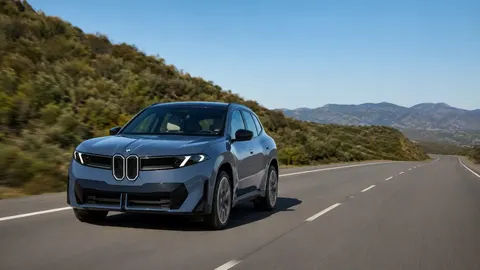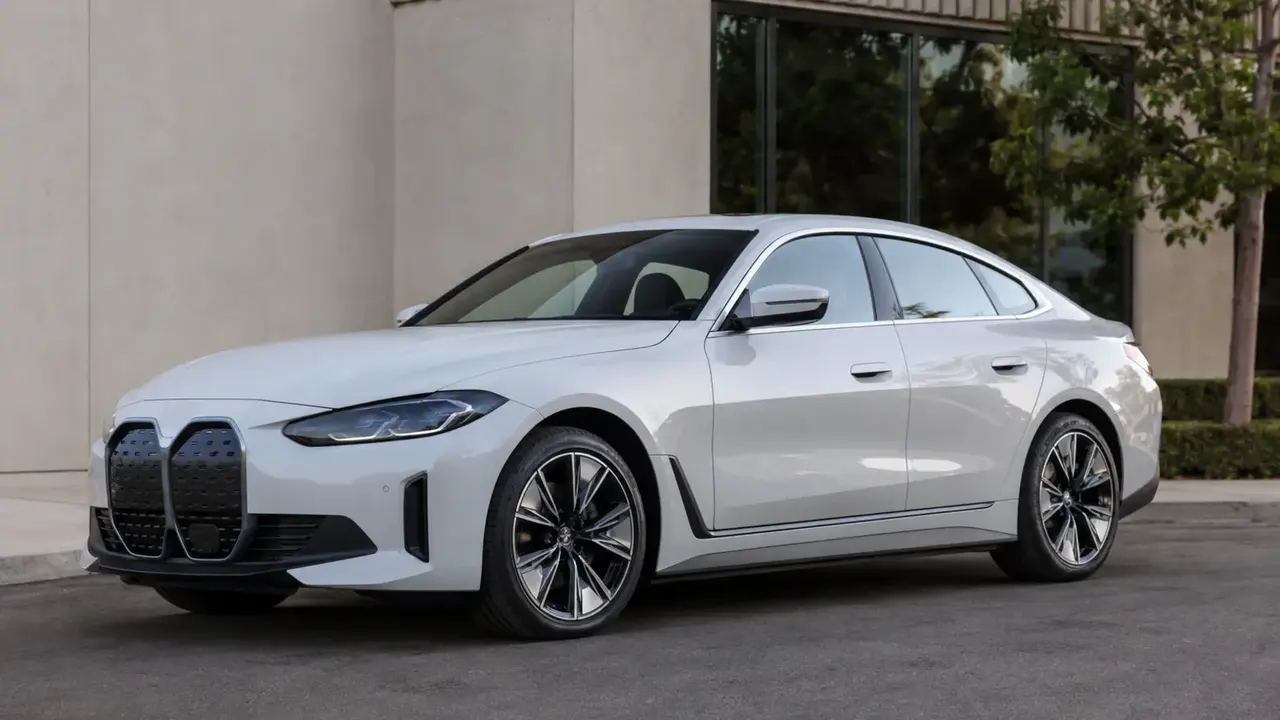
Note: prices mentioned below are US figures given before destination charges unless stated — actual transaction prices vary by dealer, options and local taxes.
Yes, but only against one gas trim: the $61,500 BMW i3 50 xDrive is $4,400 cheaper than the $65,900 M350 xDrive. Compare it with the $49,900 330 or $51,900 330 xDrive, however, and the answer flips because both gas models cost less.
At a glance
| Model | Price (excl. destination) | Powertrain | Range |
|---|---|---|---|
| 2027 BMW i3 50 xDrive | $61,500 ($62,850 with the $1,350 destination fee) | Electric, all-wheel drive, 463 hp | 446-468 miles, BMW estimate on EPA test standards |
| 2027 BMW 330 | $49,900 | 2.0-liter four-cylinder 48-volt mild hybrid, 255 hp, rear-wheel drive | Not published by BMW |
| 2027 BMW 330 xDrive | $51,900 | 2.0-liter four-cylinder 48-volt mild hybrid, 255 hp, all-wheel drive | About 450 miles per tank — TechCrunch estimate, not a BMW figure |
| 2027 BMW M350 xDrive | $65,900 | 3.0-liter inline-six, 437 hp, all-wheel drive | Not published by BMW |
The price comparison has two different answers
BMW's first fully electric 3 Series creates a price comparison that sounds simple until the trim structure is considered. TechCrunch highlighted the most striking pairing: the 2027 BMW i3 50 xDrive costs $61,500 before destination, while the gas-powered M350 xDrive costs $65,900. That makes the EV $4,400 cheaper, a gap TechCrunch calculates at 6.7 percent. The outlet describes the two as similarly powerful, similarly styled and aimed at similar buyers, which makes that comparison more meaningful than placing unrelated EV and combustion models side by side.
But that does not make the electric 3 Series cheaper than the gas 3 Series as a whole. BMW also offers the 2027 330 at $49,900 in rear-wheel-drive form and the 330 xDrive at $51,900. Both are substantially less expensive than the i3 50 xDrive, and TechCrunch notes there is no electric equivalent to those lower-priced trims yet. The correct answer therefore depends entirely on which combustion version is used as the benchmark: the EV undercuts the M350 xDrive, while both 330 versions undercut the EV.
That distinction matters because the 3 Series now provides a relatively unusual chance to compare electric and combustion choices inside one model family. TechCrunch notes that analysts had long expected EVs to become cheaper than comparable gas vehicles somewhere in the second half of the 2020s, with BloombergNEF expecting that crossover in 2026. The BMW example also shows why broad statements remain difficult, and why pricing moves differently from one trim to the next. Even within one nameplate, a price advantage can appear or disappear depending on equipment level and powertrain positioning.
There is another technical wrinkle behind the shared badge. TechCrunch reports that the two closely compared cars do not actually use the same platform. The electric i3 is based on BMW's newest Neue Klasse architecture and technology, while the gas 3 Series uses an extensively overhauled version of an existing platform. So this is a cleaner comparison than matching an unrelated EV against a gas sedan, but it is not a case of BMW simply swapping one propulsion system for another beneath an otherwise identical car.
What the electric BMW i3 actually is on paper
At launch, the sole electric version is the 2027 BMW i3 50 xDrive. Ars Technica reports that it uses all-wheel drive and produces a combined 463 hp, or 345 kW. BMW expects an EPA-standard range of between 446 and 468 miles, although certification is still being completed ahead of the car reaching showrooms in the first quarter of 2027. TechCrunch uses the upper figure of 468 miles for a full charge, while Electrek also reports BMW's 446-to-468-mile estimate.
The range is tied to several major changes beneath the body. Ars Technica says the Neue Klasse car uses a new cylindrical-cell battery pack with a cell-to-body design intended to maximize energy density, along with BMW's sixth-generation motors. Electrek describes the i3 as the second EV on Neue Klasse after the iX3 SUV and says it uses BMW's sixth-generation eDrive system. The electric sedan also gets a frunk, while light replaces chrome in the kidney grille. Cheaper cells are part of the wider story here, and battery costs have fallen a long way since the first i3 wore the badge.
Performance on paper puts the i3 50 xDrive close to the M350 xDrive in output. Its 463 hp exceeds the gas car's 437 hp, and Electrek reports a 0-to-60-mph time of 4.5 seconds. Torque reporting is less settled: Ars Technica lists 467 lb-ft, or 633 Nm, while Electrek gives a combined 476 lb-ft. That discrepancy is worth preserving rather than smoothing over, because the outlets published different numbers for the same launch model.
The cabin introduces several Neue Klasse-era features. Electrek reports a BMW Panoramic Vision display stretching across the width of the windshield, a 17.9-inch central screen running Operating System X and an optional 3D head-up display. BMW has opened US reservations, according to Electrek, with a $1,000 deposit through BMW's website. The outlet says reservations opened a week earlier than expected after strong initial demand, and reports that the i3 has already secured more than 100,000 orders in Europe.
What the gas-powered 330 and M350 are on paper
The lower-priced gas choices begin with the 2027 BMW 330. Ars Technica puts the rear-wheel-drive model at $49,900, which is $1,900 more than the outgoing 2026 version. The 330 xDrive adds all-wheel drive and costs $51,900. Both use the same 2.0-liter four-cylinder engine with a 48-volt mild-hybrid system, rated at 255 hp, or 190 kW, and 295 lb-ft, or 400 Nm, of torque.
Those prices establish why saying the electric 3 Series is simply cheaper than gas would be misleading. Before destination charges are considered, the i3 50 xDrive costs $11,600 more than the rear-wheel-drive 330 and $9,600 more than the 330 xDrive. The EV's headline price advantage exists only against the more powerful M350 xDrive at launch, which is a narrower claim than the one the affordable-EV story is usually built on.
That M350 xDrive sits at $65,900 and uses a 3.0-liter inline-six producing 437 hp, or 326 kW, and 428 lb-ft, or 580 Nm. Ars Technica reports that it is the first inline-six model to be built at BMW's Dingolfing plant in Germany. BMW's M division was involved in its development, and the car can disconnect its front axle to produce rear-drive handling through what Ars Technica describes as a drift moment function.
The M350 also carries the largest price premium among the launch models, according to Ars Technica, which helps explain why its relationship with the i3 looks so different from the cheaper 330s. The electric car is more powerful on the published horsepower figures and starts $4,400 lower before destination, whereas the 330 models trade away substantial output for significantly lower entry prices.
Charging, range and where the i3 price sits against rival EVs
Range is one of the most notable parts of the i3 specification, although BMW's final EPA certification is still pending. BMW expects 446 to 468 miles under EPA testing standards, according to Ars Technica and Electrek. For combustion context, TechCrunch estimates that the all-wheel-drive gas 3 Series is likely to remain around 450 miles per tank, similar to previous models. That roughly 450-mile figure is TechCrunch's estimate, not a BMW-rated range figure.
The i3 also uses an 800-volt electrical architecture. Electrek reports that it can DC fast-charge at up to 400 kW and add between 191 and 208 miles of range in 10 minutes. TechCrunch separately cites BMW as saying the car can replenish 208 miles in that period. Electrek adds that the i3 has a native NACS port, allowing access to Tesla Superchargers without a separate adapter — useful given how much of the US fast-charging picture still depends on which networks are actually being built out.
Bidirectional charging broadens what the battery can do beyond moving the car. Electrek reports support for vehicle-to-load operation through a discharge adapter, as well as vehicle-to-home capability intended to supply a home with power during an outage. Those features sit alongside a projected driving range close to what TechCrunch estimates for an all-wheel-drive gas 3 Series, although charging and liquid refuelling remain fundamentally different processes with different running costs at the plug.
Price also places the BMW in a specific part of the EV market. Electrek reports that the i3 50 xDrive starts at $61,500, the same price as the iX3 SUV, and at $62,850 once BMW's $1,350 destination fee is included. The outlet lists the Tesla Model 3 at $38,630 and the Mercedes-Benz CLA EV at $47,250, making both considerably cheaper on the cited starting prices. That broader comparison reinforces the narrower 3 Series lesson: the i3 can undercut a closely positioned gas BMW without becoming a low-priced EV overall.
The easiest mistake is to say the electric 3 Series is cheaper than the gas 3 Series without naming the trim. The $61,500 i3 50 xDrive undercuts the $65,900 M350 xDrive, but the $49,900 330 and $51,900 330 xDrive both cost less than the EV. All four figures exclude BMW's $1,350 destination fee.
The important numbers that are not final yet
The largest unresolved figure is official EPA range. BMW expects between 446 and 468 miles from the i3 50 xDrive using EPA testing standards, but Ars Technica says the company is still completing certification before the model reaches showrooms in the first quarter of 2027. Until that process is finished, the range should be treated as BMW's estimate rather than a final certified rating.
BMW's electric 3 Series lineup is also set to expand, but prices for those later cars have not been announced. Ars Technica says an i3 M60 xDrive is expected later in 2027, followed by the first fully electric BMW M3, which will use four motors, one for each wheel. Electrek separately reports an i3 60 xDrive arriving in 2027 with M-specific features including a new front light graphic and optional M Yellow lights, and also says pricing has not been announced.
The torque figure for the launch i3 50 xDrive differs between reports as well. Ars Technica gives 467 lb-ft, or 633 Nm, while Electrek publishes 476 lb-ft. Neither outlet resolves the other, so both figures stay attributed to the publication that reported them rather than being presented as one settled specification.
What is clear is the basic launch structure. BMW has opened US order books for a new-generation 3 Series that, for the first time, includes a fully electric version alongside gas models. BMW says the first cars arrive in the first quarter of 2027. The central price story is therefore narrower than a simple EV-versus-gas headline: at $61,500 before destination, the i3 50 xDrive costs less than the $65,900 M350 xDrive, but more than either 330.
Frequently asked questions
Is the 2027 BMW i3 cheaper than the gas 3 Series?
How much range does the 2027 BMW i3 have?
How fast can the BMW i3 charge?
What other electric BMW i3 versions are coming?
Sources & further reading
- Ars Technica, BMW reveals US 3 Series pricing (30 September 2026)
- TechCrunch, BMW built the same car for gas and electric (30 September 2026)
- Electrek, 2027 BMW i3 prices and range (30 September 2026)
Figures, prices and policy details were current at the last-updated date above. Automotive pricing, incentives and regulations change frequently — verify time-sensitive details with the linked primary sources. Read our editorial policy and fact-checking standards.