
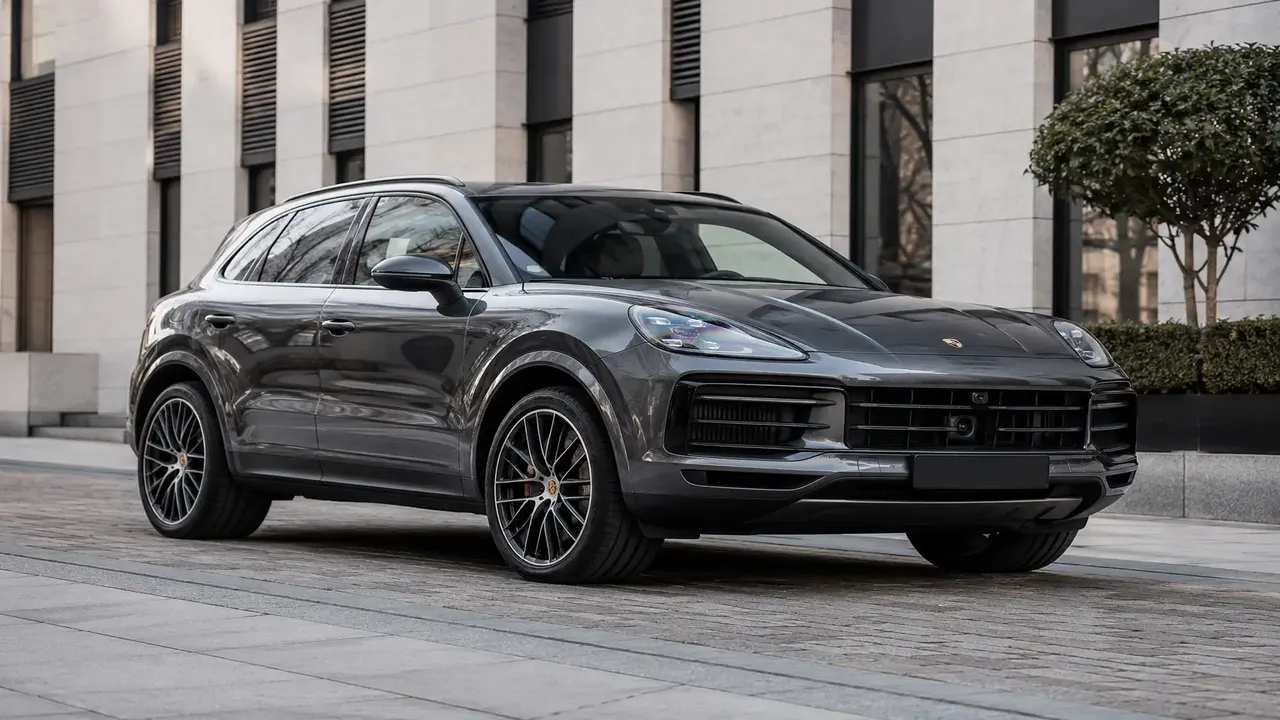


Vehicle Overview
The Cayenne is the SUV that changed what Porsche is. Porsche’s own UK copy dates the idea to “over 20 years ago”, when it asked “if a sports car could celebrate more than the individual”; we have not found a primary Porsche statement of a generation count, so this review does not assert one.
The important change for anyone shopping now is that Porsche Great Britain presents the Cayenne as four families, not two. Alongside the Cayenne and Cayenne Coupé — petrol V6 and V8 cars plus the E-Hybrid plug-in hybrids — there is now a Cayenne Electric and a Cayenne Coupé Electric, a battery-electric line with its own six variants and WLTP ranges of 344 to 413 miles. This review covers the petrol and plug-in hybrid cars; the electric Cayenne is a different vehicle on a different platform and deserves its own assessment rather than a paragraph here.
Competitors include the BMW X5, Mercedes-Benz GLE Coupé, and Range Rover Sport, but few match the Cayenne’s balance of athleticism, craftsmanship, and day-to-day usability.
Key Specifications — the full UK SUV line-up
Every figure in this table is Porsche Great Britain’s own published data, read on 1 October 2026. Prices are the “from” figures including VAT; 0–62 mph times are the ones Porsche quotes with the Sport Chrono Package; economy, CO2 and electric range are the WLTP spans across each model range, so they move with wheels and options.
| Variant | From (inc. VAT) | Power | 0–62 mph | Top speed | Economy (WLTP) | CO2 |
|---|---|---|---|---|---|---|
| Cayenne (petrol V6) | £78,300 | 260 kW / 353 PS | 5.7 s | 154 mph | 24.1–26.4 mpg | 266–243 g/km |
| Cayenne E-Hybrid | £87,100 | 346 kW / 470 PS combined | 4.9 s | 158 mph | 63.8–71.8 mpg weighted · 43–52 mi electric | 101–90 g/km weighted |
| Cayenne S (biturbo V8) | £93,800 | 349 kW / 474 PS | 4.7 s | 170 mph | 22.4–23.6 mpg | 286–271 g/km |
| Cayenne S E-Hybrid | £96,000 | 382 kW / 519 PS combined | 4.7 s | 163 mph | 62.6–71.4 mpg weighted · 44–52 mi electric | 103–90 g/km weighted |
| Cayenne GTS | £108,300 | 368 kW / 500 PS | 4.4 s | 171 mph | 22.3–23.3 mpg | 289–277 g/km |
| Cayenne Turbo E-Hybrid | £141,900 | 544 kW / 739 PS combined | 3.7 s | 183 mph | 53.9–59.4 mpg weighted · 42–48 mi electric | 119–108 g/km weighted |
The Coupé bodies track the SUV closely on paper — Porsche quotes 24.2–26.3 mpg and 265–243 g/km for the Cayenne Coupé, 22.3–23.5 mpg for the S Coupé, 22.3–23.3 mpg for the GTS Coupé and 53.6–59.0 mpg with 42–48 miles of electric range for the Turbo E-Hybrid Coupé. The Turbo E-Hybrid Coupé with the GT Package is quoted separately at 55.5–57.4 mpg and 116–112 g/km.
Two figures an earlier version of this page carried were simply wrong and have been corrected against Porsche’s data: the Turbo E-Hybrid’s combined economy is 53.9–59.4 mpg, not “up to 188 mpg”, and its electric range is 42–48 miles, not “up to 46 miles” as a single number. Its combined output is 544 kW, not 550 kW.
Exterior Design
The 2025 Porsche Cayenne refines its sporty, elegant design language with subtle yet effective updates. A new bonnet and front wings, reshaped LED Matrix HD headlights, and 3D taillight bar modernize its appearance while preserving its unmistakable Porsche DNA.
Design highlights include
Revised front bumper with larger intakes
New LED matrix headlights (standard on all trims)
Sculpted bonnet and muscular fenders
Adaptive rear spoiler (Coupé)
Wheel options up to 22 inches
In SUV form, it exudes presence and prestige; in Coupé form, it’s more dynamic and performance-oriented. Both radiate premium craftsmanship and attention to detail.
Interior, Comfort & Materials
Inside, the Cayenne’s cabin is a showcase of Porsche’s new Driver Experience concept — merging luxury with cutting-edge digitalization.
Key interior features
12.6-inch curved digital driver display
12.3-inch central touchscreen (Porsche Communication Management)
Optional 10.9-inch passenger display
| Premium materials | leather, aluminium, and natural wood or carbon-fibre trims |
Heated, ventilated, and massaging seats
Panoramic glass roof
Four-zone climate control
Build quality is exceptional, and ergonomics are pure Porsche — everything within easy reach, focused on the driver. The cabin feels both athletic and luxurious, suitable for long-distance touring or spirited drives.
Features & Infotainment
The latest Cayenne infotainment suite combines intuitive operation with cutting-edge technology.
12.3-inch HD touchscreen (PCM) with Google® integration
Apple CarPlay & Android Auto (wireless)
Integrated Spotify, Apple Music, and Google Maps
Burmester or Bose surround sound systems
Head-up display (HUD)
Wireless charging pad & multiple USB-C ports
OTA (over-the-air) software updates
The optional passenger screen allows media and navigation input without distracting the driver, enhancing the luxury experience.
Safety & Ratings
The Porsche Cayenne offers advanced safety and driver assistance technologies, delivering both security and confidence.
Standard and optional features include
Adaptive Cruise Control with Stop & Go
Lane Keep and Lane Change Assist
Traffic Jam Assist
Night Vision Assist
Park Assist with 3D Surround View
Cross Traffic Alert
Collision and Brake Assist
Porsche InnoDrive semi-autonomous system
Crash test ratings: the petrol and hybrid Cayenne has no current one
This is worth stating plainly, because it is easy to find a five-star Cayenne headline that does not apply to the car in this review. Euro NCAP holds two Cayenne records:
| Euro NCAP record | Result | Status | What it covers |
|---|---|---|---|
| Porsche Cayenne, 2017 | ★★★★★ — adult 95%, child 80%, vulnerable road users 73%, safety assist 62% | Expired 1 January 2024 | Tested car a Cayenne 3.0 diesel, left-hand drive, 2,169 kg. Applied to the 3.0 petrol, 2.9 petrol (S), 4.0 petrol (Turbo) and 3.0 diesel — engines that include a diesel Porsche GB no longer offers. |
| Porsche Cayenne Electric, 2025 | ★★★★★ — adult 91%, child 89%, vulnerable road users 81%, safety assist 79% | Current, published 10 December 2025 | Tested car a Cayenne Electric, left-hand drive, 2,512 kg. Applied to the Cayenne Electric, Cayenne S Electric and Cayenne Turbo Electric only. |
So the five-star 2025 result belongs to the battery-electric Cayenne and does not transfer to the petrol or plug-in hybrid cars, whose own 2017 rating expired at the start of 2024. Expiry is not a downgrade and is not evidence that the car became less safe — it means there is no result for these variants that can be set against anything assessed under the current protocols. Judge them on the standard assistance equipment above, and check which of it is standard on the trim you are actually quoted.
Driving Performance
Performance has always been the Cayenne’s hallmark. Even the base models deliver engaging dynamics, while the Turbo E-Hybrid pushes the boundaries of what an SUV can achieve.
| Cayenne (petrol V6) | 260 kW / 353 PS · 0–62 mph in 5.7 s · 154 mph |
| Cayenne E-Hybrid | 346 kW / 470 PS combined · 4.9 s · 158 mph |
| Cayenne S (4.0-litre biturbo V8, 600 Nm) | 349 kW / 474 PS · 4.7 s · 170 mph |
| Cayenne S E-Hybrid (3.0 V6 turbo + 130 kW / 176 PS motor) | 382 kW / 519 PS combined · 4.7 s · 163 mph |
| Cayenne GTS | 368 kW / 500 PS · 4.4 s · 171 mph |
| Cayenne Turbo E-Hybrid | 544 kW / 739 PS combined · 3.7 s · 183 mph |
Porsche GB lists Porsche Active Suspension Management as standard on every Cayenne, with the enhanced adaptive air suspension using two-chamber air-spring struts, Porsche Dynamic Chassis Control for active roll stabilisation and rear-axle steering among the chassis options; the Cayenne and Cayenne S get six-piston front and four-piston rear aluminium monobloc fixed callipers. Thanks to that hardware the Cayenne corners like a much smaller car. Ride comfort is outstanding, and noise isolation is superb — making it equally capable as a grand tourer and performance SUV.
Efficiency / Hybrid Range
| Cayenne E-Hybrid | 43–52 miles electric (WLTP) · 63.8–71.8 mpg weighted · 101–90 g/km |
| Cayenne S E-Hybrid | 44–52 miles electric · 62.6–71.4 mpg weighted · 103–90 g/km |
| Cayenne Turbo E-Hybrid | 42–48 miles electric · 53.9–59.4 mpg weighted · 119–108 g/km |
| Battery | Lithium-ion, 25.9 kWh energy content |
Charging
Porsche GB describes two ways to put charge back into an E-Hybrid: “in E-Charge mode using the combustion engine or the high-performance AC charging process”. AC only — no DC rapid charging is published for these cars, so a hybrid Cayenne cannot use a motorway rapid charger the way an electric one can. Porsche GB’s model pages do not state the maximum AC rate or a 0–100% time, so no figure is quoted here; an earlier version of this page claimed 11 kW and 2.5 hours, which we could not substantiate. Ask the centre for the charger rating on the exact car.
The spread matters more than the headline on a plug-in hybrid: those weighted mpg figures assume you start full, and a Turbo E-Hybrid run with a flat battery will not see 53.9 mpg, let alone the 188 mpg this page once claimed.
Electric mode covers most daily commutes, while the hybrid system optimises performance and fuel efficiency seamlessly on long drives.
Practicality & Everyday Usability
Despite its performance credentials, the Cayenne remains one of the most practical luxury SUVs on the road:
| Boot space | 627 L (SUV) / 545 L (Coupé) |
Folding rear seats (40:20:40) expand cargo to 1,600+ L
Comfortable five-passenger seating
| Towing capacity | 3,500 kg (braked trailer) |
Ample storage and intuitive cabin layout
The high driving position, large windows, and advanced driver aids make city driving effortless despite its size.
Warranty & Maintenance
| New Car Guarantee | Three years, unlimited mileage, valid worldwide against manufacturing defects |
| Roadside cover | Three years Porsche Assistance |
| High-voltage battery | Porsche GB publishes an 8-year / 100,000-mile HV battery guarantee, with 80% of original net capacity guaranteed to 3 years / 38,000 miles and at least 70% to the end of the term — but that document is titled for battery electric vehicles. Confirm the E-Hybrid’s HV battery terms with a Porsche Centre rather than assuming the BEV figures apply. |
| Service intervals | Not published on the Porsche GB pages read for this review — confirm with the centre |
Porsche offers extended warranties and prepaid maintenance plans beyond the New Car Guarantee. The three-year unlimited-mileage term is unusually useful if you cover big distances: an Audi Q8 or a Mercedes GLE caps its equivalent cover at 60,000 miles.
Price & Value for Money
| Trim | Powertrain | Body Style | Starting Price (UK) |
|---|---|---|---|
| Cayenne | Petrol V6, 353 PS | SUV | £78,300 |
| Cayenne E-Hybrid | V6 plug-in hybrid, 470 PS | SUV | £87,100 |
| Cayenne S | Biturbo V8, 474 PS | SUV | £93,800 |
| Cayenne S E-Hybrid | V6 plug-in hybrid, 519 PS | SUV | £96,000 |
| Cayenne GTS | Petrol V8, 500 PS | SUV | £108,300 |
| Cayenne Turbo E-Hybrid | V8 plug-in hybrid, 739 PS | SUV | £141,900 |
These are Porsche Great Britain’s own “from” prices including VAT, read on 1 October 2026, and they are materially different from the figures this page used to carry: the Cayenne S is £93,800 rather than “~£84,000”, the Turbo E-Hybrid £141,900 rather than “~£130,000”, and the E-Hybrid is cheaper than the S rather than dearer. The range also includes two variants the page previously omitted entirely — the S E-Hybrid and the GTS. Coupé bodies and the Black Edition trims are priced separately again, and Porsche’s options list is famously capable of adding five figures, so treat every number here as the floor.
UK road tax: £4,400-plus separates a hybrid Cayenne from a petrol one
First-year VED is charged on CO2, and the Cayenne is sold as both a 243–289 g/km petrol and a 90–119 g/km plug-in hybrid. Applying the GOV.UK rate tables for cars registered on or after 1 April 2017 to Porsche’s published CO2 spans:
| Variant | CO2 (Porsche GB) | First-year VED |
|---|---|---|
| Cayenne E-Hybrid | 90–101 g/km | £365–£405 |
| Cayenne S E-Hybrid | 90–103 g/km | £365–£405 |
| Cayenne Turbo E-Hybrid | 108–119 g/km | £405–£455 |
| Cayenne (petrol V6) | 243–266 g/km | £4,850–£5,690 |
| Cayenne S | 271–286 g/km | £5,690 |
| Cayenne GTS | 277–289 g/km | £5,690 |
The spans are wide because Porsche publishes CO2 across each model range rather than per build, so wheels and options can push a car over a band boundary — the plain Cayenne straddles the 255 g/km line and can land on either £4,850 or £5,690. Even at the most favourable reading, choosing an E-Hybrid over the petrol V6 saves roughly £4,400 to £5,300 in the first year alone, and the Turbo E-Hybrid is taxed less heavily in year one than the entry-level petrol. That is the single largest running-cost lever in the range, and it is worth more than most of the option packs cost.
After that first licence the picture flattens: every Cayenne lists far above £40,000, so each one pays the £200 standard rate plus the £440 additional rate — £640 a year for five years — whichever engine you chose. Our guide to the April 2026 VED changes covers how these bands moved, and the road tax, MOT and insurance connection explains how the renewals line up.
Comparison with Rivals
| Model | Powertrain | Electric range / economy / CO2 | 0–62 mph | Price |
|---|---|---|---|---|
| Porsche Cayenne Turbo E-Hybrid | V8 plug-in hybrid, 739 PS | 42–48 mi · 53.9–59.4 mpg · 119–108 g/km | 3.7 s | £141,900 (Porsche GB) |
| BMW X5 xDrive50e | Six-cylinder plug-in hybrid, 483 bhp | 65 mi · 313.9 mpg · 20 g/km | 4.8 s | Not quoted in the review read |
| Mercedes-AMG GLE 53 HYBRID 4MATIC+ Coupé | V6 plug-in hybrid, 585 hp system output | 55 mi · 72.5 mpg · 88 g/km | 4.5 s | Coupé range £79,995–£97,495 RRP (Carwow) |
| Range Rover Sport P550e | Six-cylinder plug-in hybrid, 533 bhp | 71.5 mi · 251.9 mpg · 18 g/km | 4.8 s | From £92,000 in P460e SE form |
Cayenne figures are Porsche GB’s; the GLE 53 HYBRID’s are Mercedes-Benz UK’s own technical data; the X5 and Range Rover Sport come from Auto Express reviews dated 5 March 2026 and 27 April 2026. The rival row this page used to carry — “Mercedes GLE 53 Hybrid, I6 mild-hybrid, 32 mpg, 5.0s” — was wrong on every count: Mercedes-Benz UK publishes the AMG GLE 53 HYBRID as a plug-in hybrid doing 72.5 mpg and 4.5 seconds. Read the table as four manufacturers’ own test figures rather than a like-for-like contest, and note what it shows: on paper the Cayenne is the quickest and comfortably the thirstiest plug-in hybrid here, with the shortest electric range. Its case has always rested on how it drives rather than on its WLTP numbers. If you want the same money spent on a petrol coupé-SUV instead, the Audi Q8 and BMW X6 are the obvious comparisons.
Pros & Cons
Pros
- Benchmark driving dynamics for a luxury SUV
- High-quality, driver-focused interior
- Improved hybrid range and efficiency
- Exceptional comfort and refinement
- Wide range of powerful engines
Cons
- Expensive optional extras
- The plug-in hybrids have the shortest electric range and the weakest weighted economy of the four rivals in the table above
- AC-only charging on the E-Hybrids — no DC rapid charging
- No current Euro NCAP rating for the petrol or hybrid cars; the 2017 result expired on 1 January 2024
| Overall rating | ★★★★★ (4.8 / 5) |
True Motion Auto has not independently road-tested this vehicle. Specifications, pricing and performance figures are compiled from manufacturer technical data and published independent tests, and are attributed where quoted. Our score reflects a structured research assessment of specifications, pricing, safety data and owner feedback for the segment — not an independent road test. Read how we review cars.
Final Verdict
The Cayenne is still the driver’s choice in a class full of competent, slightly anonymous large SUVs, and the chassis hardware Porsche fits as standard is the reason. What the spec sheet adds is a clearer financial argument than the brochure makes: the E-Hybrid is both cheaper to buy than the Cayenne S and thousands cheaper to tax in year one than any of the petrols, and it is the version most UK buyers should look at first.
More Porsche reviews: Porsche Macan Review, Porsche Panamera Review and Porsche Taycan Review.
Three caveats to weigh against that. There is no current Euro NCAP rating for the petrol or plug-in hybrid Cayenne. The E-Hybrids charge on AC only, which makes them a driveway car rather than a rapid-charger car. And Porsche GB now sells a battery-electric Cayenne alongside this one, with 344–413 miles of WLTP range and a current five-star Euro NCAP result of its own — which is worth knowing before you commit to the combustion car. We have reviewed it separately in our 2026 Porsche Cayenne Electric review, and set its headline numbers against the class in Porsche Cayenne EV performance figures compared.
| Who it’s for | Buyers who will genuinely use the chassis, and who can charge at home — which is what makes the E-Hybrid add up rather than just the Turbo. |
Buyer checkpoints
| Buyer checkpoint | True Motion Auto view |
|---|---|
| Best for | Drivers who want sports-car responses from a large SUV and will notice what the air suspension, PDCC and rear-axle steering do. |
| Body style | Five-seat SUV or Coupé. Porsche GB also sells a separate battery-electric Cayenne and Cayenne Coupé Electric — six variants, 344–413 miles WLTP. |
| Powertrain focus | Petrol V6 and V8, plus three plug-in hybrids (470, 519 and 739 PS). No diesel — Porsche GB lists none, despite a diesel being the car Euro NCAP crashed in 2017. |
| Price the tax first | First-year VED is £365–£455 on an E-Hybrid against £4,850–£5,690 on a petrol. Every Cayenne then pays £640 a year for five years because they all list above £40,000. |
| Can you charge at home? | If not, skip the E-Hybrid. The 25.9 kWh battery takes AC only, no DC rapid charging, and the weighted mpg figures assume you start full. |
| Check the warranty maths | Three years but unlimited mileage, which beats the 60,000-mile caps at Audi and Mercedes if you cover big distances. Ask specifically about the plug-in hybrid’s high-voltage battery cover. |
| Safety, honestly | No current Euro NCAP rating on these variants. The 2025 five-star result is the electric Cayenne’s and does not carry over. |
Frequently asked questions
How far does a Porsche Cayenne E-Hybrid go on electric power?
Is the Porsche Cayenne really capable of 188 mpg?
Does the Porsche Cayenne have a five-star Euro NCAP rating?
Can you rapid-charge a Cayenne E-Hybrid at a motorway charger?
How much is road tax on a Porsche Cayenne?
Is there an electric Porsche Cayenne?
Sources
All pages below were read on 1 October 2026 and every figure in this review is taken from one of them.
- Porsche Great Britain — Cayenne model range page and the Cayenne, Cayenne E-Hybrid, Cayenne S, Cayenne S E-Hybrid, Cayenne GTS and Cayenne Turbo E-Hybrid model pages (prices from, kW/PS, 0–62 mph, top speed, WLTP economy, CO2, electric range, battery energy content, charging method, chassis and brake specification)
- Porsche Great Britain — Cayenne Electric and Cayenne Coupé Electric WLTP range data
- Porsche GB warranty pages and the Porsche New Vehicle Warranty (Battery Electric Vehicles) conditions document
- Euro NCAP — Porsche Cayenne 2017 assessment (five stars; expired 1 January 2024; tested car and variant list) and the Porsche Cayenne Electric 2025 assessment (five stars; published 10 December 2025; variant list)
- Mercedes-Benz UK — Mercedes-AMG GLE Coupé technical data (GLE 53 HYBRID system output, economy, CO2, electric range, 0–62 mph)
- Auto Express — BMW X5 review, 5 March 2026, Alastair Crooks and Shane Wilkinson
- Auto Express — Range Rover Sport review, 27 April 2026, Shane Wilkinson and Max Adams
- Carwow — Mercedes-Benz GLE Coupe RRP range
- GOV.UK — vehicle tax rate tables (first-licence bands, £200 standard rate, £440 additional rate over £40,000)
Change log. 1 October 2026 — material data correction against the sources above. Corrected the Turbo E-Hybrid’s combined economy from “up to 188 mpg” to Porsche’s 53.9–59.4 mpg, its electric range from “up to 46 miles” to 42–48 miles and its combined output from 550 kW to 544 kW; replaced all four starting prices with Porsche GB’s current figures (the Cayenne S was understated by about £10,000 and the Turbo E-Hybrid by about £12,000) and added the S E-Hybrid and GTS, which were missing; replaced the wholly incorrect “Mercedes GLE 53 Hybrid, I6 mild-hybrid, 32 mpg, 5.0s” rival row and refreshed the X5 and Range Rover Sport rows against dated reviews; added an honest Euro NCAP section recording that the 2017 rating expired on 1 January 2024 and that the current five-star result belongs to the separate Cayenne Electric; removed the “no full EV version (yet)” con, which is no longer true; removed unsubstantiated AC charging figures (11 kW / 2.5 hours); qualified the high-voltage battery warranty, whose published terms are documented for battery-electric cars; added a per-variant road-tax section; removed a dead promotional block offering “2025 finance, lease, and insurance offers”; removed an unsourced “(2002–)” generation claim from the headline and byline.
Specifications, prices and equipment were current at publication and vary by model year, trim and market. Verify final details with a franchised dealer before ordering. Read how we review cars and our editorial policy.