The rule change that simplified everything (and the rules it didn't touch)
Since 16 December 2021, every full category B (car) licence holder may tow a trailer up to 3,500 kg Maximum Authorised Mass (MAM) — the BE entitlement was added to licences automatically, ending the post-1997 two-tier system and the separate towing test. One clean national rule.
What the change did not do: repeal the physics, the weight plates, the speed limits or the equipment law that actually govern whether your specific car, trailer and load are legal on Tuesday. That's where towing law really lives.
The weights that decide legality
Four numbers, all on plates or in the V5C/handbook:
- Your car's Gross Train Weight (GTW): the maximum legal weight of car-plus-trailer-plus-everything, on the manufacturer's plate. Exceed it and you're overloaded regardless of licence.
- The car's towing limit (braked/unbraked, handbook figure): often far below 3,500 kg — a typical family hatchback rates 1,200–1,800 kg braked.
- The trailer's MAM and actual laden weight — public weighbridges settle arguments; roadside DVSA checks carry scales.
- Unbraked trailers: capped at 750 kg MAM and no more than half the car's kerbweight — the small-trailer rule most gardeners break unknowingly.
And the guideline that isn't law but decides outcomes: the caravan industry's 85% rule — a laden trailer at or under 85% of the tow car's kerbweight is the stable envelope for non-expert towers. Legal up to 100%+ within plated limits; wise, rarely.
The rules of the road, towing edition
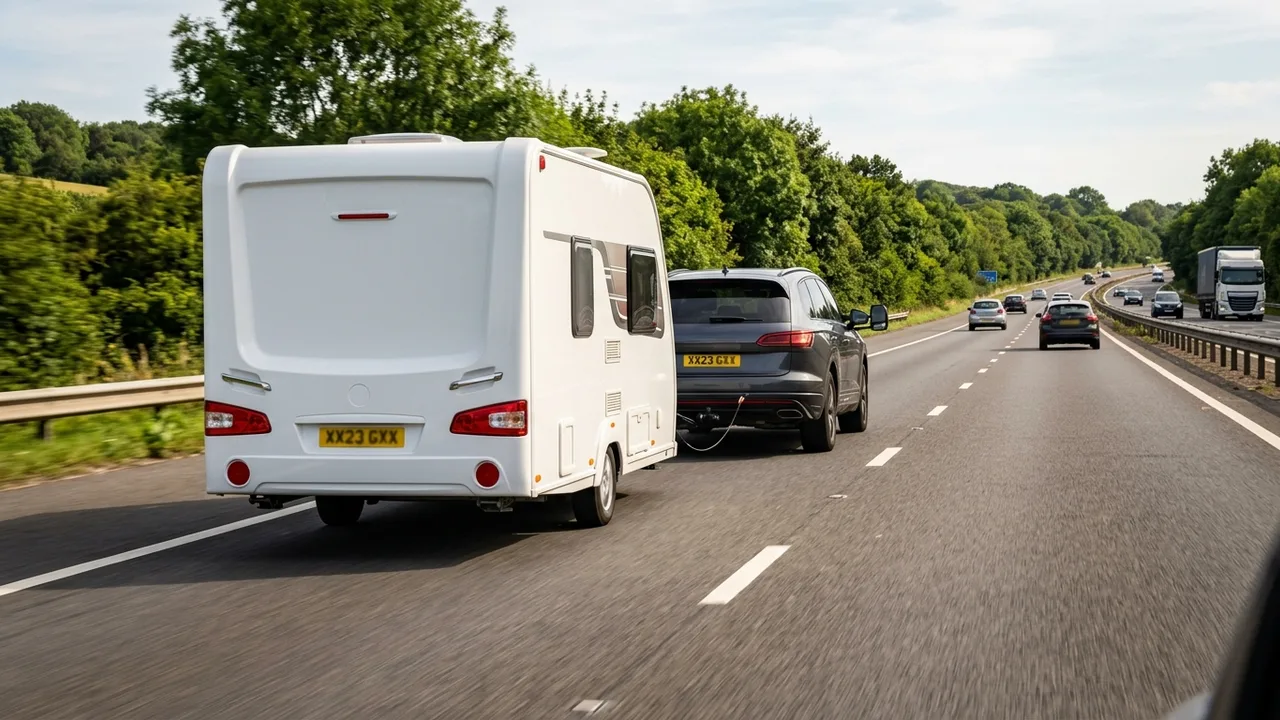
- Speed limits drop: 50 mph on single carriageways, 60 mph on dual carriageways and motorways — and the right-hand lane of a three-plus-lane motorway is prohibited while towing.
- Extended mirrors are mandatory when the trailer is wider than the car's rear view — towing a caravan on standard mirrors is one of the most-issued towing fixed penalties.
- A breakaway cable (or secondary coupling for unbraked trailers) must be correctly attached — clipped to a designated point, not looped over the towball where design forbids it.
- Number plate matching the car, lit, and functioning trailer lights — the pre-departure walk-around is a legal event, not fussiness.
- A-frames and dollies towing cars count as trailers with their own compliance headaches; recovery exemptions are narrower than forums claim.
- Nose weight (typically 5–7% of trailer weight, within the car's towbar limit) is the stability setting: too little produces the motorway snake, too much overloads the rear axle.
Loading and the art of not snaking
Heavy items over the axle(s), low; nothing heavy at the extreme rear; secure everything against shift. If a snake begins: off the accelerator, straight steering, no braking, let it damp out — and treat the event as data that your load or nose weight is wrong. Stabiliser hitches help; correct loading prevents.
The questions towers actually ask
Did the 2021 change apply to motorhomes or heavier combinations? It added B+E (car + 3,500 kg trailer). Combinations beyond that — heavier trailers behind heavier vehicles — still need C1E and upward with tests. Motorhome driving itself follows vehicle weight (B to 3,500 kg, C1 above).
Do I need towing insurance? Your car policy must note the towbar (a modification) and typically covers third-party risks while towing a compliant trailer — but damage to the trailer/caravan itself needs its own policy. Confirm both before the first trip.
Are trailer MOTs a thing? Standard small trailers and caravans have no MOT — which is why DVSA roadside checks target them, and why the annual service (brakes, bearings, tyres — age kills caravan tyres before tread does) is on you.
Electric cars and towing — anything special? Check the type approval: some EVs carry a zero towing rating and may not legally tow at all, while tow-rated EVs often allow less than combustion equivalents. Range drops sharply with a caravan behind — plan charging stops at half your usual interval, and note that many public charge bays can't accommodate car-plus-trailer without unhitching.
Key takeaways
- All full car licences now carry 3,500 kg trailer entitlement — but car tow limits and GTW plates still rule
- Unbraked trailers: 750 kg max and half the car's kerbweight; the 85% guideline is the stability sweet spot
- Towing speed limits are 50/60, right lane prohibited, extended mirrors and breakaway cables mandatory
- Load heavy-over-axle with correct nose weight; respond to snaking by decelerating, not braking
- The trailer needs its own damage insurance, and no MOT means the maintenance duty is entirely yours
Sources & further reading
- DVLA licence-entitlement changes (Dec 2021)
- Highway Code towing rules and speed-limit schedule
- DVSA trailer roadside-check guidance
- caravan-industry weight-matching guidance, 2026
Figures, prices and policy details were current at the last-updated date above. Automotive pricing, incentives and regulations change frequently — verify time-sensitive details with the linked primary sources. Read our editorial policy and fact-checking standards.