The other diesel tank
If your diesel was registered from around 2016 onward, it almost certainly has a second filler neck — usually a blue cap beside the fuel filler or under the boot floor. That is the AdBlue tank, and misunderstanding it has stranded more modern diesels than empty fuel tanks have.
AdBlue is not a fuel additive and never goes in the fuel tank. It is a precisely mixed solution of 32.5% high-purity urea in de-ionised water, injected into the exhaust — not the engine — where it converts nitrogen oxides (NOx) into harmless nitrogen and water vapour inside the SCR catalyst. It exists because Euro 6 emissions limits made big NOx cuts mandatory, and selective catalytic reduction is the technology that delivered them.
Consumption: what to actually expect
AdBlue use scales with fuel use — typically around a litre every 350 to 600 miles depending on the car, your load and your right foot. In practice:
- A typical 10–20 litre tank needs topping up every 3,000 to 8,000 miles
- Gentle motorway cruising sips it; towing and hard driving drink it
- Many drivers only ever encounter it between services on higher-mileage cars — dealers top it up at service
The dashboard gives generous notice: a first warning typically appears around 1,500 miles of range remaining, then counts down insistently.
The one rule that matters: never run it dry
This is the detail that catches owners out. Emissions law requires the car to enforce AdBlue use, so the countdown is not advisory:
- While driving on an empty AdBlue tank, the car keeps running.
- Once you switch off with the tank empty, the engine will not restart. Not "runs badly" — will not start, by design, until AdBlue is added (often a minimum of 3–5 litres before the system resets).
An empty AdBlue tank on a driveway is an inconvenience. In an airport car park after a fortnight away, it is a recovery truck.
Topping up yourself — and what it costs
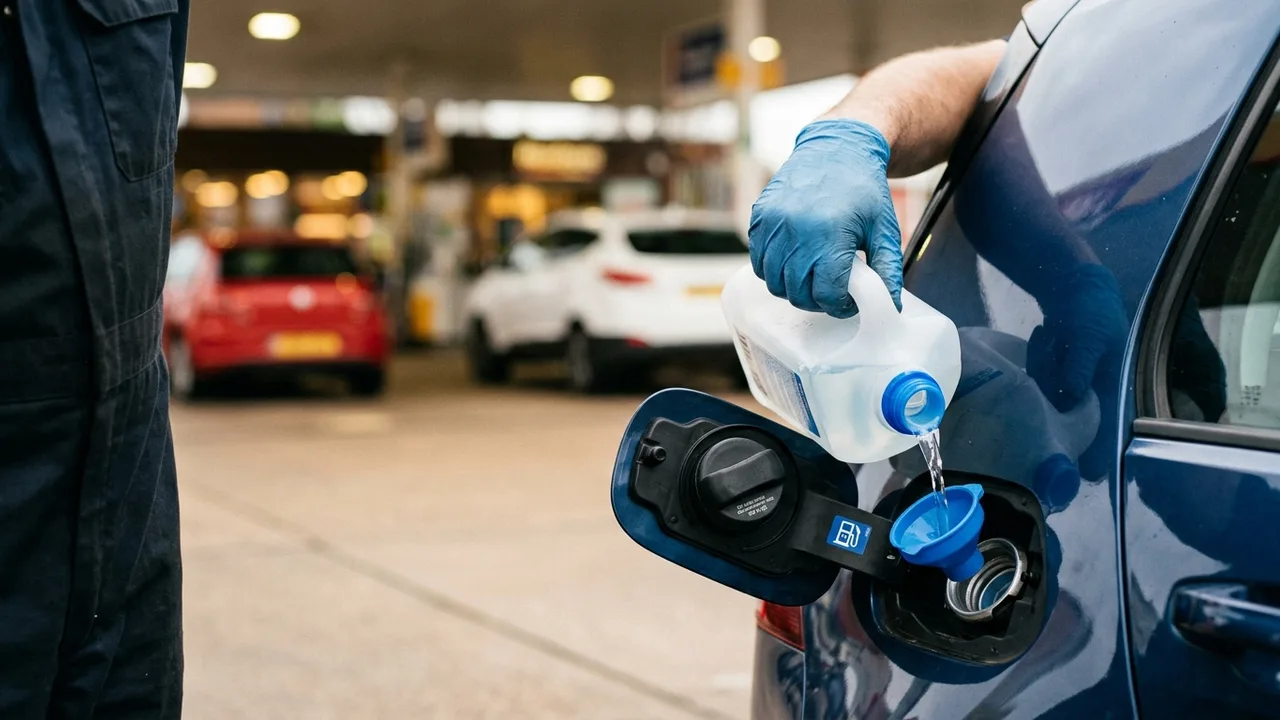
Topping up is a windscreen-washer-grade job: unscrew the blue cap, pour, done.
- Ten-litre containers with pouring spouts from supermarkets, filling stations and motor factors: typically £10–£15 — the sensible option
- Forecourt AdBlue pumps at HGV lanes: cheapest per litre, awkward access for cars
- Small 1.5–5 litre emergency bottles: proportionally expensive; fine in the boot for insurance
- Dealer top-ups billed at service: convenient, frequently the priciest per litre
Buy product certified to ISO 22241 — that is the entire quality question. Brand is irrelevant; certification is not.
The mistakes that get expensive
- AdBlue into the fuel tank. Urea solution in diesel corrodes the fuel system; do not start the engine — drain is the only fix and the bill runs to four figures.
- Diesel into the AdBlue tank. Contaminates the SCR system; pumps and injectors are sensitive and replacement is costly.
- Water or "home-brew" dilution. The 32.5% concentration and purity are the point. Contamination can poison the SCR catalyst — a £1,000–£3,000 component.
- Storing it for years in the shed. AdBlue degrades with heat and time (roughly a one-year shelf life stored cool); stale fluid triggers quality warnings.
- Ignoring crystallised deposits. White crusting around the filler or injector is normal in small amounts; heavy build-up merits a garage look at the dosing system.
When it isn't the fluid
Persistent AdBlue warnings with a full tank usually mean a system fault: the NOx sensor, level sender, heater (the fluid freezes at −11°C, so tanks are heated) or dosing injector. These are garage jobs, and NOx sensors in particular are a known wear item on many diesels — commonly £200–£500 fitted. Budget for one somewhere in a long ownership.
The questions owners actually ask
Does AdBlue expire in the car's tank? In normal use, no — you'll consume it long before it degrades. The shelf-life caution applies to half-used containers stored in hot garages; buy sizes you'll use within a season.
Can I drive harder to use less AdBlue? The opposite: dosing rises with load and NOx production, so towing and enthusiastic driving drink more, not less. Gentle cruising is the low-AdBlue driving style — though the difference is pennies per hundred miles either way.
My car says "AdBlue range 0" but the tank is full — now what? That's a system fault, not a fluid request: usually the NOx sensor, level sender or heater. Don't keep pouring; book the diagnostic. And if a restart-block has already latched, some cars need a dealer tool reset even after the fault is fixed — budget the visit rather than fighting it on the driveway.
Key takeaways
- AdBlue is exhaust treatment, not a fuel additive — it has its own tank and its own filler
- Expect a top-up every 3,000–8,000 miles; a 10-litre supermarket container for £10–£15 does the job
- Heed the countdown: once switched off with an empty tank, the car will not restart until refilled
- Only ever use ISO 22241-certified fluid, and never let diesel and AdBlue cross-contaminate
- Persistent warnings with a full tank mean sensors or dosing faults — a garage visit, not more fluid
Sources & further reading
- ISO 22241 AdBlue specification
- Euro 6 SCR emissions requirements
- UK retail AdBlue pricing sampled July 2026
- manufacturer owner-handbook consumption data across major diesel platforms
Figures, prices and policy details were current at the last-updated date above. Automotive pricing, incentives and regulations change frequently — verify time-sensitive details against the primary sources listed below. Read our editorial policy and fact-checking standards.