America's politest intersection, decoded
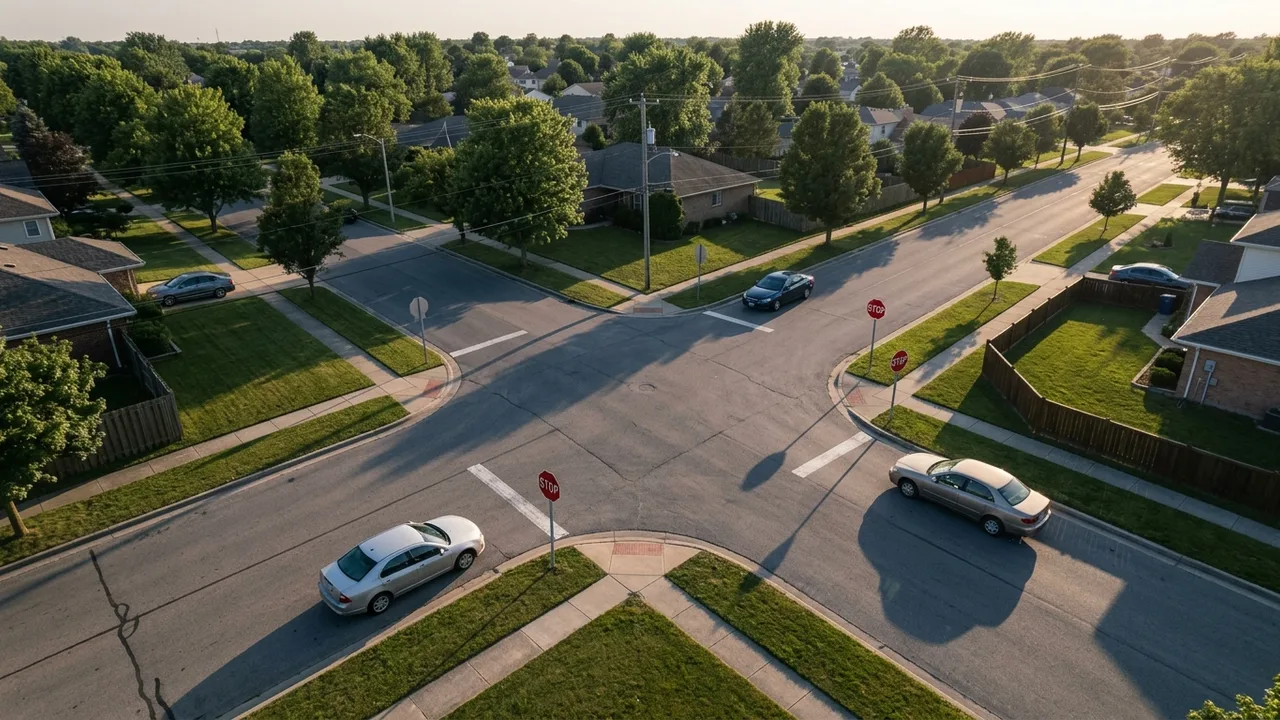
The all-way stop is a uniquely American institution: no signals, no priority road — just four stop signs and a shared understanding. When the understanding holds, it moves traffic with surprising efficiency. When it doesn't, it produces the hesitant stand-offs and simultaneous lurches every driver has witnessed. The rules are simpler than the folklore.
The three rules, in order
1. First to arrive, first to go. Order of arrival is the master rule. Each vehicle proceeds in the sequence it stopped. "Arrival" means reaching a complete stop at the line — not approaching fastest.
2. Tie goes to the right. When two vehicles stop simultaneously, the driver on the right proceeds first. This is the same yield-to-the-right principle that governs uncontrolled intersections, applied as the tie-breaker.
3. Straight before turns, only as the final tie-breaker. When two vehicles face each other simultaneously and one is turning left, the through vehicle goes first; the left-turner yields — exactly as at a green light. (Two opposite vehicles both going straight, or both turning right, can proceed together.)
That's the entire legal structure. Four simultaneous arrivals — the true stand-off — has no statutory answer; convention says the interaction resolves by eye contact and one decisive (not aggressive) driver breaking the symmetry, typically working rightward from whoever moves first.
The behaviors that break it
- The wave. Yielding your legal turn feels courteous and creates ambiguity: the waved driver hesitates, a third driver reads the gap as theirs, and the collision that follows is legally murky. Predictability is the courtesy — take your turn.
- The rolling stop. Arrival order can't function if arrivals aren't discrete events. The drifting stop is both the most ticketed offense at these intersections and the root of most disputes about who was "first."
- The assertive guesser. Accelerating to beat another car to the line doesn't purchase priority — arrival is measured at the stop, and aggressive arrival usually just manufactures a simultaneous one you now tie-break from the left.
- Pedestrians outrank everyone. Crosswalks at all-way stops belong to walkers before any vehicle sequence begins.
Cyclists, and the states doing it differently
Bicycles at a stop-controlled intersection are vehicles: same arrival order, same tie-breaks. A growing list of states (following Idaho's lead) allow cyclists to treat stop signs as yields — legally rolling through when clear. If you drive in a "stop-as-yield" state, a cyclist flowing through isn't jumping the queue; the statute re-sequenced them. Check your state; the list has grown steadily.
When it goes wrong: how fault reads
Insurers reconstruct all-way-stop crashes from arrival order, points of impact and — increasingly — dash-cam footage. Practical realities: the driver who failed to stop completely starts at a disadvantage; the left-turner carries the yield burden against opposite through traffic; and "they waved me out" transfers little legal protection — the waved driver typically still owes the yield they acted on. A camera that proves your complete stop and arrival order is the cheapest witness you'll ever hire.
The questions drivers actually ask
Does the person going straight always have priority? No — that's the most common misreading. Arrival order comes first; direction only breaks simultaneous face-offs.
What about a two-way stop that looks like a four-way? The crashes live here: if cross traffic has no sign, they aren't stopping for you. Confirm "ALL WAY" or "4-WAY" plaques under the sign before assuming reciprocity.
Emergency vehicles? Lights and sirens suspend the sequence — everyone yields, pull right and clear the box before resuming order.
Do flashing red signals count as four-way stops? Functionally yes — a signal flashing red in all directions (after outages or late-night switching) converts the intersection to an all-way stop with identical rules. A signal dark from a power cut works the same way in most states: treat every dead signal as an all-way stop, arrive, stop, and take your turn. The drivers who blow through dead signals assuming "no light, no rule" are the reason storm nights fill body shops.
Key takeaways
- Arrival order rules; simultaneous ties go to the driver on the right; left-turners yield to opposite through traffic
- Complete, discrete stops are what make the system function — and what officers actually ticket
- Don't wave your turn away: predictability prevents more crashes than courtesy does
- Cyclists follow vehicle rules except in the growing list of stop-as-yield states
- In a dispute, complete-stop proof and arrival order decide fault — dash cams settle what memories argue
Sources & further reading
- Uniform Vehicle Code right-of-way provisions
- state stop-as-yield statutes
- insurer fault-determination guidelines
- FHWA intersection-safety research, 2026
Figures, prices and policy details were current at the last-updated date above. Automotive pricing, incentives and regulations change frequently — verify time-sensitive details against the primary sources listed below. Read our editorial policy and fact-checking standards.