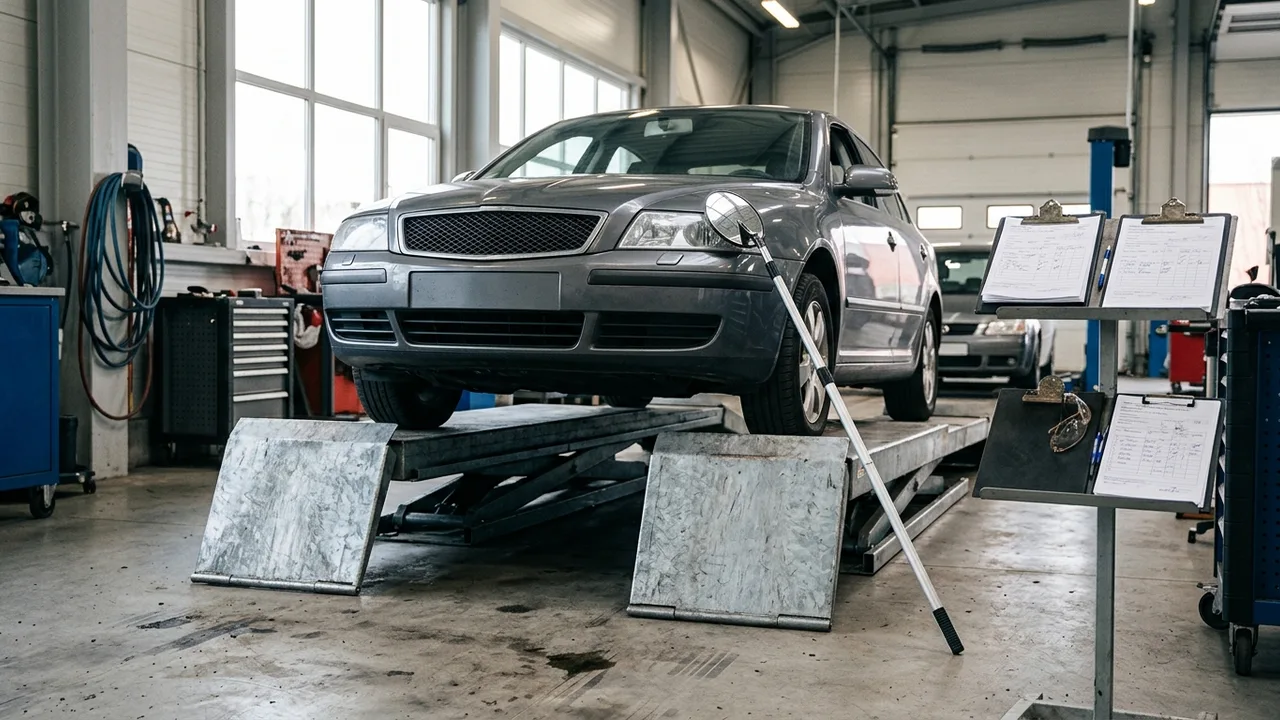
⚠️ VERIFY CURRENT RULES. MOT requirements, exemptions and testing standards are set by the DVSA and change periodically. Check the current official guidance — this explains principles rather than asserting specific current requirements.
What the MOT actually is
The MOT is an annual roadworthiness and emissions test, required for most vehicles over a defined age in Great Britain and Northern Ireland.
It is widely misunderstood, including by people who've passed dozens of them — and the misunderstandings genuinely cost money and, occasionally, safety.
⭐ Myth 1: "An MOT pass means the car is fine"
This is the most consequential misunderstanding.
An MOT is a snapshot of specific, defined checks on the day of the test. It is not a comprehensive assessment of the vehicle's condition or reliability.
What it doesn't check:
Engine condition beyond emissions. A tired engine passes an MOT.
Transmission and clutch condition.
Most of the servicing schedule — oil, filters, fluids, belts.
How long components will last. A brake pad legal on test day may need replacing next month.
The correct framing: an MOT confirms a car met defined minimum standards on one day. It doesn't tell you the car is healthy, and it isn't a substitute for servicing.
Myth 2: "An advisory doesn't matter"
Advisories are the test's most useful output, and the most ignored.
An advisory means an item is approaching a limit — a tyre near the minimum, a component beginning to wear, corrosion developing.
Advisories are how you plan. Ignoring them means a future failure and, frequently, a more expensive repair.
⭐ Practical use: MOT history for most vehicles is publicly checkable online. As our used-buying coverage argued, this is genuinely valuable — you can see a car's advisory pattern over years, which reveals both its condition and how the previous owner treated it.
A car with repeated identical advisories across years had an owner who ignored them.
Myth 3: "I can't drive without a valid MOT"
Mostly true, with narrow exceptions.
Driving without a valid MOT is generally an offence, and it can also affect insurance validity.
The commonly-cited exceptions are narrow — typically driving to a pre-arranged test, or to a garage for repairs arranged to remedy a failure.
⚠️ Verify the current rules before relying on any exception, and note that even where driving is permitted, the vehicle must still be roadworthy.
Myth 4: "The garage that tests it will find faults to charge me for"
Testing standards are defined and enforced, and testers work to published criteria rather than discretion.
That said, a reasonable precaution: you can have the test done somewhere that doesn't do repairs, if you'd prefer separation between diagnosis and quotation.
And you're entitled to a second opinion on any failure.
Myth 5: "Older cars are exempt, so they're fine to ignore"
Some historic vehicles are exempt from MOT testing.
⚠️ Exemption from testing is not exemption from roadworthiness. The legal requirement that a vehicle be in a roadworthy condition applies regardless, and an exempt vehicle still needs maintaining properly.
Verify current exemption criteria, which have specific conditions.
Myth 6: "Emissions checks are just a formality"
Emissions testing has become more rigorous over time, and diesel particulate testing in particular has tightened.
⚠️ And a genuine warning: removing or defeating emissions equipment — including DPF removal — is illegal and will cause a failure. As our India modification coverage argued about undeclared modifications generally, it can also have insurance consequences.
⭐ What actually helps
1. Pre-check the easy things. A substantial proportion of failures are for items an owner could check — lights, wipers, washer fluid, tyre condition and pressures, registration plate condition.
Ten minutes before the test genuinely reduces failure risk.
2. Act on advisories before they become failures.
3. Check the MOT history when buying used. Free, public and revealing — and as our used-car column argued, it's one of the highest-value checks available.
4. Don't confuse MOT with servicing. They test different things. A car can pass an MOT and be overdue major service work.
5. Book early. Testing can be done in advance of expiry without losing time on the certificate — verify the current window.
The bottom line
The MOT confirms a vehicle met defined minimum standards on one day. It is not a health check, not a reliability assessment, and not a substitute for servicing.
Advisories are the most valuable and most ignored part of the test — they're how you plan repairs rather than being surprised by them.
MOT history is publicly checkable and genuinely useful when buying used — a pattern of repeated advisories tells you how the previous owner treated the car.
And a large share of failures are for things you could check yourself in ten minutes. Lights, tyres, wipers, washer fluid.
⚠️ Verify current requirements with official guidance, because rules and standards change.
Key takeaways
- ⚠️ Verify current rules with official DVSA guidance — requirements and standards change periodically
- ⭐ An MOT pass is not a clean bill of health — it's a snapshot of defined checks on one day, and doesn't assess engine, transmission or how long parts will last
- Advisories are the most valuable and most ignored output — they're how you plan repairs instead of being surprised
- MOT history is publicly checkable and genuinely useful when buying used — repeated identical advisories reveal a neglectful previous owner
- A large share of failures are for things you could check in ten minutes: lights, tyres, wipers, washer fluid, plate condition
Sources & further reading
- DVSA framework
Figures, prices and policy details were current at the last-updated date above. Automotive pricing, incentives and regulations change frequently — verify time-sensitive details with the linked primary sources. Read our editorial policy and fact-checking standards.