The law written in roadside memorials
Every US state has a Move Over law, and nearly every one was written after a trooper, paramedic, tow operator or road worker was killed on a shoulder. The mechanics are simple; the awareness statistics are dismal — national surveys have repeatedly found a third or more of drivers can't describe the requirement. Here it is, plainly.
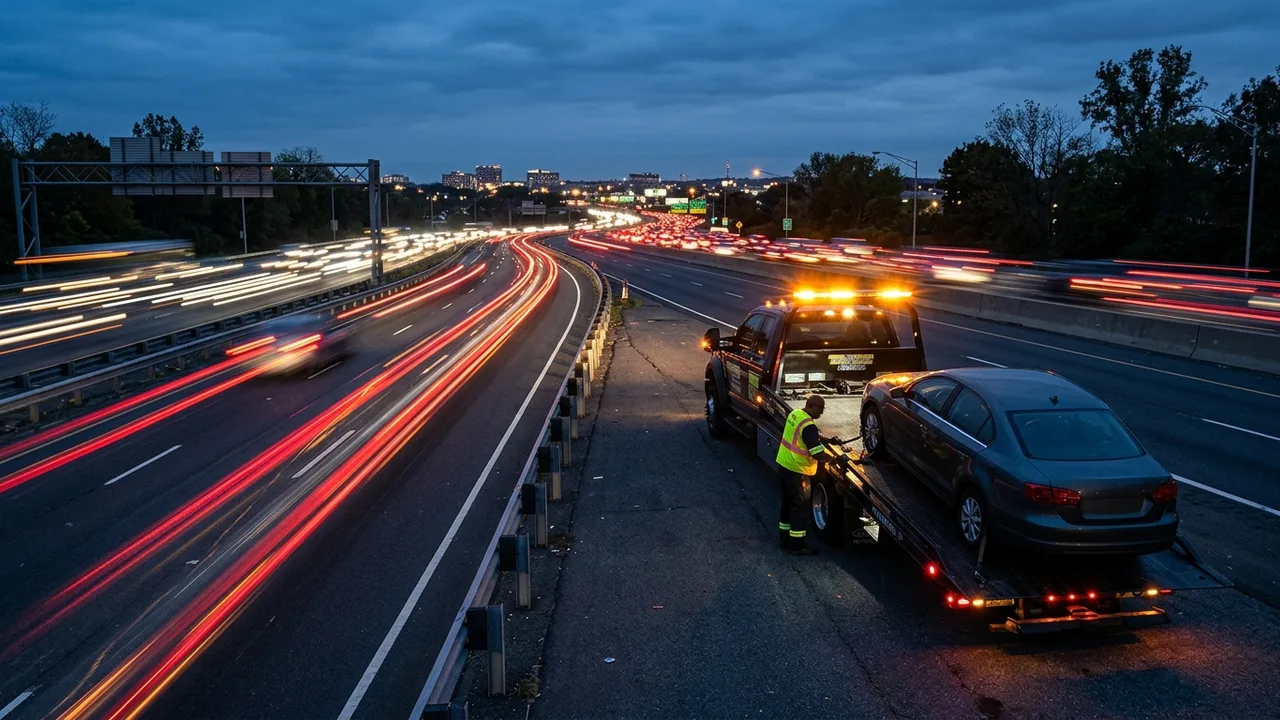
When you approach a stopped vehicle displaying flashing lights on or beside the road, you must:
- Move over one full lane away from the stopped vehicle, if a lane is available and the change can be made safely; or
- Slow down significantly if changing lanes isn't possible — with many states defining "significantly" in numbers: commonly 15–20 mph below the limit, and some requiring far less (a set speed like 25 mph, or "reasonable and prudent" left to the officer's judgment).
That two-step structure — vacate or decelerate — is universal. The details that vary are who's protected and what it costs.
Who counts as protected — the list keeps growing
The original statutes covered police, fire and EMS. The modern trend is expansive, and the safest reading is any stopped vehicle showing any flashing lights:
- Law enforcement, fire, ambulance — everywhere
- Tow trucks and recovery vehicles (amber lights) — nearly everywhere
- Highway maintenance, utility and sanitation vehicles — most states
- Any disabled passenger vehicle with hazards on — a fast-growing group of states now explicitly protect ordinary motorists stopped with flashers, and several add pedestrians at disabled vehicles
Since the roster differs by state and grows almost yearly, the practical rule costs nothing: flashing lights on the shoulder — any color, any vehicle — trigger your move-over routine.
What violations cost
First-offense fines range widely: roughly $50 to $500 in most states, with escalators to four figures, points in most jurisdictions, and license suspension provisions where violations injure roadside workers. Several states have upgraded penalties sharply after high-profile deaths, and "struck-by" incidents involving a violation convert quickly into criminal charges. Insurers treat the violation as a moving offense with the usual premium follow-through.
The enforcement reality: officers run targeted details precisely because compliance is poor — an unmarked car "stopped" on a shoulder with a spotter, and a queue of tickets downstream. It is among the easiest violations to prove and the least sympathetic to contest.
Doing it well — the technique
- Scan far ahead on shoulders, especially at night when light bars are visible for a mile. The early sighting makes the lane change trivial.
- Signal early and move over well before the scene — a smooth change a quarter-mile out beats a swerve at 200 feet, and tells traffic behind you what's coming.
- If boxed in, decelerate decisively — a visible, definite slowdown to the statutory band, not a token lift. Your speed past the scene is what the officer standing there experiences.
- Never stop or gawk — rubbernecking causes secondary crashes, which are the very thing the law exists to prevent.
- On two-lane roads, slow hard and give what width you safely can; the slow-down prong applies fully where no second lane exists.
The questions drivers actually ask
Does it apply on city streets or only highways? Most statutes apply on any road; the lane-change prong simply depends on a lane existing. The slow-down duty travels everywhere.
What if traffic won't let me over? The law asks for the lane change when safe — forcing a dangerous merge isn't required or wise. But "couldn't get over" without evidence of slowing is the losing version of the story; the deceleration prong is your fallback and your defense.
Am I covered when I'm the one broken down? Increasingly yes — and position yourself accordingly: hazards on, wheels turned away from traffic, exit on the passenger side, stand well off the roadway behind a barrier if one exists.
Key takeaways
- All 50 states: move over a full lane for stopped flashing-light vehicles, or slow significantly if you can't
- Protection increasingly covers tow trucks, utility crews and ordinary motorists with hazards — treat all flashing lights the same
- Many states define the slow-down numerically (commonly 15–20 mph below the limit); fines run $50–$500-plus with points
- Early scanning and early lane changes make compliance effortless; decisive deceleration is the fallback
- The law exists because shoulders kill responders weekly — drive past every scene as if the worker were yours
Sources & further reading
- 50-state Move Over statute compilations
- AAA Foundation awareness surveys
- responder struck-by fatality data (ERSI/NIOSH)
- state penalty schedules, 2026
Figures, prices and policy details were current at the last-updated date above. Automotive pricing, incentives and regulations change frequently — verify time-sensitive details against the primary sources listed below. Read our editorial policy and fact-checking standards.