Three nations, three rules
Pavement parking is the rare driving question where "it depends where you are" is the precise legal answer:
- London: banned since 1974. Parking with any wheel on the footway (or verge) anywhere in Greater London is a PCN offence — commonly £130 (halved if prompt) — unless the borough has explicitly exempted that spot with signs and markings. The exemptions are the only permission; the default is the ban.
- Scotland: a national ban enforced from December 2023 — footway parking, double parking and parking across dropped kerbs all attract £100 PCNs, council-enforced, with limited signed exemptions. Compliance rounds have been vigorous in Edinburgh and Glasgow.
- England outside London and Wales: the confused middle. Parking on the pavement is not itself a general offence for cars — but driving onto the pavement to get there technically is (an old Highways Act offence, rarely enforced alone), obstruction of the footway is enforceable by police, and any local Traffic Regulation Order or signed restriction converts spots to PCN territory. Successive governments have consulted on extending a London-style ban nationally; councils await powers, and the direction of travel is unmistakable.
The practical summary: in London and Scotland, wheels stay off the kerb, full stop. Elsewhere, the absence of a ban is not the presence of permission — obstruction law fills the gap.
Obstruction: the rule that applies everywhere
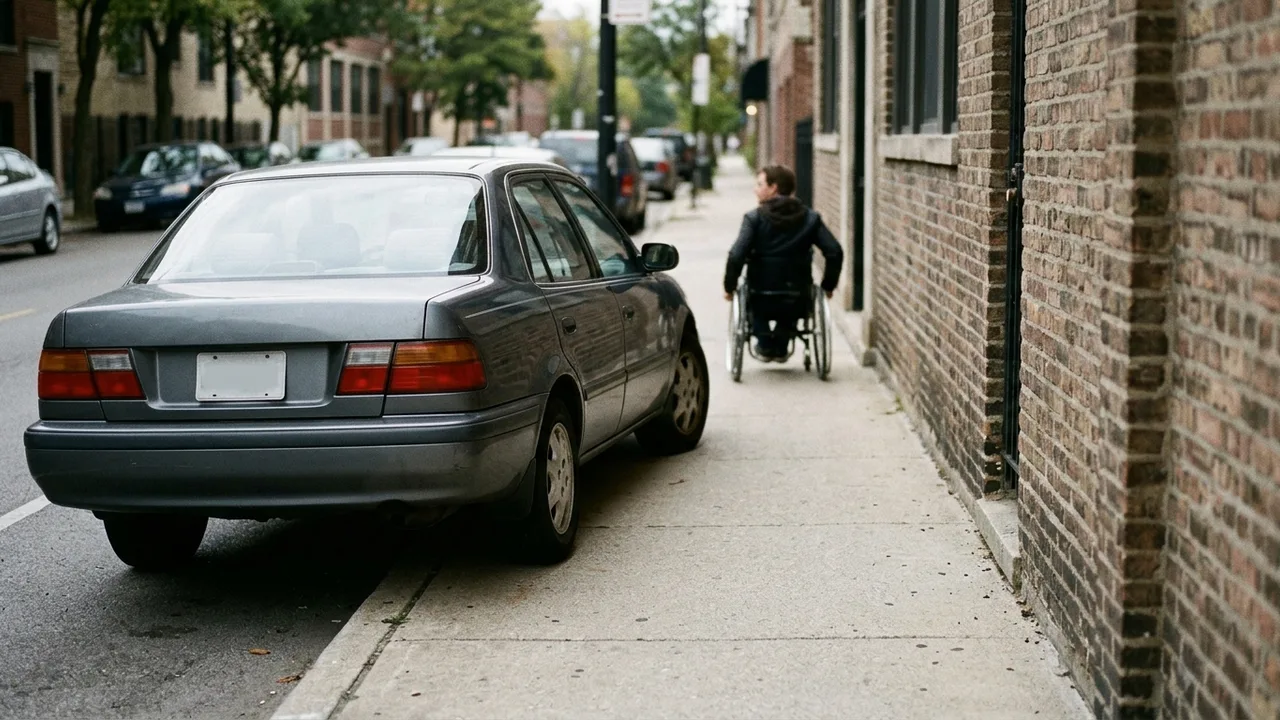
Wherever you park, wilful obstruction of the highway (which includes the footway) is a police-enforceable offence. The working test enforcement uses: could a wheelchair user or a double buggy pass without entering the road? If not, the parking is an obstruction regardless of local pavement rules — and forces increasingly act on photographed reports. Guide-dog and disability charities' campaigning here is why the law keeps tightening: the driver "leaving room" at car-door width has still forced a wheelchair into live traffic.
Dropped kerbs: the fine people don't see coming
Parking across a dropped kerb — the lowered sections for pedestrian crossing points, cycle access, or private driveways — is a civil contravention enforceable without any signs or lines, in London and in most civil-enforcement areas across England and Wales (and within Scotland's ban):
- Pedestrian dropped kerbs: enforceable on sight by councils; blocking a crossing point is the textbook PCN.
- Residential driveways: enforceable typically on the occupant's complaint — you may return to a ticket the householder requested. Blocking someone into their own drive is actionable; note the asymmetry — a car blocking a driveway with the owner's own car absent is the classic complaint-driven ticket, while parking across your own dropped kerb is, in many boroughs, still a contravention (the kerb, not the house, owns the protection).
- Fines: standard PCN rates — £70 outside London, £110–£130 within — halved for prompt payment.
Where this is heading
Expect convergence on the London/Scotland model: national consultations have repeatedly favoured extending council powers across England, Wales has piloted approaches, and every accessibility review points the same way. The parking habit to build now — fully on-carriageway, or in genuinely marked bays — is the one that will be law everywhere soon enough.
The questions drivers actually ask
"Everyone parks half-on the pavement in my street — surely it's fine?" Custom is not law. Outside ban areas it may be tolerated until the first obstruction report or TRO; inside them, the whole street can be (and in Scotland's first year, was) ticketed together.
Can I be fined for parking across my own driveway's kerb? In many enforcement areas, yes — the contravention attaches to the dropped kerb itself. Check your council's policy before making a habit of it.
What about verges and grass strips? London's ban covers them; elsewhere, signed restrictions, TROs and (for lorries) specific verge-parking offences apply. The safe reading: verge = footway.
Motorcycles and pavement parking? The bans cover them too — footway parking by motorcycles is ticketable in London and Scotland, with only marked bays offering refuge.
Key takeaways
- London (since 1974) and Scotland (since 2023) ban pavement parking outright — PCNs of £100–£130 apply
- Elsewhere in Britain, obstruction law still bites: if a wheelchair can't pass, the parking is enforceable
- Dropped kerbs are protected without signage — crossings on sight, driveways on complaint
- Blocking access earns tickets; even your own dropped kerb can be a contravention in many areas
- A national English ban has been consulted repeatedly — park fully on-road and the future can't fine you
Sources & further reading
- Greater London Council (General Powers) Act 1974
- Transport (Scotland) Act 2019 enforcement commencement
- Traffic Management Act 2004 dropped-kerb provisions
- DfT pavement-parking consultations
- council PCN schedules, 2026
Figures, prices and policy details were current at the last-updated date above. Automotive pricing, incentives and regulations change frequently — verify time-sensitive details against the primary sources listed below. Read our editorial policy and fact-checking standards.