The strictest rule on American roads
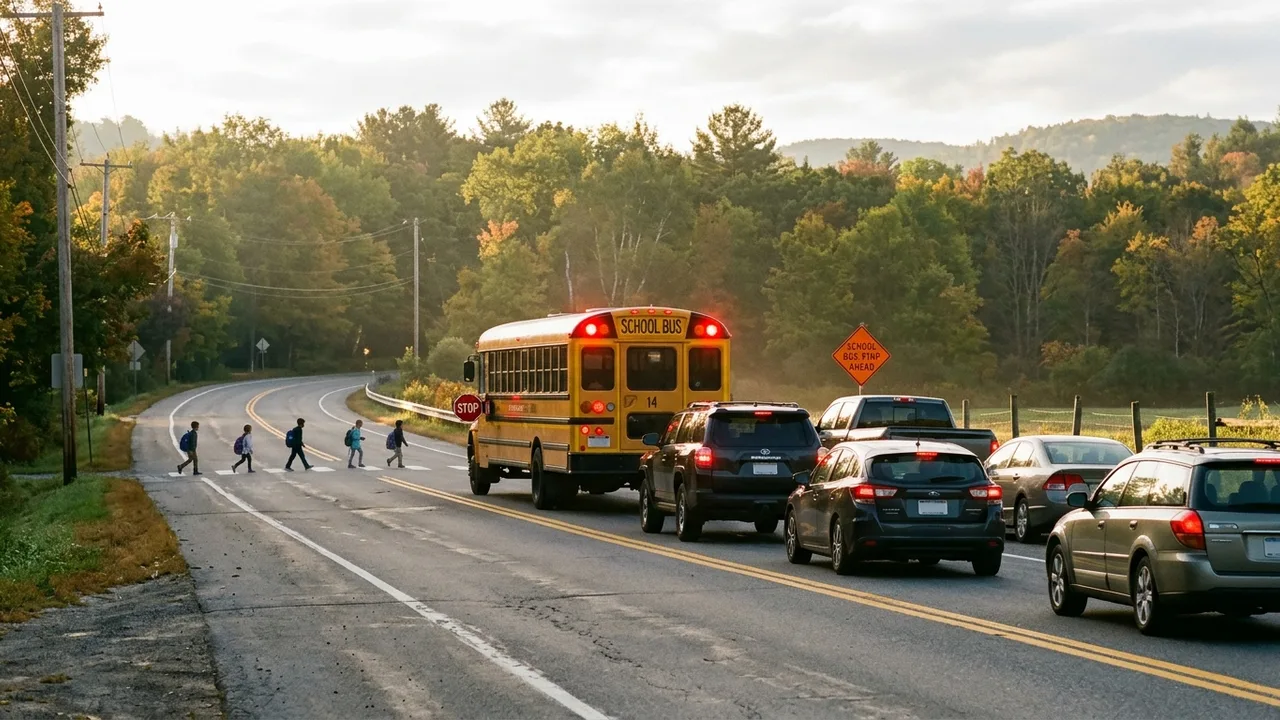
No traffic law in the US is enforced with less sympathy than the school bus stop-arm statute, and none varies less in principle: when a school bus displays flashing red lights and its stop arm, traffic must stop — in both directions on an undivided road — and remain stopped until the lights stop flashing. All fifty states agree on that core. The stakes explain the severity: children crossing to and from a bus are the most unpredictable pedestrians in traffic, and the law is built around their worst-case movement, not your schedule.
The light sequence, and what each phase demands
Yellow/amber flashing lights mean the bus is preparing to stop — begin slowing, do not accelerate to beat the reds. A long list of states makes passing during ambers its own violation.
Red flashing lights + extended stop arm mean full stop, minimum distance typically 20 feet from the bus (state distances vary from 10 to 30-plus feet), whichever direction you're traveling on an undivided road. Remain stopped until reds cease and the arm retracts — not merely until children seem clear.
The only exception: physically divided roads
Whether oncoming traffic must stop is decided by the road between you and the bus:
- Two-lane road: both directions stop. Always.
- Multi-lane road with only painted lines or a center turn lane: in the large majority of states, both directions still stop — paint is not a divider. (A minority of states exempt oncoming traffic on four-plus-lane roads even without a barrier; do not assume you're in one.)
- Physically divided highway — a median, barrier, or unpaved separation: oncoming traffic generally proceeds with caution; traffic behind the bus stops regardless.
- Never is traffic traveling behind the bus, in any state, on any road, permitted to pass flashing reds.
The safe national default: if there's no physical barrier, stop both ways. No state punishes over-stopping.
What violations actually cost
First-offense fines commonly run $250–$1,000, with several states starting higher; repeat offenses climb toward multi-thousand-dollar fines and license suspension in many jurisdictions. Points are standard, insurers price the violation as a serious child-endangerment marker, and a rising share of states treat stop-arm camera evidence — buses increasingly carry automated cameras — as sufficient for mailed citations. Where injury results, the same act converts into criminal exposure. Enforcement campaigns publish astonishing single-day violation counts every year; the cameras have ended the era of the unwitnessed pass.
The habits that keep you legal
- Treat ambers as reds forming. The driver who accelerates on amber is the one the camera catches on red.
- Watch the bus, not just the arm. Arms malfunction; red lights control. Either one flashing means stop.
- Expect stops without stops. Children cross mid-block, run back for dropped items, and emerge from in front of the bus where the driver's arm signal — not your sightline — is managing them. The 20-foot buffer exists so a child stepping out from the bus's shadow meets empty asphalt, not your bumper.
- School zones stack. Reduced zone limits, crossing guards' hand signals (which carry legal authority), and bus rules operate simultaneously around schools at bell times.
The questions drivers actually ask
The bus is loading in a parking lot or on the shoulder with hazards only — do I stop? Hazard flashers alone are not the stop-arm signal; pass with caution where lawful. The red-light/arm combination is the trigger.
Divided road, but the median is just a paint-striped island? Paint is paint: stop. "Physical" means raised, grassy, or barrier-separated in nearly every statute.
Am I liable if the citation arrives by camera without an officer? In camera-authorized states, yes — typically as an owner-liability civil citation, contestable but rarely beaten when the footage shows the pass.
Key takeaways
- Flashing reds + stop arm: stop in both directions on any road without a physical divider — nationwide
- Only a physical median or barrier exempts oncoming traffic; paint never does
- Stop roughly 20 feet back and stay stopped until the reds end, not when it "looks clear"
- Fines commonly reach four figures with points and suspension for repeats; stop-arm cameras mail citations in a growing list of states
- Treat ambers as the beginning of the stop, and assume a child will appear from in front of the bus
Sources & further reading
- State stop-arm statutes (50-state compilations)
- NASDPTS annual stop-arm violation counts
- NHTSA school-transportation safety data
- state stop-arm camera enforcement laws, 2026
Figures, prices and policy details were current at the last-updated date above. Automotive pricing, incentives and regulations change frequently — verify time-sensitive details with the linked primary sources. Read our editorial policy and fact-checking standards.