The network you're stuck with, decoded
New smart motorway construction was cancelled in 2023 amid safety controversy — but hundreds of miles of existing all-lane-running (ALR), dynamic hard shoulder and controlled motorway remain in daily service, and they are not being converted back. Whatever your view of the concept, the rules and survival drills below govern real journeys on the M1, M6, M25 and beyond.
The three types, quickly:
- Controlled motorway: variable limits, permanent hard shoulder. The benign one.
- Dynamic hard shoulder: hard shoulder opens as a running lane at peak times — read the gantry over lane one.
- All-lane running (ALR): no hard shoulder at all; emergency areas (orange-surfaced laybys) appear at intervals. The controversial one, and the reason the drills below matter.
The two rules that generate the fines
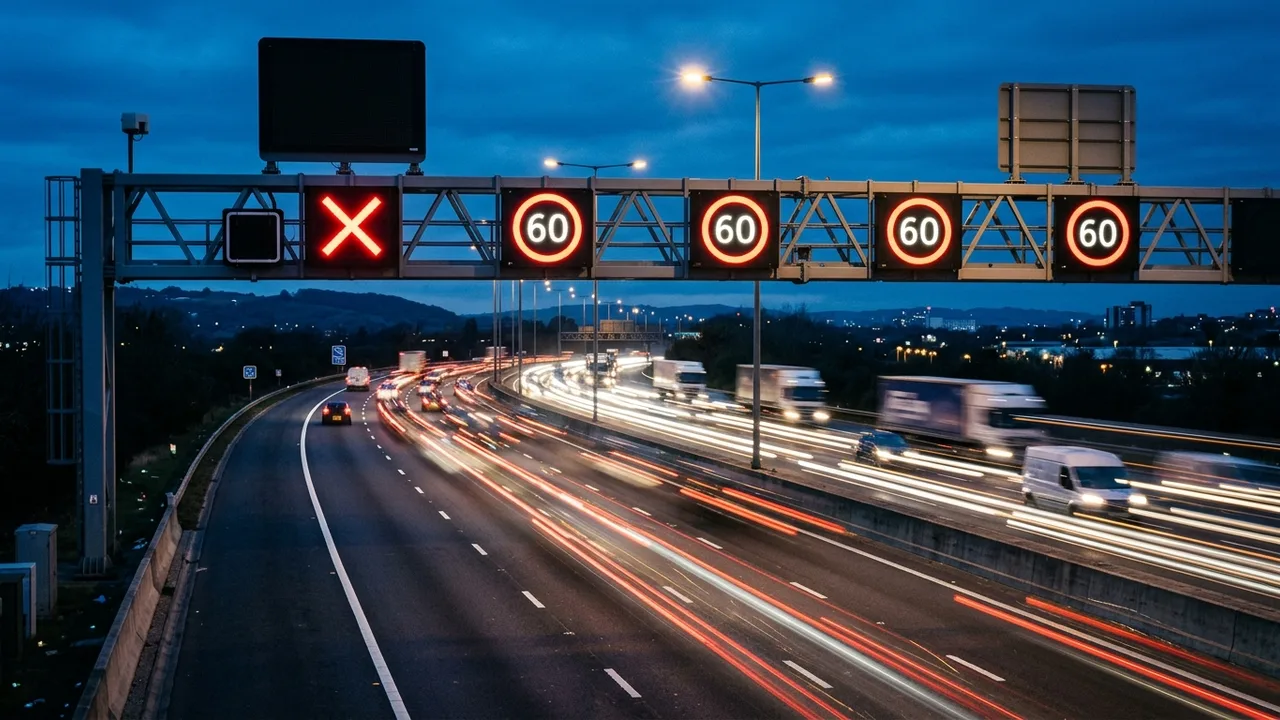
Variable speed limits are real limits. The number in a red circle on the gantry is legally enforceable from the moment it displays, and the HADECS cameras enforcing it are attached to those gantries — small, grey, high-mounted and capable across lanes. A 40 through overnight roadworks at 2am is still a 40. Limits without the red circle (on matrix boards) are advisory — but ignoring them next to a queue-protection camera invites scrutiny anyway.
The Red X closes a lane — absolutely. A red X over a lane means it is closed: debris, a stopped vehicle, workers, or an incident ahead you can't see. Driving under one is camera-enforced nationally, carrying £100 and three points (and court escalation where it's egregious). Move out of a Red X lane as soon as you see it — the closure protects whatever is in that lane a mile ahead, which may be a person.
Breaking down where there's no hard shoulder
This is the drill worth rehearsing mentally on every ALR journey:
- First choice: leave the motorway — exit, services, anything. Modern cars limp surprisingly far on warnings.
- Second: reach an Emergency Area (orange surface, blue SOS signs, roughly every ¾–1 mile on newer stretches). Stop, hazards on, exit left over the barrier, use the SOS phone — it pinpoints you and connects to the control room.
- Third: get as far left as possible in lane one, hazards on. If you can exit safely, get everyone out through the passenger side and behind the barrier, upslope of the car.
- If you cannot exit — trapped in a live lane, can't reach the left: stay belted, hazards on, call 999 immediately. Control rooms can set the Red X over you and dispatch. Stopped-vehicle detection radar now covers ALR stretches, but it supplements your 999 call; it doesn't replace it.
Never attempt roadside repairs, never re-enter the carriageway to retrieve anything, and don't leave the scene's protection until recovery positions itself.
The habits that keep you out of the statistics
- Read gantries continuously — limits and closures change mid-journey by design; the signs are the road talking.
- Keep left when lanes are empty — ALR tempts lane-three cruising; the Red X you fail to see coming is over the lane you needn't have been in.
- Note Emergency Areas as you pass them — knowing one is 800 metres back or likely a mile ahead converts panic into a plan.
- Fuel and tyres before ALR stretches — the "I'll make the services" gamble has no shoulder to lose on.
- In queues, leave escape room — smart-motorway congestion arrives abruptly under queue-protection limits; the gap ahead is your crumple zone.
The questions drivers actually ask
Are the speed cameras always on? Treat them as always-on. Enforcement thresholds exist but aren't published per-site, HADECS units enforce whatever limit displays, and "it was only briefly at 60" loses to the timestamp.
Can I use a Red X lane to pass a slow queue "just briefly"? No — it's among the most automatically enforced offences on the network, and among the least defensible: the camera captures exactly the act.
What if the gantry shows nothing? National speed limit applies (70 mph), lanes open. Signs showing blank after displaying limits means the restriction has lifted.
Key takeaways
- Red-circle gantry limits are enforceable instantly; HADECS cameras sit on the same gantries
- Driving under a Red X is camera-enforced: £100, three points, no sympathy
- ALR breakdown drill: exit if possible, Emergency Area second, far left third — and 999 from a live lane
- Exit passenger-side and wait behind the barrier whenever you can leave the car safely
- Read every gantry and keep left: the network communicates constantly, and lane discipline is the free safety margin
Sources & further reading
- National Highways smart-motorway driver guidance
- Highway Code Rule 258–270 provisions
- DfT smart-motorway stocktake and 2023 cancellation statement
- HADECS enforcement documentation, 2026
Figures, prices and policy details were current at the last-updated date above. Automotive pricing, incentives and regulations change frequently — verify time-sensitive details against the primary sources listed below. Read our editorial policy and fact-checking standards.