The most useful sticker in the shop
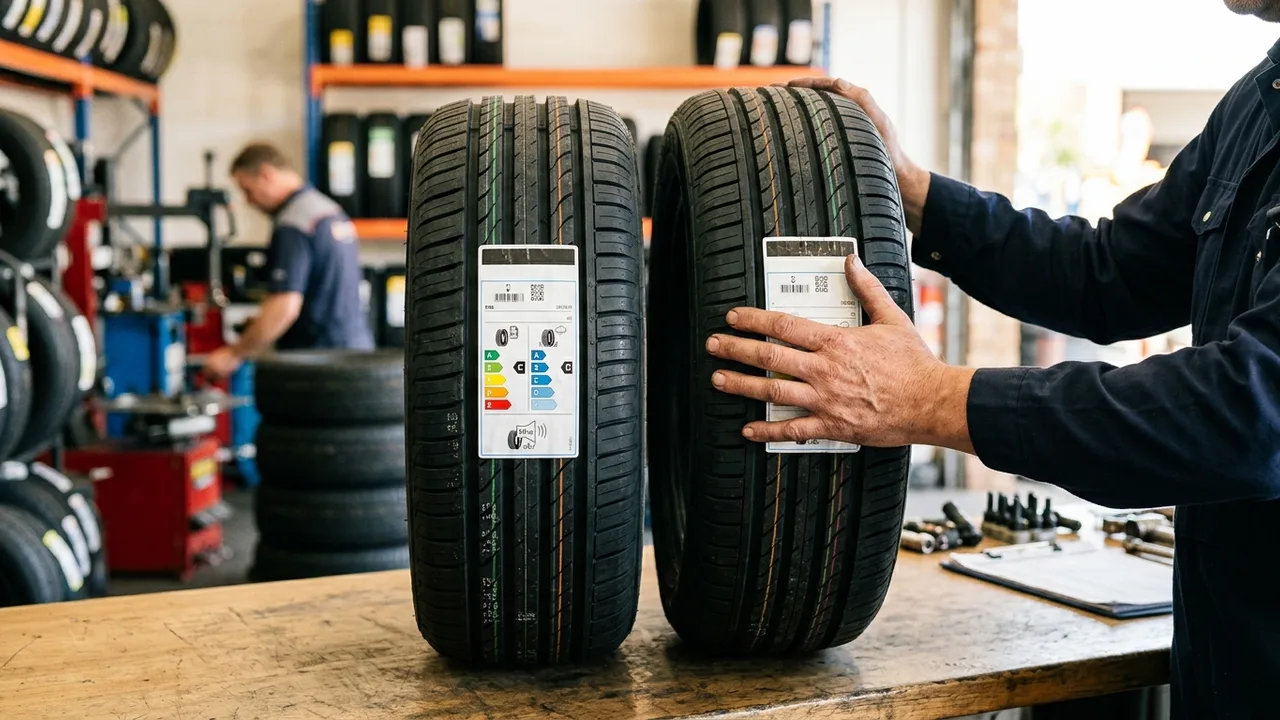
Tyres are the purchase drivers research least and rely on most — the only four contact patches between everything you love and the road. The EU-style tyre label (used across Europe and the UK, and mirrored by similar schemes elsewhere) was designed to make the invisible comparable: three measured ratings, printed identically on every tyre, straight from standardized tests. Learn its three symbols and you can out-shop most salesmen in thirty seconds.
The three ratings, decoded
1. Wet grip (A–E): the safety number. Measured as braking distance from 50 mph on wet tarmac against a reference tyre. The spread is not academic: between class A and class E lies roughly 18 metres of braking distance — four-plus car lengths, the difference between a stop and an impact. This is the rating to maximize first, always. Between two tyres in budget, the better wet-grip letter is the safer car, full stop.
2. Fuel efficiency (A–E): the running-cost number. Grades rolling resistance. Class A versus class E costs roughly 6–7% in fuel — on a typical 10,000-mile year, tens of pounds/euros per year, per set; on an EV, the same physics shows up as measurable range. Efficiency and grip once traded off against each other; modern premium compounds increasingly deliver both, which is largely what you're paying for over budget brands.
3. Exterior noise (A–C + decibels): the comfort number. Drive-by noise in dB, classed A (quietest) to C. Three decibels is a doubling of sound energy — a 69 dB tyre genuinely halves the roadside noise of a 72 dB one, and the cabin difference on coarse surfaces is audible. Long-distance drivers and EV owners (no engine masking) should weight this more than they expect.
Plus the badges: the 3PMSF snowflake (tested snow performance — what "winter-rated" legally means, and what all-season buyers should insist on) and an ice-grip badge on Nordic-spec tyres. M+S lettering alone, without the snowflake, is marketing, not a test.
Reading it like a professional
- Rank wet grip > efficiency > noise for most drivers — reordered only by honest self-knowledge (an EV commuter might promote efficiency; a motorway hauler, noise).
- Compare within the same size and season. Labels compare like with like; a winter tyre's efficiency class will read worse by design.
- Beware the unlabeled middle. The label is mandatory at sale in labeled markets — a retailer who can't show it is telling you something.
- The label doesn't measure everything. Dry braking, aquaplaning resistance, wear life and handling balance live in independent tests (auto-club and magazine tyre tests are the label's perfect complement). A tyre can label well and test middling — use both sources.
- Price against the label, not the brand. Mid-tier tyres from major groups frequently match premium labels at two-thirds the price; equally, the cheapest imports often reveal their savings in that E-class wet number. The label converts "budget vs premium" from tribal loyalty into arithmetic.
What the classes are worth in money
Work the lifetime numbers on a typical set: an A-wet/B-efficiency tyre at a £40 premium per corner over a C/D budget option buys ~10 metres of wet braking and ~3–4% fuel across a 25,000-mile tyre life — the fuel alone returns a meaningful slice of the premium, and the braking margin is the part you buy insurance for by other means. Cheap tyres are the only "saving" that degrades every safety system you own: ABS, stability control and emergency braking all end their work at the contact patch the label just graded.
The questions buyers actually ask
Are part-worn tyres with good labels a deal? The label described the tyre new; wear, age and unknown history void it. Part-worns test as the worst value per usable millimetre in almost every study — buy new mid-tier instead.
Do labels apply to all-seasons? Yes — and the 3PMSF badge is the item to verify alongside the wet-grip letter. An all-season without the snowflake is a summer tyre with ambitions.
Same tyre, different sizes — same label? Not necessarily; classes can shift between sizes of one model. Check the label for your size, not the range's headline.
Key takeaways
- Three symbols summarize measured performance: wet grip (safety), rolling resistance (economy), noise (comfort)
- A-to-E wet grip spans ~18 metres of braking from 50 mph — prioritize this rating above all
- Efficiency classes are worth several percent of fuel or EV range; noise classes are real and audible
- Insist on the 3PMSF snowflake for winter capability — M+S lettering alone proves nothing
- Use labels to compare within a size, then independent tyre tests for what labels don't measure
Sources & further reading
- EU Regulation 2020/740 tyre-labelling framework and UK equivalent
- standardized wet-grip and rolling-resistance test protocols
- auto-club independent tyre testing
- retail price sampling, 2026
Figures, prices and policy details were current at the last-updated date above. Automotive pricing, incentives and regulations change frequently — verify time-sensitive details against the primary sources listed below. Read our editorial policy and fact-checking standards.