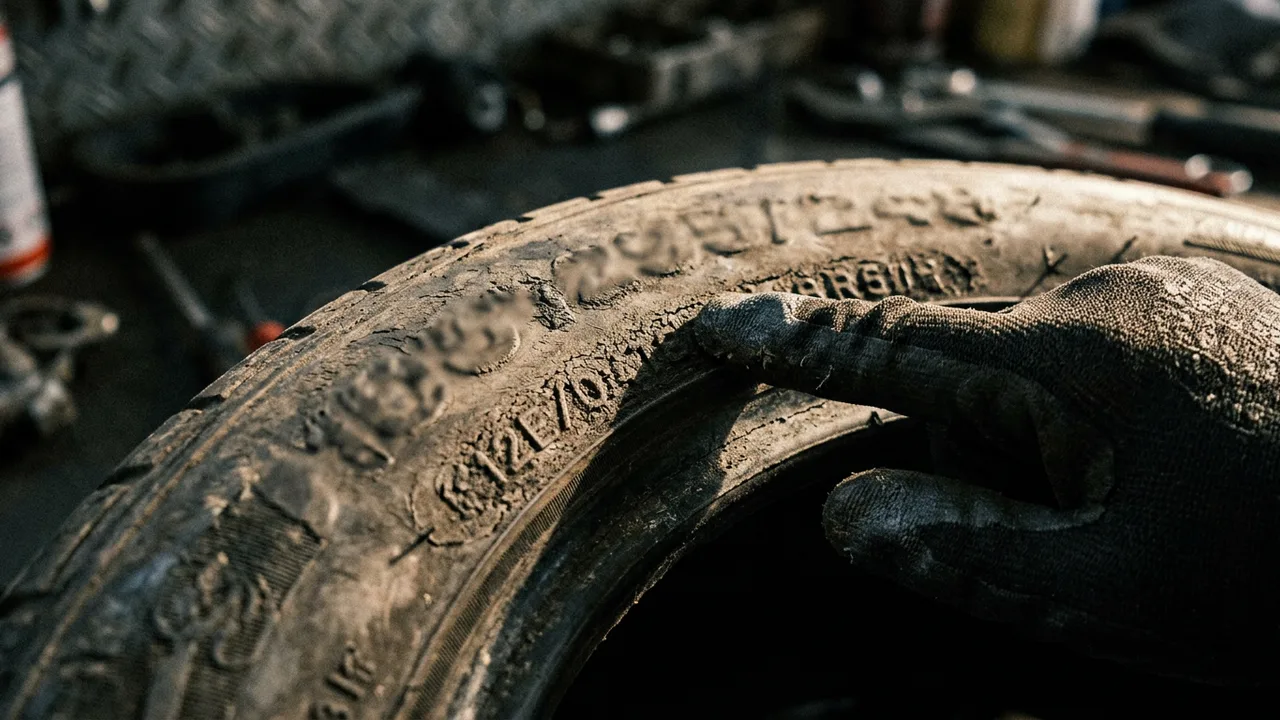
The code, cracked in one line
Take the commonest size on Earth: 205/55 R16 91V. That's 205 mm of tread width; 55 — the profile — sidewall height as a percentage of width (so ~113 mm here); R for radial construction; 16 — wheel diameter in inches; 91 — the load index (91 = 615 kg per tyre; the chart runs roughly 60s–110s for cars); and V — the speed rating (V = 240 km/h; the everyday ladder runs T-H-V-W-Y upward). Two rules follow immediately: never fit tyres below the load or speed rating the manufacturer specifies, and match sizes across an axle, always.
The four digits that age a tyre
Moulded in an oval after "DOT" sits the date code — four digits, week and year: 3624 means week 36 of 2024. Rubber ages regardless of tread: oxidation hardens compounds and invites cracking, which is why the industry consensus treats five-plus years as inspection territory and ten as retirement, whatever the tread depth. Two date-code habits protect you: check codes on new purchases (old stock sold as new is common enough to check for — a "new" tyre already three years old has spent a third of its safe life in a warehouse), and check the spare, which is routinely the oldest tyre on the car.
The fine print worth knowing
M+S and the 3PMSF snowflake separate marketing ("mud and snow") from tested winter capability (the mountain-snowflake symbol). XL/Reinforced marks higher-load carcasses many EVs and heavy crossovers require — replace like with like. Run-flats carry maker-specific codes (RFT, SSR, ROF…) and shouldn't silently swap against convention tyres without understanding the no-spare consequence. Treadwear/traction/temperature (UTQG) grades allow rough same-brand comparisons. And the max-pressure figure on the sidewall is not your inflation target — the car's door-jamb placard is; the sidewall states the tyre's ceiling.
While you're down there: sidewall bulges mean broken internal cords — replacement, not observation; perished micro-cracking between tread blocks is the ageing tell; and uneven shoulder wear is the alignment conversation your tyre has been trying to have with you.
The questions drivers actually ask
Can I fit a higher speed rating than specified? Yes — higher is fine (sometimes with small comfort trade-offs). Lower is the mistake, and insurers notice.
Do wider tyres always grip better? Dry, often; wet and snow, narrower can bite better. The engineered spec is the smart default.
Are part-worn tyres ever sensible? You're buying someone else's unknowns — age, punctures, storage. If budget forces it, demand visible date codes and inspect inside and out.
Key takeaways
- 205/55 R16 91V = width/profile/radial/diameter/load index/speed rating
- DOT date code (week+year) — check it on new tyres and the spare
- 5 years = inspect regularly; ~10 = retire regardless of tread
- Door-placard pressure, not sidewall max; bulges = replace immediately
- 3PMSF snowflake is tested winter grip; M+S alone is marketing
Sources & further reading
- Tyre-industry labelling standards
- manufacturer ageing guidance
- workshop inspection practice
Figures, prices and policy details were current at the last-updated date above. Automotive pricing, incentives and regulations change frequently — verify time-sensitive details against the primary sources listed below. Read our editorial policy and fact-checking standards.