Stars come to the tyre shop
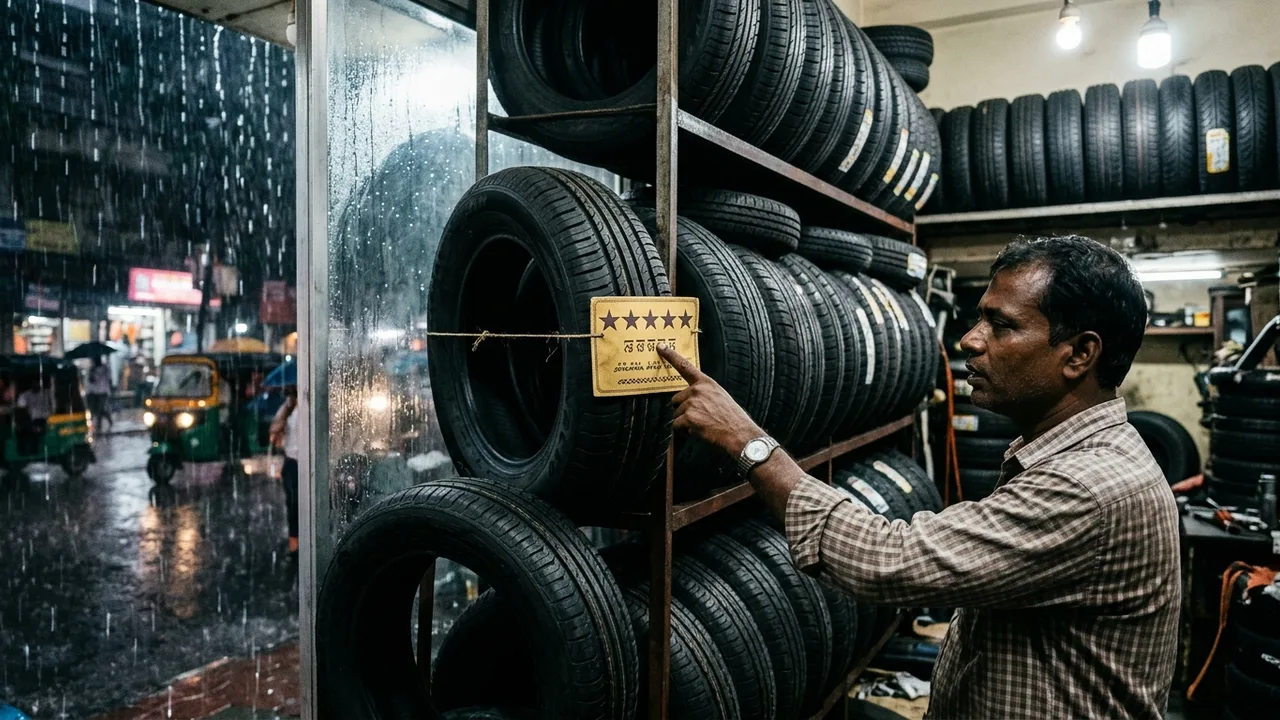
Indians buy appliances by BEE star labels; tyres are joining the system. Under the Bureau of Energy Efficiency's star-rating programme for passenger tyres — introduced on a voluntary footing with notified standards and moving toward wider adoption — tyres are graded on rolling resistance (the property that decides how much fuel your tyres quietly burn), with the familiar 1-to-5-star scale, alongside conformity marks under mandatory BIS quality control orders. The scheme's rollout has been phased, catalogue coverage is still building, and not every tyre on the rack carries a star card yet — but the direction is set, and knowing how to read it (plus the sidewall codes that were always there) turns tyre shopping from brand-faith into arithmetic.
What the stars measure — and what they're worth
A tyre's rolling resistance can consume a meaningful slice of your fuel: the spread between the best and worst classes is worth roughly 3–7% of consumption — for a 15,000 km/year driver at Indian fuel prices, real money every year, doubled in effect on an EV where it converts to range. Five stars = lowest rolling resistance.
The honest caveat imported from every labelling scheme worldwide: rolling resistance can trade against wet grip in cheap engineering. A bargain tyre wearing high stars but built down to a price may give up the braking metre that matters most in the monsoon. Premium construction increasingly delivers both — that's what the brand premium legitimately buys. So: use stars to compare within your shortlist, and let independent wet-braking tests (auto-magazine and tyre-industry tests translate well) pick the shortlist itself. Grip first, then stars, then price.
The sidewall: the label that's always been there
Every tyre already publishes its specification in a code like 205/65 R16 95H:
- 205 — width in mm; 65 — sidewall height as % of width; R16 — radial, 16-inch rim.
- 95 — the load index: 95 = 690 kg per tyre. Fit nothing below your car's placard index — insurers and physics both notice.
- H — the speed rating (H = 210 km/h; S=180, T=190, V=240). Match or exceed the original fitment.
- The date code (DOT ... 2325) — week 23 of 2025. The number that matters most in India, where slow-moving stock and "fresh" tyres three years old share shelves: insist on manufacture within the last 12 months, and treat any tyre over 5 years old — whatever its tread — as end-of-life rubber. Age hardens compounds; hardened compounds skate in rain.
- Treadwear/traction/temperature (UTQG) figures appear on many tyres — comparable within a brand, marketing-adjacent across brands.
Buying well in the Indian market
- Stick to placard size and pressure — upsizing folklore costs ride, mileage and sometimes clearance; our alloy-upsize warnings apply squarely.
- Prioritise wet grip for monsoon reality; ask specifically for the model's wet-braking test results.
- Check the date code before billing — and reject storage-scarred stock (cracking, flat-spotting).
- Match in axle pairs minimum; rotate every 8,000–10,000 km; align at every second rotation or after big impacts.
- Tubeless repairs: mushroom/patch-from-inside beats string plugs for anything larger than a pinhole — the ₹150 string fix on a sidewall-adjacent puncture is how blowouts are manufactured.
The questions buyers actually ask
Are 5-star tyres worth the premium? Where the wet-grip credentials hold, yes — fuel savings alone typically repay the difference across the tyre's life, before counting the EV-range case. Where stars come with unknown grip, you're buying the wrong trade.
Do stars apply to my existing tyres? Labels attach at sale; your current set carries only its sidewall truth. Judge it on age, tread (replace at 2–3 mm in practice, before the 1.6 mm legal limit) and vibration behaviour.
Imported vs Indian-made? BIS marking is mandatory for tyres sold here; beyond compliance, buy the model with published test results and a fresh date code, whatever the flag.
Nitrogen filling — worth the upsell alongside new tyres? Marginal: nitrogen leaks slower, but the win comes from pressure discipline, not the gas. Free air checked fortnightly beats paid nitrogen checked never.
Key takeaways
- BEE-style star labels grade rolling resistance — worth 3–7% of fuel between best and worst
- Grip outranks stars: shortlist on wet-braking performance, then compare stars within it
- Read the sidewall: load index and speed rating are legal floors; the date code is the freshness test
- Reject tyres older than 12 months at purchase; retire any tyre past 5 years regardless of tread
- Placard sizes and pressures, axle-pair replacement and proper puncture repair complete the discipline
Sources & further reading
- BEE tyre star-rating programme notifications
- BIS quality control orders for pneumatic tyres
- tyre rolling-resistance and wet-grip test literature
- Indian retail stock-age sampling, 2026
Figures, prices and policy details were current at the last-updated date above. Automotive pricing, incentives and regulations change frequently — verify time-sensitive details against the primary sources listed below. Read our editorial policy and fact-checking standards.