🏆 THE RESULT
1st — Maruti e Vitara · the service network and range make it the most reassuring first EV in India
2nd — MG Windsor · India's best-selling EV, and the comfort-and-value champion by a distance
3rd — Tata Nexon EV · the segment pioneer with the deepest EV experience, now facing genuinely strong rivals
An unusually close three-way result. All three are good, and the right answer depends heavily on whether you can charge at home.
The three that matter
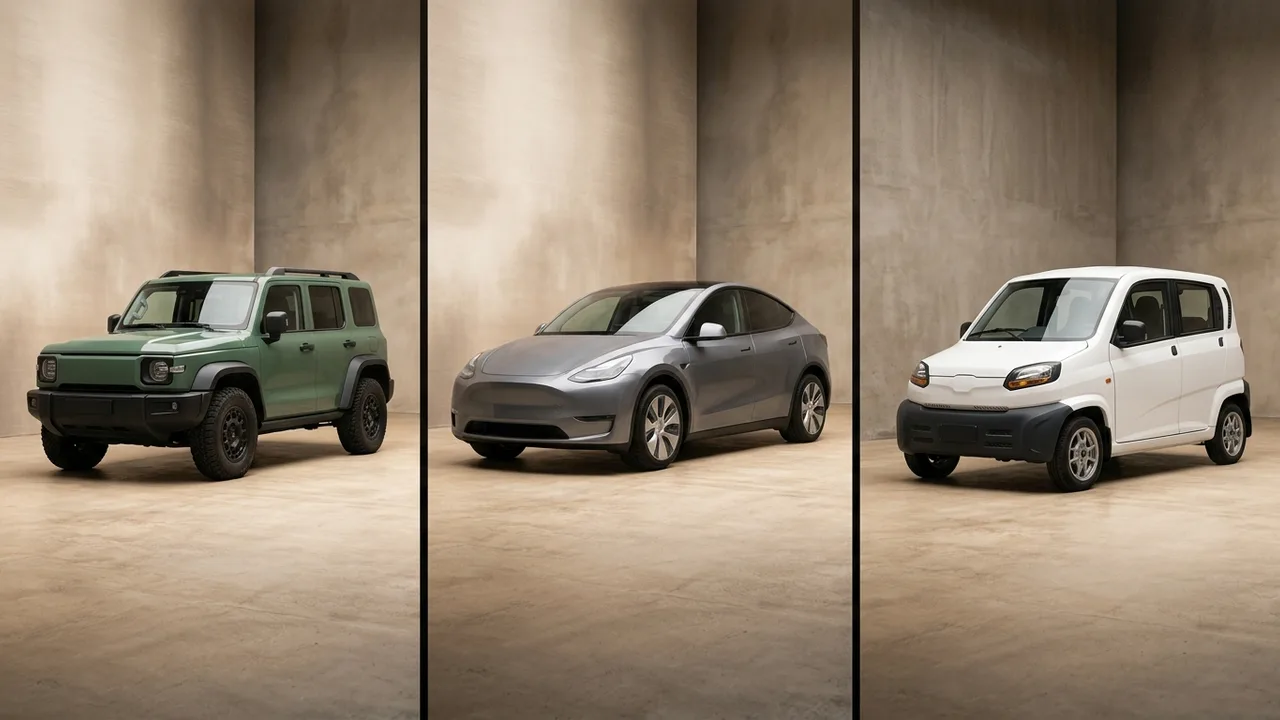
These are the EVs that will determine whether India's mainstream goes electric. Between them they represent the three arguments that actually persuade Indian buyers:
- Maruti e Vitara — trust and reach: the largest service network in India, applied to an EV
- MG Windsor — comfort and clever pricing: India's best-selling EV, and the BaaS pioneer
- Tata Nexon EV — experience and ecosystem: from India's EV segment leader
One thing to establish before the ranking: as our Indian apartment charging test found, the decisive variable in Indian EV ownership is usually whether you can charge where you park — not range or price. Read this comparison with your own charging situation in mind.
Maruti e Vitara vs. Tata Nexon EV vs. MG Windsor: the numbers
| Maruti e Vitara | MG Windsor | Tata Nexon EV | |
|---|---|---|---|
| Price (ex-showroom) | ₹15.99–19.99 lakh | ₹13.99–18.09 lakh | competitive |
| BaaS option | from ₹10.99 lakh + ₹3.99/km | from ~₹9.99 lakh + ~₹3.9–4.5/km | — |
| Battery | 49 / 61 kWh | 38 / 52.9 kWh | multiple options |
| Range (claimed) | up to ~543 km | 331 / 449 km | competitive |
| Platform | born-electric (Heartect-e) | dedicated | ICE-derived origins |
| Safety | 5-star Bharat NCAP | 6 airbags | strong Tata record |
| Service network | 1,500+ EV-ready points — largest | growing | strong, EV-experienced |
| Standout feature | service reach + range | reclining "Aero lounge" rear seats | charging ecosystem |
| Warranty | 8yr/1.6 lakh km battery | lifetime battery (first owner) | strong |
3rd place — Tata Nexon EV
The pioneer that built India's EV market, now facing the strong rivals its success created.
What it still does best:
- Tata's EV experience is genuinely the deepest in India. Years of real-world data, mature battery management, developed software and a serious charging ecosystem — none of which rivals can shortcut.
- A proven, established product with a large owner base and well-understood ownership costs.
- Strong safety credentials, consistent with Tata's excellent recent record.
- Good charging infrastructure support through Tata's network investments.
- Competitive pricing and a broad variant range.
Why it finishes third:
- Its ICE-derived origins show. Both rivals here use dedicated electric architectures, which deliver better packaging, floor height and interior space for a given footprint.
- The Maruti's range and service reach, and the MG's comfort and BaaS pricing, are each clearer differentiators than anything the Nexon EV now leads on outright.
- It's been overtaken on features by newer designs.
Buy the Nexon EV if: you want India's most experienced EV maker with the most developed charging ecosystem and a proven product. Tata's depth is a genuine advantage — and if the deal is right, it remains a sound choice.
2nd place — MG Windsor
India's best-selling EV, and it earned that position honestly.
Our rated review scored it 8.5/10, and this comparison confirms why it outsells everything.
What it does best:
- The BaaS pricing is a masterstroke. Buying without the battery from around ₹9.99 lakh and paying a per-km rental slashes roughly ₹3.5 lakh off the upfront cost. This single innovation democratised Indian EV ownership more than any subsidy, and it's the clearest reason for its sales success.
- The "Aero lounge" rear seats are genuinely unique. Reclining to nearly flat, they offer a rear-seat comfort experience no rival at any nearby price matches — and for the booming EV-taxi market, that's a commercial advantage, not just a nicety.
- Feature-loaded — a 15.6-inch screen (biggest in class), ventilated seats, panoramic sunroof, 360-degree camera, Level 2 ADAS on Pro variants.
- A lifetime battery warranty for first owners, plus buyback schemes guaranteeing up to 60% after three years.
- Genuinely spacious and comfortable, with a smooth 134 bhp urban drive.
Why it doesn't win:
- The infotainment is laggy and frustrating — a real daily irritation on a car built around comfort and features.
- Odd omissions: no rear wiper/washer, parcel shelf or sunblinds.
- Base-battery range is limited (331 km) — the 52.9 kWh Pro is the one to have.
- Service network reach doesn't match Maruti's, which in India matters enormously.
Buy the Windsor if: you want maximum comfort and value, you're drawn to the BaaS pricing, and rear-seat comfort matters (family or commercial use). Get the 52.9 kWh Pro.
🏆 1st place — Maruti e Vitara
It wins on the two things that most reduce Indian EV anxiety: service reach and range.
Our rated review scored it 8.5/10, and in comparison its advantages sharpen.
Why it takes the win:
1. The service network is decisive. 1,500+ EV-ready service touchpoints — a reach no rival approaches. In a market where the genuine barrier to EV adoption is support anxiety rather than range anxiety, this is worth more than any specification. If something goes wrong in a smaller town, Maruti is there and the others may not be.
2. Range that removes the question. Up to ~543 km claimed (ARAI ~517 km) is comfortably the most here, and enough that range simply stops being a consideration for most buyers. Combined with our finding that congested Indian city traffic actually helps EV range, urban owners should see genuinely reassuring real-world figures.
3. Born-electric architecture. The Heartect-e platform (co-developed with Toyota) delivers proper EV packaging rather than an adapted design — better space efficiency and a more resolved layout.
4. Trust. For millions of Indian buyers, "Maruti" means reliability and resale. Attaching that to an EV removes the largest psychological barrier to going electric, and no rival can manufacture that credibility.
5. Strong fundamentals throughout — 5-star Bharat NCAP, Level 2 ADAS, a spacious feature-rich cabin, an 8-year battery warranty, and a complimentary 7.4 kW home charger (which, per our charging test, is genuinely valuable).
Where it's beatable:
- The ride is firmer than ideal for Indian roads.
- The steering wheel design divides opinion.
- The MG is cheaper, especially via BaaS, and more comfortable in the back.
- It's sensible rather than exciting.
The bottom line
The e Vitara wins because it addresses the two genuine barriers to Indian EV adoption — support anxiety and range anxiety — more completely than either rival. Recommended pick: the Zeta 61 kWh at around ₹17.49 lakh.
The Windsor is a very close second and remains India's best-selling EV for good reason: unbeatable comfort, clever BaaS pricing and generous equipment. If value and rear-seat comfort matter most, buy it — and get the 52.9 kWh Pro.
The Nexon EV finishes third but brings the deepest EV experience in India, which counts for a lot.
Before any of this, resolve your charging. As our apartment charging test found, a 7.4 kW home wallbox transforms EV ownership and a 15A socket limits it. Sort that first; then pick your car.
Key takeaways
- Winner: Maruti e Vitara — 1,500+ EV-ready service points and up to ~543 km range address India's two real barriers: support and range anxiety
- MG Windsor (2nd) is India's best-seller for good reason: BaaS pricing from ~₹9.99 lakh and uniquely reclining rear seats no rival matches
- Tata Nexon EV (3rd) brings India's deepest EV experience and charging ecosystem, but its ICE-derived origins show against dedicated platforms
- MG's Battery-as-a-Service has arguably democratised Indian EV ownership more than any subsidy, cutting ~₹3.5 lakh off the upfront price
- Resolve your home charging before choosing a car — a 7.4 kW wallbox transforms ownership; a 15A socket constrains it
Sources & further reading
- Autocar India
- CarWale
- ZigWheels
- manufacturer specifications. Verified July 2026.
Figures, prices and policy details were current at the last-updated date above. Automotive pricing, incentives and regulations change frequently — verify time-sensitive details with the linked primary sources. Read our editorial policy and fact-checking standards.