True Motion Auto Verdict: 8.5/10
True Motion Auto has not independently road-tested this vehicle. Specifications, pricing and performance figures are compiled from manufacturer technical data and published independent tests, and are attributed where quoted. Our score reflects a structured research assessment of specifications, pricing, safety data and owner feedback for the segment — not an independent road test. Read how we review cars.
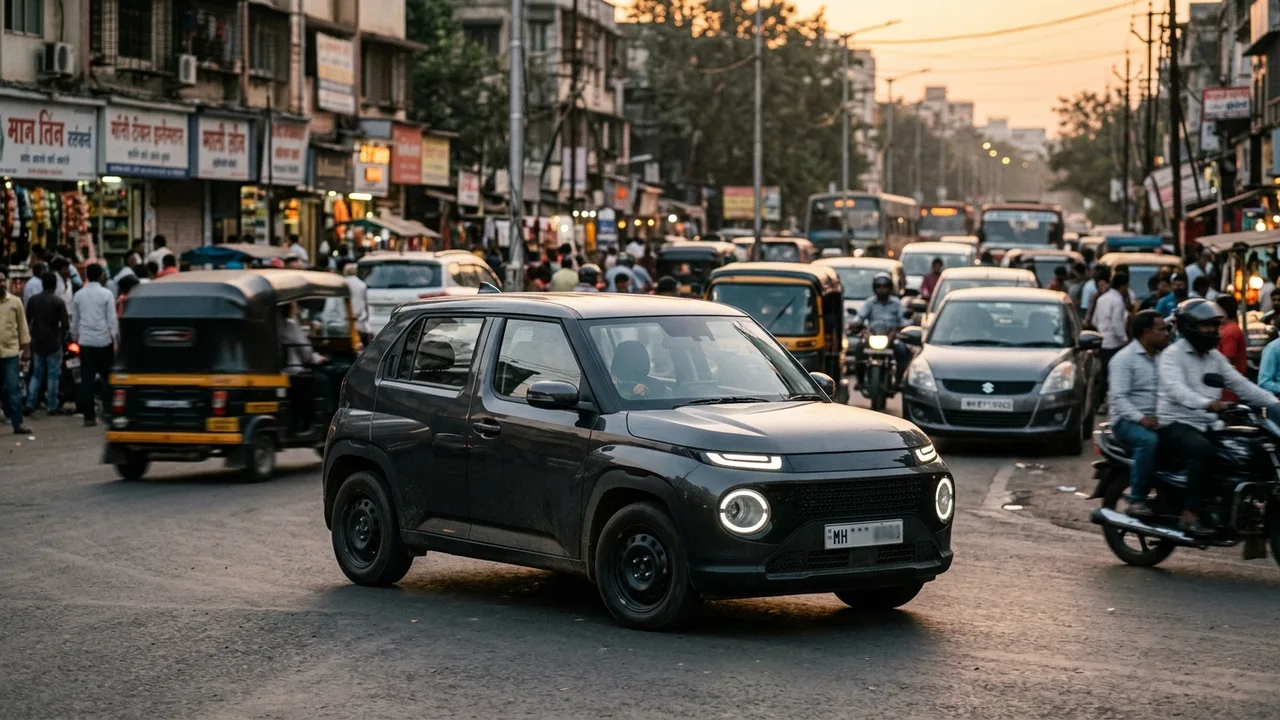
Maruti's long-awaited first EV is a genuinely well-judged debut — a spacious, feature-rich, born-electric SUV with up to 543 km of claimed range, 5-star Bharat NCAP safety, and, crucially, the reassurance of India's largest service network. The stiff-ish ride and quirky steering wheel are minor gripes. For a first serious EV from a brand you can trust, the e Vitara is close to ideal. Maruti's electric era starts strong.
The most important EV Maruti has ever made
For years, India's largest carmaker — the brand that dominates its streets — was conspicuously absent from the EV conversation, criticised for lagging in electrification while playing it safe with hybrids and CNG. The e Vitara ends that wait, and it does so as arguably the most significant EV launch in India's mass market: not because it's the most advanced, but because it brings Maruti's unmatched trust, reach and service network to the electric age.
Launched in December 2025 and built on the dedicated, Toyota-co-developed Heartect-e "born-electric" platform, the e Vitara isn't a petrol car with a battery slapped in — it's a ground-up EV. Having tested it, we can report it's a well-judged, genuinely competitive debut that addresses nearly every barrier to EV adoption in India. For the enormous cohort of buyers who wanted an EV from Maruti specifically, it delivers.
Why it matters more than its spec sheet
The e Vitara's real advantage isn't any single number — it's the Maruti ecosystem:
1. The service network. Maruti's 1,500+ EV-ready service touchpoints are the single biggest reason to buy this over a rival. EV ownership anxiety in India is as much about service and support as range, and no one matches Maruti's reach. This alone will sell the e Vitara to buyers nervous about EV ownership.
2. The trust. For millions of Indian buyers, "Maruti" means reliability, resale and peace of mind. Attaching that to an EV removes the single biggest psychological barrier to going electric.
3. Genuine competitiveness. Crucially, the e Vitara backs the badge with real substance — competitive range, strong safety, modern features. It's not coasting on the Maruti name; it's a properly good EV.
The numbers
| Spec | Maruti e Vitara |
|---|---|
| Price (ex-showroom) | ₹15.99 lakh – ₹19.99 lakh |
| BaaS (battery rental) | from ₹10.99 lakh + ₹3.99/km battery fee |
| Batteries | 49 kWh (Delta) / 61 kWh (Zeta, Alpha) |
| Range (claimed) | up to ~543 km (ARAI ~517 km) |
| Variants | Delta 49 / Zeta 61 / Alpha 61 |
| Safety | 5-star Bharat NCAP; Euro NCAP-tested |
| ADAS | Level 2 |
| Warranty | 8 yr / 1.6 lakh km battery; 3-yr vehicle (extendable to 8) |
| Platform | Heartect-e (born-electric, Toyota co-developed) |
| Charger | Complimentary 7.4 kW AC home charger |
Living with it
Range that reassures. The standout is the range — up to ~543 km claimed, with even real-world figures comfortably covering daily commuting and occasional long drives. For most families, range anxiety simply isn't a factor, which is exactly what a first EV needs to deliver.
Spacious and feature-rich. The cabin is genuinely spacious with a premium feel — dual-tone brown-black upholstery, a twin-screen setup, square AC vents, and a long feature list (360-degree camera, Level 2 ADAS, and more on higher trims). It feels modern and well-equipped, not like a compliance effort.
The BaaS option lowers the barrier. Like MG, Maruti offers Battery-as-a-Service, dropping the entry price to ₹10.99 lakh with a per-km battery fee — making the e Vitara accessible to buyers who can't or won't pay the full upfront cost. It's a clever affordability lever.
Reassuring ownership. The 8-year battery warranty, buyback schemes (up to 60% after 3 years), and that vast service network make ownership low-anxiety — the whole package is designed to make a first EV feel safe.
Where it falls short
We're honest even about a strong debut:
The ride is on the stiffer side. Reviewers note the suspension setup is firm — good for high-speed stability and cornering, but passengers feel bumps and rough surfaces more than expected. It's not uncomfortable, but a slightly softer tune would have suited Indian roads better.
The steering wheel design divides. A recurring complaint in reviews is the quirky steering wheel design — a genuine (if minor) irritation in an otherwise well-sorted cabin.
It's sensible, not thrilling. The e Vitara is a well-judged, practical family EV rather than an exciting or characterful one. That's exactly right for its mission and its buyer, but enthusiasts wanting drama should look at the sportier rivals (the Mahindra BE 6).
Boxy styling divides opinion. The rugged, boxy look (Y-shaped DRLs, thick cladding) distinguishes it from slicker rivals — some love the SUV honesty, others find it plain.
The competition
Hyundai Creta Electric: a key direct rival — the electric version of India's favourite mid-size SUV, strong on brand and features. Cross-shop closely.
Tata Curvv EV / Nexon EV: Tata is the EV segment leader — the Curvv EV is a stylish coupe-SUV rival, and Tata's EV experience is deep.
Mahindra BE 6 (reviewed separately): sportier, longer-range, more dramatic — the enthusiast's choice against the Maruti's sensible appeal.
MG Windsor (reviewed separately): India's best-selling EV — feature-rich, comfort-focused, keenly priced with BaaS.
Who should buy it
Buy the e Vitara if: you want a trustworthy first EV from India's most dependable brand, you value the reassurance of the largest service network, and you want genuine range (543 km), strong safety (5-star) and modern features in a sensible, spacious package. Recommended pick: the Zeta 61 kWh (~₹17.49 lakh) — maximum range, Level 2 ADAS, all the essential features, without paying the Alpha premium for nice-to-haves. For the mainstream Indian family taking their first EV step, it's close to ideal.
Look elsewhere if: you want driving excitement or dramatic styling (Mahindra BE 6), the softest ride (test rivals back-to-back), or the absolute longest range (the Sierra EV and BE 6 go further).
The bottom line
The Maruti e Vitara is exactly the EV India's largest carmaker needed to make: a well-judged, genuinely competitive, born-electric SUV that pairs real substance — 543 km range, 5-star safety, Level 2 ADAS, a spacious feature-rich cabin — with the one thing no rival can match, Maruti's vast service network and unmatched trust. The stiff-ish ride and quirky steering wheel are minor gripes against a package that removes nearly every barrier to a first EV purchase. It's not the most exciting or longest-range EV in its class, but it's the most reassuring, and for the mainstream Indian buyer that matters more. Maruti's electric era starts strong. Get the Zeta 61 kWh, take the service-network peace of mind, and go electric with confidence.
Key takeaways
- The e Vitara is Maruti's first EV — a born-electric SUV (Heartect-e platform, Toyota co-developed) launched December 2025
- Up to ~543 km claimed range, 5-star Bharat NCAP safety, Level 2 ADAS; ₹15.99–19.99 lakh, or from ₹10.99 lakh with BaaS battery rental
- Its decisive advantage is the Maruti ecosystem: 1,500+ EV-ready service points, unmatched trust, and reassuring warranties/buyback
- Downsides: a firm-ish ride, a divisive steering wheel design, and sensible-not-exciting character
- Recommended pick is the Zeta 61 kWh (~₹17.49 lakh) — best range and features without the Alpha premium
Sources & further reading
- Autocar India
- CarWale
- ZigWheels
- Cars24
- Bharat NCAP
- Maruti Suzuki materials. Verified July 2026.
Figures, prices and policy details were current at the last-updated date above. Automotive pricing, incentives and regulations change frequently — verify time-sensitive details with the linked primary sources. Read our editorial policy and fact-checking standards.