Start here: one number underneath everything
The Section 232 tariff on imported passenger vehicles and light trucks is 25%.
That's the baseline. It took effect in April 2025 (parts followed in May 2025), it survived the Supreme Court's February 2026 ruling completely intact, and it is the number that determines what a car built outside the United States costs when it arrives here.
Everything else in this article is an exception to, or a modifier of, that 25%.
The country map
Different trading partners have negotiated different deals down from the 25% baseline. Here's where the major auto-exporting nations sit in 2026:
| Origin | Total US auto tariff | How |
|---|---|---|
| EU (Germany, etc.) | 15% | Bilateral deal — an all-inclusive ceiling |
| Japan | 15% | Bilateral deal |
| South Korea | 15% | Bilateral deal |
| United Kingdom | 10% | Separate "Economic Prosperity Deal" |
| Canada / Mexico | 0%* | USMCA carve-out (rules-of-origin conditions apply) |
| China | effectively prohibitive | 25% S232 + Section 301 stack |
| Everyone else | 25% | Section 232 baseline |
\USMCA-compliant vehicles and parts only — and "compliant" is doing enormous work in that asterisk. More below.
The parts tariff — the one that quietly matters more
Here's what most consumers miss. Even an "American" car is stuffed with imported parts, and those parts carry their own 25% Section 232 tariff.
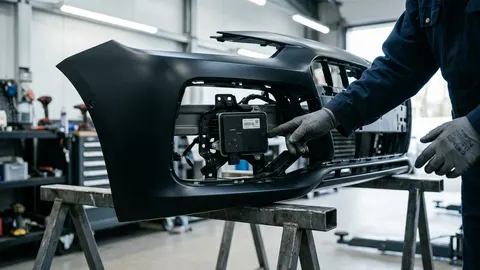
The covered-parts list — engines, transmissions, drivetrains, body panels, most OEM components (broadly HTS chapters 8407–8409, 8706–8708) — means that a vehicle assembled in the US from imported engines, transmissions and electronics still absorbs tariff cost on every one of those components.
This is why "build it in America" doesn't make tariffs disappear. A US assembly plant running on imported powertrains is paying 25% on the powertrains. The tariff is baked into the bill of materials long before the badge goes on.
One relief valve exists: an "import adjustment offset" lets an automaker apply for an offset equal to 3.75% of the aggregate MSRP of all its US-built vehicles (revised October 2025, running April 2025 to April 2030). It softens the parts blow for manufacturers with significant US assembly — but it's a partial cushion, not an exemption.
The USMCA carve-out — and why it's fragile
Canada and Mexico get a 0% rate — but only for vehicles and parts that meet USMCA rules of origin. That's a demanding test:
- 75% regional value content — the strictest threshold of any major trade agreement
- Core components (engine, transmission, chassis, axle — and for EVs, the battery) must themselves qualify as originating
- Steel/aluminium sourcing and labour-value-content tests must be satisfied
Miss the threshold, and the vehicle reverts to the 25% baseline — plus, for the non-North-American content of even compliant vehicles, additional exposure. Canada in April 2025 imposed its own 25% on non-USMCA-compliant vehicles and on the non-Canadian/non-Mexican content traded under USMCA.
Why this matters right now: the USMCA is under joint review in 2026, with the US having declined a clean 16-year extension and triggered a review cycle. Tightening the automotive rules of origin is explicitly on the table (we cover this in full in our USMCA piece). The 0% carve-out that makes a Mexican-built car competitive today is precisely what's being renegotiated.
What the layers do — and don't — stack
This trips up even trade professionals. The key rule:
Section 232 auto tariffs do NOT stack with the Section 122 global tariff. Autos and parts covered by Section 232 are exempt from the 15% Section 122 surcharge that replaced the struck-down IEEPA tariffs.
But Section 301 tariffs DO stack on top of Section 232 — which is why Chinese vehicles face an effectively prohibitive combined rate.
And a critical near-term wrinkle: Section 122 itself expires around 24 July 2026 (150-day statutory limit), unless Congress acts. The USTR has proposed replacing it with 12.5% Section 301 duties on 46 countries. Since autos are already exempt from Section 122, this particular change won't directly move vehicle prices — but it's a reminder of how unstable the surrounding structure is.
Worked examples: what the tariff actually adds
| Vehicle | Origin | Price (pre-tariff) | Tariff | Duty added |
|---|---|---|---|---|
| Luxury saloon | Germany (EU) | $50,000 | 15% | $7,500 |
| Family sedan | Japan | $28,000 | 15% | $4,200 |
| Compact SUV | South Korea | $30,000 | 15% | $4,500 |
| Sports car | UK | $60,000 | 10% | $6,000 |
| Pickup | Mexico (USMCA-compliant) | $40,000 | 0%* | $0 |
| Same pickup's imported engine | (parts) | — | 25% | (embedded) |
Note: whether the full duty reaches the sticker depends on how much the manufacturer absorbs — the subject of our separate piece on who's eating the cost.
The honest caveats
Three things you must hold in mind reading any tariff coverage, including ours:
1. These rates change constantly. Bilateral deals get renegotiated, quotas fill, statutory clocks expire. Several numbers in this article have expiry dates within weeks of publication. Verify against current Federal Register notices before making a purchase decision.
2. "Total tariff" definitions vary. Some sources quote the Section 232 rate alone; others quote an all-inclusive figure including base MFN duty. The EU/Japan/Korea "15%" is generally an all-inclusive ceiling; older MFN rates (2.5% on cars, 25% on light trucks under the "Chicken Tax") sit underneath the modern structure.
3. Quotas complicate the country map. The EU, UK, Japan and Korea arrangements involve tariff-rate quotas — the negotiated rate applies up to an annual volume, above which imports can revert to 25%. A "15% country" isn't 15% on the millionth car if the quota's full.
The bottom line for a US car buyer
If you're buying an imported car in 2026, a tariff is priced into it — 25% baseline, 15% from the EU/Japan/Korea, 10% from the UK, and (in principle) 0% from USMCA-compliant Mexican and Canadian production. Even a US-assembled car carries embedded parts tariffs.
The single most useful question you can ask at a dealership is: "Where is this specific vehicle built, and where's its engine from?" The badge won't tell you. The bill of materials does.
Key takeaways
- The baseline Section 232 auto tariff is 25%; it survived the Supreme Court ruling intact
- Deal rates: EU, Japan, Korea 15%; UK 10%; USMCA-compliant Mexico/Canada 0% (conditions apply)
- Auto parts carry their own 25% tariff — even US-assembled cars absorb it via imported components
- Section 232 does NOT stack with the 15% Section 122 tariff, but Section 301 (China) DOES stack
- Rates change constantly and involve quotas — verify against current Federal Register notices before buying
Sources & further reading
- Congressional Research Service IN12545
- GingerControl
- CalcMyTariff
- TariffsTool
- Dutiable
- Dimerco US Tariff Update 2026. Verified July 2026 — tariff rates change frequently
- confirm before acting.
Figures, prices and policy details were current at the last-updated date above. Automotive pricing, incentives and regulations change frequently — verify time-sensitive details with the linked primary sources. Read our editorial policy and fact-checking standards.