The deal in one line
Under the US-UK Economic Prosperity Deal (Executive Order 14309, June 2025), UK-built cars enter the US at a 10% total tariff — but only for the first 100,000 vehicles a year. Above that quota, they revert to the punishing 27.5%.
That's a remarkable arrangement, and understanding why requires seeing what Britain avoided and what it accepted.
What Britain escaped
When the US imposed its 25% Section 232 auto tariff in April 2025 — stacked on the existing 2.5% base rate for a 27.5% total — it hit British carmakers hard. JLR, which sends a fifth of its global volume to North America, paused US shipments entirely rather than eat the duty.
The deal cut that 27.5% down to 10% (a 2.5% MFN base plus a reduced 7.5% Section 232 rate) for cars within the quota. JLR resumed exports within weeks, citing the "security" the deal provided.
For context on how good this is: 10% is lower than the EU's, Japan's or Korea's 15%. Britain got the best headline auto rate of any major exporter to the US. As one trade analyst put it, the UK's 100,000-unit quota covers roughly 99% of its 2024 export volume (~101,000 units) — whereas the same 100,000 quota would cover only about 13% of EU exports, 8% of Korea's, and 7% of Japan's. Proportionally, Britain got a far better deal than its rivals could ever expect.
The catch: the 100,000 ceiling
Here's the constraint, and it's a real one.
The 10% rate applies only to the first 100,000 UK-built vehicles imported into the US each year. The 100,000 figure was chosen to roughly match Britain's actual export volume — around 101,000–102,000 cars in recent years.
Above 100,000, cars revert to the full 27.5%.
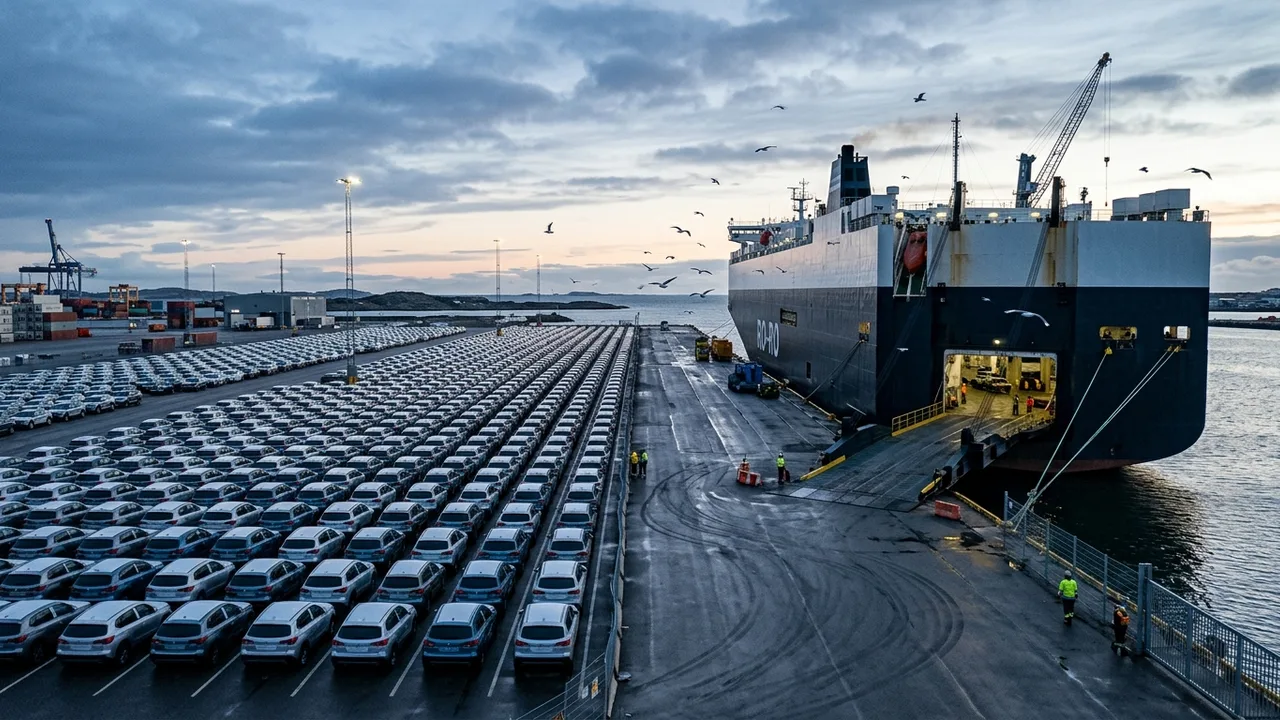
And here's the squeeze: JLR alone exported around 102,000 vehicles to the US last year. That means JLR by itself very nearly fills — or exceeds — the entire national quota. Every other British exporter to the US — Mini (BMW-owned, built at Oxford), Bentley, Aston Martin, McLaren, Rolls-Royce — is competing for whatever headroom remains, if any.
The quota that "covers 99% of exports" covers it only if Britain doesn't grow its US sales. The moment the UK industry tries to expand in America — exactly what a trade deal is supposed to enable — it hits the ceiling and the marginal car is taxed at 27.5%.
How the quota is administered (and why it matters)
The quota is a tariff-rate quota (TRQ), administered by US Customs and Border Protection on a quarterly basis via CBP quota bulletins, confirmed in CBP's January 2026 guidance.
Quarterly administration matters because it affects who gets the 10% rate and when. If the quota fills early in a quarter, later shipments in that period face the full rate. This creates a scramble — manufacturers front-loading shipments to claim quota space, and smaller players at risk of being crowded out by whoever ships first and largest.
For a company like Aston Martin or McLaren — low-volume, high-value — being squeezed out of the quota by JLR's mass would be commercially serious. Their cars are expensive enough that 27.5% versus 10% is a five-figure difference per vehicle.
Winners and losers within Britain
Best placed:
- JLR — the deal's headline beneficiary, having faced a warned £1.6 billion potential tariff burden. But also the biggest quota-filler, and therefore the most exposed if it tries to grow.
- Bentley, Aston Martin, McLaren, Rolls-Royce — ultra-premium brands whose buyers are least price-sensitive, and who can most easily absorb even the 10% (though not comfortably the 27.5% if pushed out of quota).
Most exposed:
- Any UK brand wanting to grow US volume. The quota rewards the status quo and penalises expansion — the opposite of what an exporter wants from a trade deal.
- Smaller players at risk of being crowded out of the quarterly quota by JLR's volume.
The parts wrinkle
The deal also reduced duties on UK-origin automotive parts, provided they meet rules of origin — helpful for manufacturers running transatlantic supply chains. But as of the deal's early phase, 25% tariffs remained on a range of auto parts, so the relief was partial. A British car built with British engines and drivetrains benefits; one leaning on imported components less so.
What the industry actually said
The reception was relief tempered with realism.
JLR's CEO Adrian Mardell welcomed the deal as securing "greater certainty for our sector" and the 250,000 jobs the UK car industry supports. But the SMMT's Mike Hawes called it a necessary "first step towards broader and deeper cooperation" — diplomatic language for this isn't enough.
The honest assessment: the deal converted an existential threat (27.5%, shipments paused) into a manageable cost (10%, within quota). That's a genuine win. But it's a ceiling on ambition, not a springboard for growth, and it remains four times the ~2.5% rate British cars faced before the whole tariff era began. Starmer noted there was "scope to increase that quota" — which tells you the industry already regards 100,000 as too tight.
What it means for you
If you're a UK car buyer: this deal is about exports, and its direct effect on UK showroom prices is limited. Its real importance to you is indirect — it protects the health and employment of Britain's car industry, which underpins everything from JLR's UK investment to the servicing network for the brands you buy.
If you're watching the industry: the number to track is whether UK US-bound exports push past 100,000. The day they do, the marginal British car in America is taxed at 27.5% again — and the pressure to expand the quota (or build in the US) becomes acute.
If you're buying a British car in the US: JLR, Mini and the premium brands within the quota carry a 10% tariff — better than a German rival's 15%, far better than the 27.5% they'd face without the deal. Ask whether the specific vehicle shipped within the quota period; it affects the landed cost.
The bottom line
Britain negotiated the best auto tariff of any major US exporter — 10%, covering essentially all of its current volume. It's a real achievement that pulled JLR back from the brink. But it's a quota, not an exemption: it rewards standing still and penalises growth, JLR alone nearly fills it, and it sits at four times the pre-tariff baseline. A lifeline, not a liberation.
Key takeaways
- The UK-US Economic Prosperity Deal cuts UK-built car tariffs from 27.5% to 10% — the best rate of any major US exporter
- But only for the first 100,000 vehicles a year; above that, cars revert to 27.5%
- JLR alone exports ~102,000 cars to the US annually — nearly filling the entire national quota
- The quota rewards the status quo and penalises export growth, and sits at 4× the pre-tariff ~2.5% rate
- Administered quarterly by US CBP; smaller UK brands risk being crowded out of quota space
Sources & further reading
- White House fact sheet
- Executive Order 14309
- US CBP quota bulletins (Jan 2026 guidance)
- Automotive Logistics
- Lexology
- Motor Finance Online
- SMMT
- JLR. Verified July 2026.
Figures, prices and policy details were current at the last-updated date above. Automotive pricing, incentives and regulations change frequently — verify time-sensitive details with the linked primary sources. Read our editorial policy and fact-checking standards.