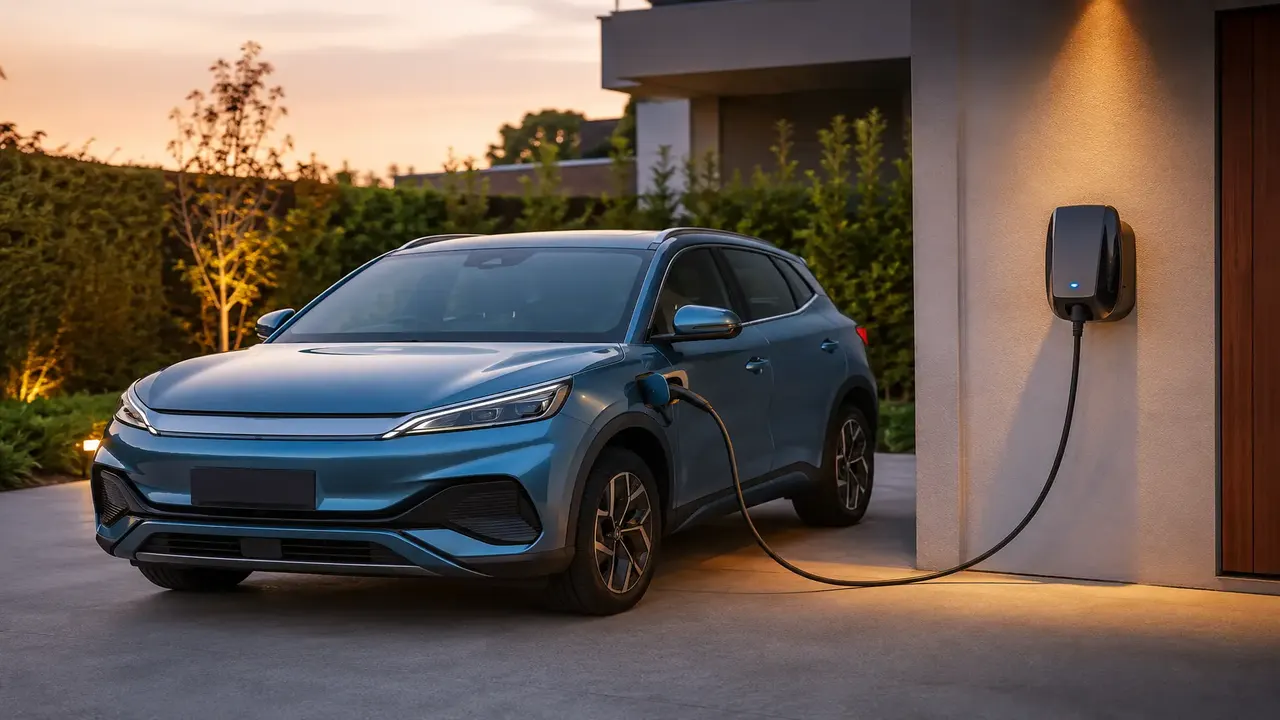
Sizing a home charger comes down to three numbers: your car's maximum onboard AC charging rate (commonly 7.4kW single-phase in the UK/EU, 7.2-11.5kW in the US, 3.3-7.2kW in India), your daily mileage, and your home electrical panel's spare capacity. Charging time is simply battery size (kWh) ÷ charger power (kW) - a 60kWh battery on a 7kW charger takes roughly 8.5 hours from empty, comfortably an overnight charge. Most drivers with under 60 miles/100km of daily driving are fine on a basic 7kW Level 2 unit; higher-mileage drivers or larger batteries benefit from an 11kW+ charger, if the car and panel both support it.
At a glance: charger levels
| Charger type | Typical power | Full charge time (60kWh battery) |
|---|---|---|
| Level 1 (standard household socket) | 1.4-2.4kW | 25-40+ hours |
| Level 2 (dedicated home unit) | 7-11kW | 5.5-8.5 hours |
| Level 2, three-phase (where available) | 11-22kW | 3-5.5 hours |
| DC fast (public, not home) | 50-350kW | 20-40 minutes to 80% |
The arithmetic
Charging time in hours is battery capacity in kWh divided by charger power in kW, adjusted down slightly (roughly 5-10%) for charging losses. Start from your car's onboard AC charger rating (in the owner's manual or specification sheet — this is not the same as the battery's DC fast-charge rating), then work backwards from how many hours you realistically have available to charge, usually overnight, to suggest the minimum charger power that comfortably covers your daily driving.
Why the car's onboard charger is the ceiling
Every EV has a maximum AC charging rate built into its onboard charger hardware, and a home charger can never exceed it - installing a 22kW home unit on a car limited to 7.4kW onboard still only charges at 7.4kW. Base and mid-tier EVs commonly cap at 7-7.4kW single-phase; some cars, mainly in markets with three-phase household supply (much of continental Europe), support 11kW or 22kW AC. Always check the car's spec before buying a charger more powerful than it can use.
Worked example
A driver covers 40 miles (64km) a day in a car with a 60kWh battery and roughly 3.5 miles/kWh efficiency, using about 11.4kWh a day. On a 7kW home charger, that's replaced in under 2 hours - well inside an 8-hour overnight window, so a basic single-phase 7kW unit is enough even with charging losses, and there's no efficiency case for paying extra for an 11kW unit. A driver covering 150 miles (240km) a day in the same car uses about 43kWh daily; on the same 7kW charger that takes roughly 6.5 hours, still fitting an overnight window but with less margin for a late-arrival or a partially depleted start - at that point an 11kW charger, if the car and the panel both support it, starts to buy real buffer.
Panel capacity: the constraint people forget
Check your electrical panel's spare capacity before you choose a unit, because a 7-11kW continuous load is significant - roughly equivalent to running several ovens at once for hours. Homes with an older or already-loaded panel may need a panel upgrade or a load-management device that automatically reduces charger output when other high-draw appliances switch on, rather than a full electrical service upgrade. This is a genuine cost variable that no arithmetic can settle without knowing your panel's rated amperage and existing load, which is why a qualified electrician's assessment is the final step in every case.
Regional notes
- UK/EU: most homes run single-phase supply, capping practical home charging at 7.4kW unless three-phase is installed, which is costly to retrofit; the UK also requires smart-charging functionality (scheduling, app connectivity) on new home chargers under OZEV-linked regulations.
- US: home Level 2 chargers are typically wired to a 240V circuit via a dedicated breaker (30-60A common), giving 7.2-11.5kW; installation cost and permitting requirements vary significantly by state and utility.
- India: household supply is often single-phase at lower amperage than UK/US norms, so many home setups top out around 3.3-7.2kW, and installers commonly recommend a dedicated line from the meter rather than sharing an existing circuit.
Common mistakes to avoid
- Buying the most powerful charger available without checking the car's onboard AC limit - the extra power is wasted.
- Ignoring panel capacity and discovering mid-installation that a costly panel upgrade is required.
- Assuming public DC fast-charging speeds (50-350kW) apply at home - home AC charging is a different, much slower system by design, and is easier on battery longevity.
- Skipping professional installation to save money - most manufacturer warranties and insurance require a certified electrician for a permanent home charging circuit.
Tips for choosing well
- Check your car's onboard AC charger rating before comparing chargers.
- Calculate your typical daily kWh need (miles driven ÷ efficiency) against your available overnight charging window.
- Get a panel capacity check from a qualified electrician before ordering hardware.
- Favour a charger with scheduling/app control to charge during off-peak electricity rates where available.
Frequently asked questions
Is a faster home charger always better?
Can I just use a regular wall socket to charge my EV?
How long does it really take to charge an EV at home overnight?
Do I need an electrician to install a home EV charger?
Does charging at home cost less than public charging?
Sources & further reading
- US Department of Energy - EV charging basics
- UK Office for Zero Emission Vehicles - electric vehicle chargepoint regulations
- International Energy Agency - Global EV Outlook
Figures, prices and policy details were current at the last-updated date above. Automotive pricing, incentives and regulations change frequently — verify time-sensitive details with the linked primary sources. Read our editorial policy and fact-checking standards.