Note: costs mentioned below are given in US dollars as a general point of reference — actual prices vary by country, currency, and local market.
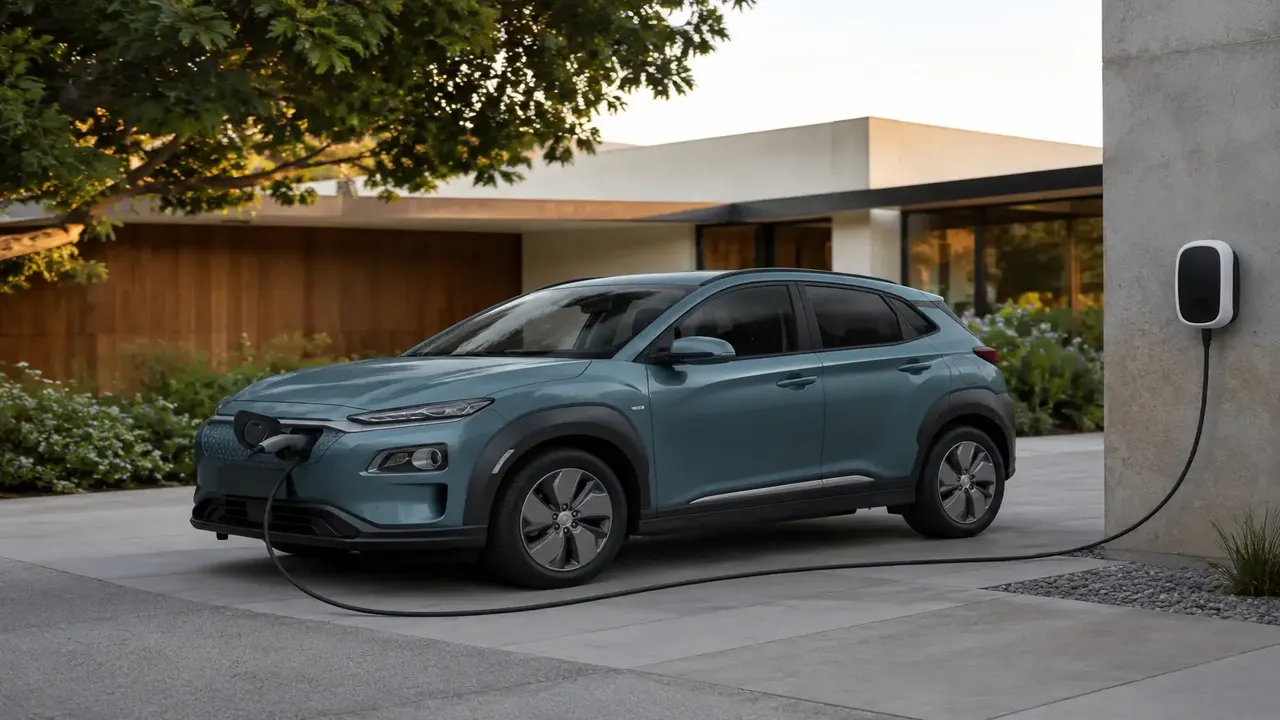
Portable EV chargers are compact EVSE units, usually supporting both 120V (Level 1) and 240V (Level 2) with adjustable amperage (typically 16-40A) and interchangeable plug adapters, letting you charge from a standard outlet, a dryer outlet, or an RV park pedestal. They cost $150-$500 depending on max amperage and included adapters, and are a smart purchase for renters without a dedicated home charger, frequent travelers, or as a backup if a fixed home charger fails.
At a glance
| Feature | Typical range |
|---|---|
| Voltage support | 120V and 240V (dual-voltage) |
| Adjustable amperage | 16-40A |
| Common plug adapters included | NEMA 5-15, 6-20, 10-30, 14-50 |
| Price band | $150-$500 |
Who actually benefits from a portable charger
Renters and apartment dwellers without a dedicated home charging setup, frequent travelers visiting family or cabins with only a standard outlet available, and homeowners who want a backup in case a fixed Level 2 charger needs service are the clearest use cases. For someone with a permanent home Level 2 charger and no travel needs, a portable unit is mostly redundant.
What makes a good one
- Adjustable amperage — lets the unit safely match whatever circuit is available, from a shared 15A household outlet to a dedicated 50A circuit.
- Interchangeable plug heads — NEMA 5-15 (standard outlet), 6-20, 10-30 (older dryer), and 14-50 (newer dryer/range/RV) cover the most common outlets you'll encounter.
- Compact housing with a carry bag — since portability is the entire point, bulk and weight matter.
- Weatherproof rating — needed for outdoor use at RV parks or driveways without covered parking.
Are they as fast as a fixed wall charger?
At matched amperage, yes — a portable unit set to 40A on a proper 50A circuit charges just as fast as a fixed 40A wall charger, since the charging speed is determined by amperage and voltage, not the physical form factor. The practical limitation is usually the outlet you have access to, not the portable unit itself.
Compatibility with NACS and CCS vehicles
Portable EVSE units are connector-specific just like fixed chargers — they don't inherently work across NACS and CCS/J1772 vehicles without a separate adapter. Confirm the unit's connector matches your vehicle, or budget for a compatible plug adapter if you need cross-compatibility.
Mistakes to avoid
Setting a portable charger's amperage higher than the outlet's circuit is rated for is a real fire risk — always confirm the circuit's breaker rating before selecting amperage, especially on unfamiliar outlets like those at a relative's house or an RV park. Also check UL certification (UL 2594/2231) before buying, since portable units vary widely in build quality.
Using a portable charger outdoors without confirming its weatherproof rating is another common issue — not all units are rated for rain or snow exposure, and using an unrated unit in wet conditions is a genuine safety hazard.
Frequently asked questions
Are portable EV chargers as fast as wall-mounted units?
Can I use a portable charger at any outlet?
Do portable chargers work with both NACS and CCS EVs?
Are portable EV chargers weatherproof?
Why does UL certification matter for portable chargers?
Sources & further reading
- U.S. Department of Energy — Alternative Fuels Data Center: EV Charging Levels
- UL — Electric Vehicle Supply Equipment Safety Standards
Figures, prices and policy details were current at the last-updated date above. Automotive pricing, incentives and regulations change frequently — verify time-sensitive details with the linked primary sources. Read our editorial policy and fact-checking standards.