The question is harder than it looks
Ask which cars are British and most people name the famous badges: Jaguar, Land Rover, Mini, Bentley, Rolls-Royce, Aston Martin, Lotus, McLaren.
Nearly all of those are foreign-owned. And several of Britain's largest car factories build vehicles wearing badges nobody thinks of as British at all.
"British car" has at least four possible meanings, and they give different answers:
- Who owns the brand?
- Where is it designed and engineered?
- Where is it assembled?
- Where do the components come from?
Untangling those is genuinely useful — for understanding the industry, and because in the tariff era it determines what a car costs.
Ownership: mostly not British
The famous badges are overwhelmingly foreign-owned:
- Jaguar Land Rover — owned by Tata Motors (India)
- Mini and Rolls-Royce — owned by BMW (Germany)
- Bentley — owned by the Volkswagen Group (Germany)
- Lotus — majority-owned by Geely (China)
- Vauxhall — part of Stellantis (multinational)
Remaining British-owned: McLaren and Aston Martin have complicated, internationally-invested ownership structures, and a handful of low-volume specialists remain independent.
But ownership is the least interesting measure, because it tells you almost nothing about where value is created or jobs exist.
Manufacturing: substantially British
This is where the picture reverses, and it's the part most people underestimate.
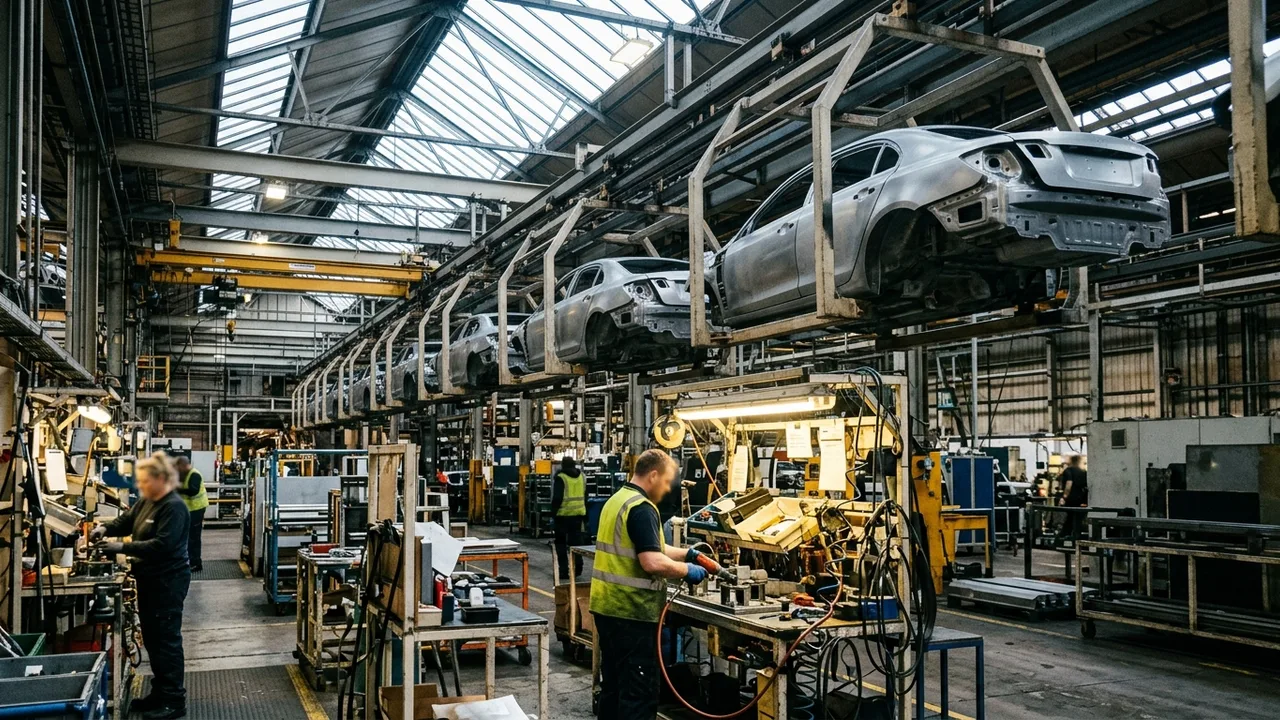
Britain builds a great many cars, and several of its largest plants produce vehicles under foreign badges:
- Nissan Sunderland — one of Britain's largest car plants
- Toyota Burnaston and the Deeside engine plant
- BMW Oxford — where Mini is built
- JLR's Solihull, Halewood and Wolverhampton operations
- Bentley Crewe, Rolls-Royce Goodwood, McLaren Woking, Aston Martin Gaydon and St Athan
So a Nissan built in Sunderland by British workers is, in manufacturing terms, more British than a Jaguar-badged car built abroad — a genuinely counterintuitive result that badge-based thinking obscures completely.
Design and engineering: a real British strength
Britain's motorsport and engineering cluster is world-leading and frequently invisible to consumers.
Formula One teams, specialist engineering consultancies and design houses based in Britain — particularly around the "Motorsport Valley" corridor — work on vehicles for manufacturers worldwide.
A car designed in Britain, built in Europe, wearing a Japanese badge is not unusual. This is where a substantial amount of British automotive value actually sits, and no badge reflects it.
Why this matters in the tariff era
This is where the question stops being trivia and becomes money.
As our tariff coverage established, origin determines cost. The UK–US Economic Prosperity Deal gives UK-built cars a 10% US tariff within a 100,000-vehicle annual quota — the best rate of any major exporter, though JLR alone nearly fills that quota. Above it, cars revert to 27.5%.
Crucially, that deal is about where cars are BUILT, not who owns the badge. A BMW-owned Mini built in Oxford qualifies as a UK export. A Jaguar-badged car built elsewhere would not.
Similarly, our India–UK CETA coverage found that qualifying UK-origin vehicles get progressively reduced Indian duties — with rules of origin requiring genuine UK manufacture and a TRQ certificate, explicitly to prevent third-country routing.
Origin is a legal and financial fact. The badge is marketing.
How to find out what you're actually buying
1. Check the VIN. As our parts-content piece explained, the first character indicates the country of assembly — S for the United Kingdom, W for Germany, J for Japan, K for Korea, 1/4/5 for the US, 3 for Mexico.
2. Look at the manufacturer's stated build location, usually available and sometimes on the documentation.
3. Remember that assembly isn't the whole story. As our AALA analysis noted for the US market, a car assembled in one country from components made elsewhere has its value originating elsewhere. Britain doesn't have an equivalent mandatory parts-content label, which is a genuine information gap for UK buyers.
4. Don't assume the badge tells you anything. It reliably tells you who markets the car. It tells you nothing about where it was made.
What this means
1. Foreign ownership is not the same as foreign manufacture. Britain's car industry employs large numbers of people building vehicles for foreign-owned brands. Those are British jobs producing British value, whatever the badge says.
2. British ownership doesn't guarantee British manufacture either.
3. The industry is genuinely international, and any framing that treats "British car" as a simple category misdescribes how modern manufacturing works.
4. In tariff terms, only manufacture counts — which is why the UK–US quota and the India CETA rules of origin are written around build location rather than ownership.
The bottom line
Almost every famous British car brand is foreign-owned, and several of Britain's biggest factories build cars wearing badges nobody thinks of as British.
A Nissan built in Sunderland is, in every meaningful manufacturing sense, more British than a Jaguar-badged car assembled abroad.
The four questions — who owns it, who designed it, where it's built, where the parts came from — give four different answers, and only the last two determine tariffs, jobs and cost.
Check the VIN's first character. Ignore the badge. In the tariff era, where a car was actually built is worth real money — and it's the one thing the marketing won't tell you.
Key takeaways
- Nearly every famous British badge is foreign-owned: JLR (Tata), Mini and Rolls-Royce (BMW), Bentley (VW Group), Lotus (Geely)
- Manufacturing reverses the picture — a Nissan built in Sunderland is more British in manufacturing terms than a Jaguar-badged car built abroad
- Britain's design and motorsport engineering cluster works on vehicles worldwide — substantial British value that no badge reflects
- In the tariff era only build location counts: the UK–US deal's 10% rate within a 100,000-car quota, and India's CETA rules of origin, are written around manufacture, not ownership
- Check the VIN's first character — S indicates UK assembly. The badge tells you who markets the car, not who built it
Sources & further reading
- UK automotive manufacturing data
- SMMT
- VIN standards. Verified July 2026.
Figures, prices and policy details were current at the last-updated date above. Automotive pricing, incentives and regulations change frequently — verify time-sensitive details with the linked primary sources. Read our editorial policy and fact-checking standards.