
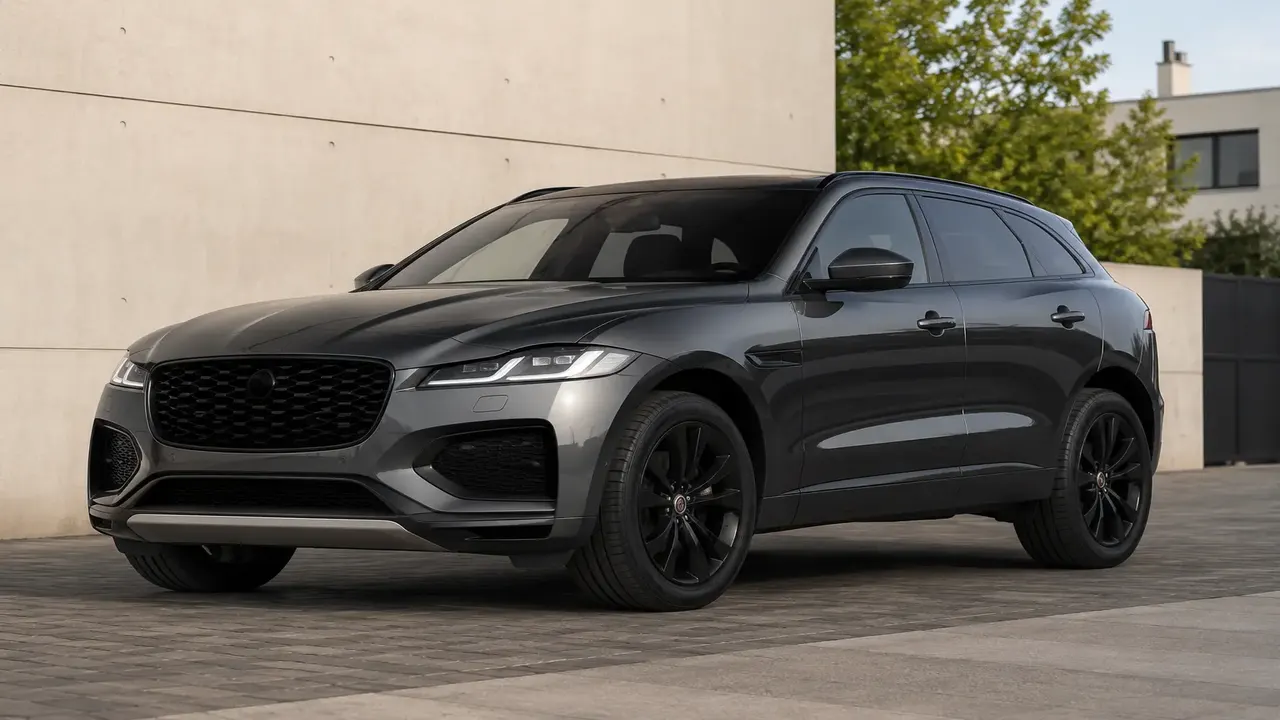


Vehicle Overview
The Jaguar F-Pace is the mid-size premium SUV Jaguar launched in 2016 on its own aluminium-intensive iQ-AL platform, sharing running gear with the XE and XF saloons and much of its structure with the Range Rover Velar. This page covers it as a used purchase in Britain, with the entry-level four-cylinder 2.0-litre diesel as its subject. “Base” is this page’s shorthand for that entry diesel; Jaguar UK never sold a trim under that name, and the car a buyer will actually find advertised is badged F-PACE, R-Dynamic S, R-Dynamic SE Black or R-Dynamic HSE Black depending on when it was registered.
The reason it is a used-buyer page is that Jaguar says so. On its own UK F-Pace page, read on 1 October 2026, the brand states: “Jaguar is being reimagined for a new era, but our commitment to new and existing owners remains. New sales of our current generation of vehicles have now ended. Services and maintenance remain accessible for owners.”
| Segment | Mid-size premium SUV |
| Body style | 5-door SUV, all-wheel drive, 8-speed automatic |
| Years sold new in the UK | 2016 to 2024, per Auto Express’s review heading; Jaguar now lists no new F-Pace for sale |
| Subject of this page | 2.0-litre four-cylinder diesel, all-wheel drive — the 163bhp D165 and 204bhp D200 after the 2021 renaming |
| Buying route today | Used only. Jaguar’s own site offers an Approved Used search and no configurator |
| Euro NCAP | Five stars, 2017 protocol — expired 1 January 2024 |
| Manufacturer warranty | Three years from the car’s first delivery, so expired on most F-Paces |
Jaguar has stopped selling new F-Paces in Britain
This is the single most important thing to establish before reading any price on any F-Pace review, and it is not a rumour: four separate checks on Jaguar’s own UK site on 1 October 2026 all point the same way.
First, the sentence quoted above sits on the F-Pace model page itself. Second, every call-to-action on that page is “Search F-Pace Approved” or “Search Approved Used” — there is no “build” or “configure” link anywhere in the page body. Third, the new-car buy path has gone: /build-your-own/ returns 404 on both jaguar.com/en-gb and jaguar.co.uk, and configure.jaguar.co.uk does not resolve at all. Fourth, Jaguar’s own “Purchase” menu now contains only Approved Used, insurance and accessories.
Carwow reaches the same conclusion from the outside: its F-Pace review lists “Can’t buy a new one anymore” among the car’s drawbacks. So treat any new on-the-road price you see quoted for an F-Pace as a historical list price, useful for one thing only — working out whether the car is caught by the £40,000 road-tax supplement explained below. If you want the brand’s own used stock, Jaguar’s Approved Used programme and an ordinary used car differ in warranty and preparation, and that difference is worth pricing.
What Jaguar’s diesel figures actually say
Jaguar’s own F-Pace WLTP data page, linked from the model page as “F-PACE WLTP”, now returns a 404 — the manufacturer no longer publishes the table for a car it no longer sells. The figures below therefore come from Auto Express’s prices-and-specs database for the UK 2.0-litre diesel, which reproduces the full WLTP set rather than a single combined headline.
WLTP publishes two combined figures for the same car: TEL, for the lightest and most economical set of options, and TEH, for the heaviest and least economical. The spread matters, because it is decided by the wheels and equipment on the specific used car in front of you.
| WLTP cycle | 2.0 D165 AWD auto — mpg |
|---|---|
| Combined (TEL, lightest options) | 45.4 |
| Combined (TEH, heaviest options) | 42.1 |
| Low phase (urban) | 36.5 – 37.6 |
| Medium phase | 43.4 – 46.5 |
| High phase | 48.5 – 52.7 |
| Extra High phase (motorway) | 39.3 – 42.9 |
| CO2, combined | 163 g/km |
Two things in that table are worth a buyer’s attention. The urban figure, 36.5 to 37.6 mpg, is the worst of the four phases, and the Extra High motorway phase at 39.3 to 42.9 mpg is the second worst — this is a 1,876 kg all-wheel-drive SUV, and sustained high speed costs it roughly a quarter of its best-case economy. The High phase, which is roughly A-road and dual-carriageway work, is where it does its best at up to 52.7 mpg.
The more powerful 204bhp D200 is barely thirstier on paper: Auto Express lists 43.9 mpg combined and 169 g/km for an R-Dynamic SE. Carwow puts the D200 at about 44 mpg and the six-cylinder D300 at about 37 mpg combined and calls both “pretty realistic figures in the real world”. If you are weighing the engines against each other, our guide to cutting the running costs of a car you already own covers the tyre, servicing and driving-style levers that move the real figure further than the badge does.
Where the sources disagree. Carwow states that “the D200 engine has exactly the same CO2 emissions as the cheaper 165hp engine, so there’s no tax savings in going for the most basic model”. Auto Express’s own data gives 163 g/km for the D165 and 169 g/km for a D200 R-Dynamic SE — six grams apart, and on opposite sides of no tax band that matters. Both positions are reported here as published. The figure that decides your bill is the one printed on the car’s V5C, not either outlet’s range, and our V5C logbook checklist explains where to find it.
Road tax depends on when the car was first registered
This is the section that changes what an F-Pace costs to keep, and it is the one most reviews skip. Britain runs two different vehicle-tax systems for cars of this age, and the dividing line falls right through the F-Pace’s production run.
Registered before 1 April 2017 — so the earliest F-Paces, including launch cars — pay a flat annual rate set by the car’s CO2 band, with no expensive-car supplement at all. From GOV.UK’s current tables, read 1 October 2026:
| Band (CO2) | Annual rate, 12-month payment |
|---|---|
| D: 121 to 130 g/km | £170 |
| E: 131 to 140 g/km | £200 |
| F: 141 to 150 g/km | £225 |
| G: 151 to 165 g/km | £275 |
| H: 166 to 175 g/km | £325 |
Registered on or after 1 April 2017 pays a flat standard rate of £200 a year from the second licence onwards, regardless of emissions — but adds £440 a year on top if the car’s original list price was over £40,000, making £640 a year. GOV.UK is explicit that the supplement runs “for 5 years (from the second time the vehicle is taxed)” and that the list price is “the published price of the vehicle before it’s registered for the first time”, before any discount.
For an F-Pace that matters a great deal, because almost every one of them listed above £40,000 new. The practical consequence is a cliff edge in ownership cost by age: a car first registered six or more years ago has finished its five supplement years and now costs £200 a year, while a two- or three-year-old one is still paying £640. On a car advertised at £23,500, that is a £440-a-year difference that no listing mentions.
One correction worth making explicitly: Carwow’s F-Pace review puts the supplement at £410. GOV.UK’s current table reads £440. Government-set rates change every April, so take them from GOV.UK and not from a review of any vintage — the same discipline we apply in our coverage of the April 2026 VED changes. The first-year CO2 rate, incidentally, is never a used buyer’s problem: it is paid once, by whoever registered the car new. At 163 g/km that was £1,410 for a diesel meeting the RDE2 standard and £2,270 for one that does not.
Safety: five stars that have expired
Euro NCAP crash-tested the F-Pace in 2017, and the car it crashed was a Jaguar F-Pace 20d AWD, right-hand drive, at a kerb weight of 1,874 kg. That is unusually helpful: the tested car is precisely the version this page is about, rather than a left-hand-drive variant Britain never received. The assessment’s variants table extends the rating to the 2.0 petrol, 3.0 V6 petrol and 3.0 V6 diesel as well, all 4x4.
It earned five stars, with 93% for adult occupant protection, 85% for child occupant, 80% for vulnerable road users and 72% for safety assist. The rating expired on 1 January 2024. Euro NCAP’s own rating-validity log on the assessment page records it published on 13 December 2017, annually reviewed on 13 December 2018 and 13 December 2019, reviewed again after the facelift on 13 December 2020, reviewed on 22 December 2021, and expired on 1 January 2024.
Expiry is not a downgrade and is not evidence the car became less safe. It means there is no longer a result comparable with cars assessed under current protocols, so the car should be judged on its standard equipment and on the per-measure detail of the original test. We explain the mechanics in our guide to how Euro NCAP ratings work and why they lapse.
The per-measure detail is worth reading, because the headline five stars hide four marginal results. In the full-width rigid-barrier test, protection of the rear passenger’s chest was rated marginal on rib compression. In the frontal offset test, the 10-year-old child dummy’s neck was marginal on neck tension. A geometric assessment of the rear seats indicated marginal whiplash protection, although the front seats and head restraints tested good. And for pedestrians, head protection was mostly good or adequate across the bonnet but recorded weak and poor results on the stiff windscreen pillars, with pelvis protection mixed between good and poor.
The strong results are genuinely strong. Both the side barrier impact and the more severe side pole test returned good protection of every critical body area and maximum points, 16 out of 16. The frontal offset test protected knees and femurs well for both dummies. The standard-fit autonomous emergency braking scored 2.9 of 3 at city speeds, took maximum points in the pedestrian-detection tests, and avoided or mitigated collisions in all highway-speed tests. Seatbelt reminders front and rear, a driver-set speed limiter and lane-departure warning were all standard. One caveat from Euro NCAP itself: the F-Pace shares much of its structure with the Range Rover Velar, tested in October 2017, and in some cases the Velar’s results were used for this assessment.
Warranty, recalls and the reliability record
Jaguar’s UK ownership pages, read on 1 October 2026, set out a three-year manufacturer’s warranty from the day a new Jaguar is collected. On a car whose new sales have ended, that means the original warranty has lapsed on the overwhelming majority of F-Paces on sale, and the page the previous version of this review cited — a five-year, 60,000-mile term — was never a UK arrangement at all.
Two cover periods do still travel with an older car. The paint warranty runs three years from first delivery regardless of mileage, and the corrosion warranty runs six years from first delivery, “regardless of mileage or any change of ownership” — Jaguar’s own wording, and the one term a second or third owner can still claim on. Jaguar also sells extended warranties to pick up where the three years stop. Buying through Jaguar’s Approved Used programme adds its own cover: every listing read this week carried “up to 24 months warranty” and roadside assistance, and Jaguar is running an offer doubling both for Approved Used cars bought on PCP or HP finance between 1 October 2026 and 31 December 2026. Our guide to how UK manufacturer warranties are structured covers what transfers and what does not.
Recalls are the checkable risk here. Carwow records that the F-Pace has had five recalls in the UK, for detaching driveshafts, fuel leaks, fire risk and CO2 emissions issues. Recall work is free and is logged against the vehicle, so this is something to verify on the specific car rather than worry about in the abstract — ask the selling dealer for a recall check by VIN, and run the usual provenance and finance checks at the same time.
On everyday reliability the picture is better than Jaguar’s reputation suggests, with one caveat. Carwow reports the F-Pace finished 13th in the 2024 Driver Power Top 50 Cars To Own, with owners rating it relatively well for reliability and quality, and Jaguar itself placing 9th of 32 brands in the wider satisfaction survey — while 43% of owners reported faults with their cars. Carwow’s own summary is that core items such as engines and gearboxes have largely held up, but that owners commonly report electrical niggles. It also notes that the engines with the best reliability record are the ones derived from older Ford designs: the 3.0-litre V6 diesel, the 3.0-litre supercharged V6 petrol and the 5.0-litre supercharged V8 — none of which is the four-cylinder diesel this page covers. A methodical pre-purchase inspection, with every electrical function exercised, is the right response to that.
Boot space: three published numbers, none of them matching
The F-Pace’s luggage capacity is a good example of why a single figure copied from a press release is worth little. Auto Express’s data gives 583 litres seats-up for the D165 and 601 litres for a D200 R-Dynamic SE. Carwow gives 1,440 litres with the rear seats folded, and 552 litres for the P400e plug-in hybrid, whose battery eats into the floor. Jaguar’s own current page advertises 1,842 litres of loadspace — but its footnote says that is a wet volume, measured by simulating the loadspace filled with liquid, on the F-Pace SVR 575 Edition.
Those are three different measurements of three different things, and they should not be averaged or reconciled. If maximum load volume is the reason you are buying the car, measure the one in front of you with the load you actually carry. The useful structural facts are consistent across sources: the rear seats split and fold 40:20:40, there is extra storage under the boot floor, and the loading lip is flat — though Carwow notes the metal cover on that lip scratches easily, which is a thing to look at on a used example.
What a used F-Pace costs today
Jaguar’s own Approved Used search, read on 1 October 2026 with the range filter set to F-Pace and the radius set to nationwide, returned “30+ used vehicles found”. Prices on the first page of results, in Jaguar’s default newest-listed order, ran from £19,495 to £59,990. Three of those listings show the shape of the market:
| Car | Registered | Mileage | Price | Retailer |
|---|---|---|---|---|
| F-Pace Chequered Flag AWD, 2.0 diesel automatic | 2020, 70 plate | 32,789 | £21,500 | Sytner Jaguar, Maidstone |
| F-Pace R-Dynamic S, D200 diesel automatic | 2022, 22 plate | 37,931 | £23,500 | Pentland Jaguar, Dundee |
| F-Pace R-Dynamic HSE Black 90th Anniversary Edition, D200 | 2025, 74 plate | 35,146 | Listed, price varies by retailer | Jaguar Approved network |
That is roughly £21,500 for a five-year-old four-cylinder diesel with a third of its likely life behind it, against a list price that started north of £40,000 — and it is why the road-tax cliff edge above is worth more to a buyer than another paragraph about steering feel. Because this is a brand that has stopped selling new cars, residuals are a live question rather than a settled one, so there is more room than usual to negotiate on a used price.
What independent testers concluded
Auto Express rates the F-Pace 4.0 out of 5, in a review by Shane Wilkinson dated 28 July 2023 and now carried under the heading “Jaguar F-Pace (2016-2024) review” with a banner noting it is an older review of a superseded car. Its judgement is that the F-Pace is “a front runner in the mid-sized premium SUV class” and that where the car has a real edge over its rivals is the way it drives, with lots of grip and good body control, staying composed on bumpy roads without surrendering much comfort. It criticises the manual shift paddles as producing more sluggish changes than leaving the eight-speed automatic alone, and rates the optional Dynamic Pack, around £2,900 with adaptive dampers, as worth choosing.
Carwow rates it 8 out of 10, in a review published 21 December 2022 and last updated 20 December 2024. Its stated positives are that this is one of the best large SUVs to drive, that the updated infotainment is good, and that it is keenly priced yet well equipped; its negatives are that you cannot buy a new one any more, road noise on larger wheels, and some fiddly switchgear.
Both outlets name the same rivals, and three of them have current reviews here: the BMW X3, the Volvo XC60 and the Porsche Macan, with the Alfa Romeo Stelvio as the other driver’s choice in the class. Within Jaguar’s own range the closest alternatives are the smaller E-Pace and the electric I-Pace; the XE saloon shares the F-Pace’s platform.
The wider engine range, and what changed when
Jaguar renamed and revised the F-Pace line-up more than once, which is why used adverts use several naming conventions for the same car. Auto Express records a facelift in late 2020 that left the exterior largely alone but significantly overhauled the cabin, most visibly by fitting the 11.4-inch Pivi Pro touchscreen; a further round of updates in 2023 enlarged the P400e plug-in hybrid’s battery to 19.2 kWh and raised its electric range to around 40 miles; and a slimming of the range in 2023 that made R-Dynamic S the entry point, above it R-Dynamic SE Black, and R-Dynamic HSE Black at the top.
| Engine | Power | 0–62 mph | Notes |
|---|---|---|---|
| 2.0 D165 diesel | 163bhp | 9.9 s | Entry diesel; 121 mph; 163 g/km |
| 2.0 D200 diesel | 201bhp or 204bhp, depending on the source | 8.0 s or 8.2 s | 430 Nm; the all-rounder pick of both outlets |
| 3.0 D300 six-cylinder diesel | 296bhp | 6.4 s | About 37 mpg combined; the more reliable diesel per Carwow |
| 2.0 P250 petrol | 246bhp | 7.3 s | The only engine without mild-hybrid assistance |
| 3.0 P400 six-cylinder petrol | 395bhp | 5.4 s | 400 Sport models only |
| P400e plug-in hybrid | 398bhp | 5.3 s | 19.2 kWh battery from 2023; 552-litre boot |
| 5.0 V8 SVR | 542bhp | 4.0 s | 700 Nm, 178 mph |
The D200’s figures are a genuine disagreement inside one outlet: Auto Express’s written review gives 201bhp and 8.2 seconds, while its own prices-and-specs entry for a D200 R-Dynamic SE gives 204bhp and 8.0 seconds. Both are reported here rather than silently averaged. On the plug-in hybrid, note that Jaguar’s current page advertises a WLTP expected real-world range of up to 64 km, or 40 miles, and emissions from 39 g/km, while Carwow’s review — written before the 2023 battery enlargement — records 49 g/km and a 33-mile claim that it reckoned was nearer 25 miles in practice, and warns that a P400e running on a flat battery on a long motorway journey is likelier to return around 35 mpg than the 129 mpg on the certificate.
Buyer checkpoints for this specific car
| What to check | Why it matters on an F-Pace |
|---|---|
| The registration date on the V5C | It decides which of two road-tax systems applies, and whether the £440 expensive-car supplement is still running. The gap between a car past its five supplement years and one still inside them is £440 a year. |
| The CO2 figure on the V5C, not in the advert | Auto Express and Carwow disagree about whether the D165 and D200 share an emissions figure. The certificate settles it for your car. |
| Wheel size against the published economy spread | WLTP gives 45.4 mpg for the lightest option set and 42.1 for the heaviest. Larger wheels also draw Carwow’s road-noise criticism. |
| Recall history by VIN | Five UK recalls are recorded for this model, including detaching driveshafts, fuel leaks and fire risk. Work is free; confirm it was done. |
| Every electrical function, individually | Electrical faults are the commonly reported complaint, against a 43% owner-reported fault rate for the brand in Driver Power 2024. |
| Remaining corrosion cover | Six years from first delivery, transferable with ownership — the one factory term a later owner can still use. |
| Whether it is an Approved Used car | Approved listings carried up to 24 months of warranty and roadside assistance, doubled on finance purchases made between 1 October and 31 December 2026. |
| Boot volume with your own load | Published figures range from 583 to 1,842 litres and measure different things. Bring the pram, the dog crate or the golf bag. |
Overall Rating
4.0 / 5
True Motion Auto has not independently road-tested this vehicle. Specifications, pricing and performance figures are compiled from manufacturer technical data and published independent tests, and are attributed where quoted. Our score reflects a structured research assessment of specifications, pricing, safety data and owner feedback for the segment — not an independent road test. Read how we review cars.
Four out of five, revised down from a previous 4.3 to sit level with both independent verdicts on record — Auto Express’s 4.0 of 5 and Carwow’s 8 of 10. The driving dynamics and the cabin earn the score; the expired safety rating, the five recalls and the brand’s fault rate are what keep it from going higher.
Final Verdict
As a used purchase the four-cylinder diesel F-Pace makes a straightforward case: a genuinely good-driving premium SUV, with a cabin that was overhauled in 2020, at around £21,500 for a five-year-old example of a car that listed well above £40,000. Economy in the low-to-mid forties is competitive rather than class-leading, and the motorway phase figure is the one to plan around.
The things that should decide the purchase are not the ones a road test covers. Check the registration date for the road-tax band, confirm the recall work on the specific VIN, exercise every electrical function, and remember that the factory warranty has almost certainly expired while the six-year corrosion cover may not have. Because Jaguar has stopped selling new cars here, service and parts support continues but residual values are an open question — which is an argument for negotiating hard rather than for staying away.
Frequently asked questions
Can you still buy a new Jaguar F-Pace in the UK?
What fuel economy does the Jaguar F-Pace 2.0 diesel actually return?
How much is road tax on a used Jaguar F-Pace?
Is the Jaguar F-Pace’s five-star Euro NCAP rating still valid?
How many recalls has the Jaguar F-Pace had?
What warranty is left on a used Jaguar F-Pace?
Sources
All figures on this page were collected on 1 October 2026 from the following named sources. Where sources disagree, both positions are stated above rather than reconciled.
| Source | Used for |
|---|---|
| Jaguar UK, F-Pace model page (jaguar.com/en-gb), read 1 October 2026 | The statement that new sales of the current generation have ended; the absence of any new-car buy path; the Approved Used calls-to-action; the 1 October to 31 December 2026 double-warranty offer; the 1,842-litre wet-volume loadspace figure and its SVR footnote; the plug-in hybrid’s 64 km / 40-mile WLTP range and 39 g/km emissions; Pivi Pro and Interactive Driver Display screen sizes |
| Jaguar UK, “F-PACE WLTP” data page linked from the model page | Checked and found to return HTTP 404 — recorded as the reason the WLTP table below comes from Auto Express rather than the manufacturer |
| Jaguar UK, standard and extended warranty page | Three-year manufacturer’s warranty from collection; the availability of extended warranties after it expires |
| Jaguar UK, paint and corrosion warranty page | Three-year paint warranty regardless of mileage; six-year corrosion warranty regardless of mileage or change of ownership |
| Jaguar Approved Used search (buy.jaguar.co.uk), F-Pace nationwide, read 1 October 2026 | “30+ used vehicles found”; the £19,495 to £59,990 spread on the first page of results; the three named listings, their plates, mileages, prices and retailers; the “up to 24 months warranty” label on every listing |
| Auto Express, Jaguar F-Pace Estate 2.0 D165 5dr Auto AWD prices and specifications | Full WLTP economy set including all four phases and both TEL and TEH figures; 163 g/km; 163bhp; 0–62 mph in 9.9 s; 121 mph; 583-litre boot; 1,876 kg minimum kerb weight; 60-litre tank; insurance group 28E; exterior dimensions; standard equipment |
| Auto Express, Jaguar F-Pace Estate 2.0 D200 R-Dynamic SE prices and specifications | 204bhp; 0–62 mph in 8.0 s; 130 mph; 43.9 mpg WLTP combined; 169 g/km; 601-litre boot |
| Auto Express, “Jaguar F-Pace (2016-2024) review”, Shane Wilkinson, 28 July 2023 | The 4.0/5 verdict and its reasoning; the 2016-2024 sales window; the late-2020 facelift and the 2023 updates and range slimming; the full engine line-up with power and 0–62 times; the iQ-AL platform and its relationship to the XE, XF and Range Rover Velar; the Dynamic Pack price; the named rivals |
| Carwow, Jaguar F-Pace review, published 21 December 2022, updated 20 December 2024 | The 8/10 verdict with its stated pros and cons including “can’t buy a new one anymore”; approximate real-world economy for the D200 and D300; the claim that the D165 and D200 share a CO2 figure; the 1,440-litre seats-folded and 552-litre P400e boot figures; 40:20:40 split folding and the scratch-prone load-lip cover; five UK recalls and their subjects; the electrical-fault pattern; the 2024 Driver Power placings and the 43% fault rate; the Ford-derived engines’ reliability record; the £410 supplement figure that GOV.UK now puts at £440 |
| Euro NCAP, Jaguar F-Pace assessment (published 13 December 2017) | Five-star rating and all four category scores; the tested model — F-Pace 20d AWD, right-hand drive, 1,874 kg; the variants table; the rating-validity log through to expiry on 1 January 2024; the per-measure commentary on chest, child neck, rear-seat whiplash, windscreen pillars, pelvis, side impacts and AEB; the Range Rover Velar structural note |
| GOV.UK, vehicle tax rate tables, read 1 October 2026 | Both VED systems: the pre-April-2017 CO2 band rates; the £200 standard rate from the second licence; the £440 expensive-car supplement, the £40,000 threshold, its five-year duration and the definition of list price; the 151–170 g/km first-year rates for RDE2 and non-RDE2 diesels |
Change log
1 October 2026 — rebuilt as a used-buyer review, and the market framing corrected. This page previously presented the F-Pace as a car a reader could order new, with a “Compare current offers” heading and a “Ready to claim your F-Pace?” line beneath it. Jaguar has ended new sales of the model in Britain and says so on its own F-Pace page, so the review has been rewritten around a used purchase. The old version was also a United States review sitting on a UK URL: it gave fuel economy as “27 mpg combined (est.)” and headed the section “Combined (US EPA cycle)” on a British page, quoted power in horsepower and acceleration to 60 rather than 62 mph, claimed a five-year 60,000-mile basic warranty that is not a UK term, printed a “UK MSRP From £31,000” using an American pricing label, listed a 68-litre fuel tank and a 650-litre boot where Auto Express’s UK data gives 60 litres and 583 litres, gave a kerb weight of about 1,835 kg against a published 1,876 kg, built a rivals table around United States city-and-highway economy pairs, and presented the 2017 Euro NCAP five-star rating as a current fact when it expired on 1 January 2024. An unsourced “(2016–)” generation claim has been removed from the heading, the meta keywords tag has been dropped, the generic buyer-checkpoint and frequently-asked-question blocks have been replaced with F-Pace-specific sourced material, and the overall score has been revised from 4.3 to 4.0 to match the two independent verdicts on record. Every figure above was replaced with Jaguar UK, Euro NCAP, GOV.UK, Auto Express and Carwow data collected on the date of this note.
Specifications, prices and equipment were current at publication and vary by model year, trim and market. Verify final details with a franchised dealer before ordering. Read how we review cars and our editorial policy.