The shortage that taught the industry a lesson
For decades, the automotive industry treated semiconductors as commodity components — cheap, plentiful, and beneath strategic attention.
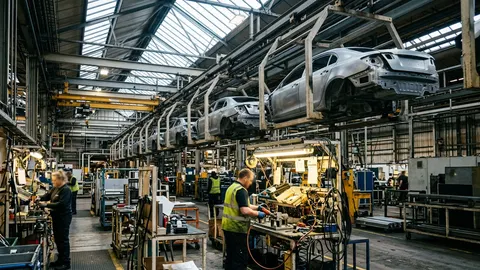
Then a shortage stopped production lines worldwide, and the industry discovered that a car cannot be completed without a chip costing a fraction of a percent of its value.
The lesson was expensive and instructive: in a modern vehicle, semiconductors are not peripheral. They are, increasingly, the product.
What's actually in a car
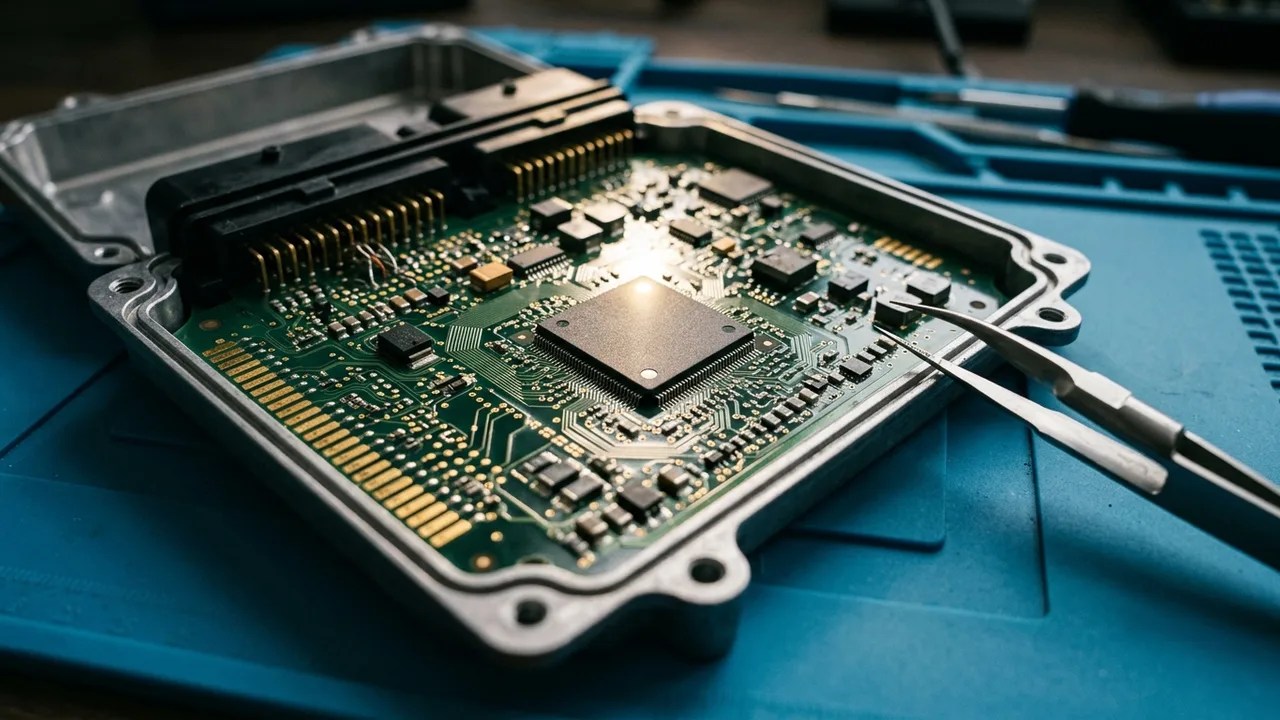
A modern vehicle contains hundreds of semiconductors, and they fall into genuinely different categories that behave differently:
1. Microcontrollers (MCUs). The workhorses — dozens per car, running individual functions: window motors, seat adjustment, lighting, climate. Individually cheap, collectively essential, and typically manufactured on older, mature process nodes.
2. Power semiconductors. Managing high-current electrical systems. Enormously important in EVs, where they control the flow between battery and motor — and where silicon carbide (SiC) has become significant because it handles high voltage more efficiently, directly improving range.
3. Sensors. Cameras, radar, ultrasonic and increasingly lidar — feeding the driver-assistance systems that, as our safety coverage argues, genuinely prevent crashes rather than merely surviving them.
4. Processors and SoCs. The high-performance chips running infotainment, driver assistance and increasingly the vehicle's central computing. These are the ones built on advanced nodes, and where the automotive industry competes with consumer electronics for capacity.
5. Memory. Increasingly substantial as software grows.
Why the shortage happened
The causes are instructive because several were self-inflicted:
1. Just-in-time ordering met a demand shock. When vehicle demand fell sharply, manufacturers cancelled chip orders. Semiconductor capacity was immediately reallocated to consumer electronics, where demand was surging. When vehicle demand recovered, the capacity was gone.
2. Automotive chips are frequently made on older nodes. Counterintuitively, the problem chips were often the cheap, mature ones — and there was limited commercial incentive to expand capacity for low-margin legacy products.
3. Automotive qualification is slow and demanding. Chips must meet stringent temperature, vibration and longevity standards over long service lives. You cannot simply substitute a consumer part.
4. The supply chain was deeper than anyone had mapped. Many manufacturers didn't know which chips were in their vehicles, because they bought modules from suppliers who bought from other suppliers.
5. Concentration. Semiconductor manufacturing is geographically concentrated, creating single points of failure.
What changed as a result
1. Manufacturers now map their silicon supply chains, frequently contracting directly with chip makers rather than relying on tier-one suppliers.
2. Some hold strategic inventory, abandoning pure just-in-time for critical components.
3. Chip content is being rationalised. Some manufacturers are reducing the number of separate controllers by consolidating functions into fewer, more capable computers — which is architecturally significant.
4. Software-defined vehicle architectures are accelerating. Instead of dozens of single-purpose controllers, centralised computing running software modules — fewer chips, more capability, and easier updating.
5. Semiconductors became a strategic and political matter, with substantial government investment in domestic capacity across several markets.
Why this matters to a buyer
This isn't only industrial trivia — it affects what you're buying:
1. Software quality is now a primary quality signal. As our Gen Z piece found, younger buyers judge in-car software against phones, and our reviews repeatedly identify laggy interfaces as genuine daily irritations — the MG Windsor's 15.6-inch screen being our sharpest example.
2. Over-the-air updates change the ownership proposition. As our re-testing policy established, a car can genuinely improve — or degrade — after purchase. That's only possible because of the computing architecture underneath.
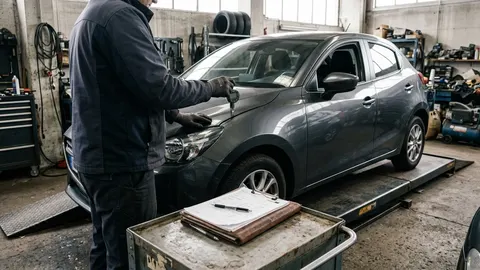
3. Repairability is affected. More semiconductors and more integration mean more that requires dealer-level diagnostic equipment. As our Corolla then-and-now analysis found, complexity is one of the two genuine regressions of modern motoring — and this is why.
4. Longevity questions are real and under-discussed. A car built to last 15–20 years contains electronics whose supported lifespan may be shorter. What happens when a central computer fails on a 12-year-old vehicle and the part is obsolete? This is a genuine unanswered question, and it's worth asking manufacturers.
5. Silicon carbide directly improves EV range, which is a rare case of a component choice with a directly measurable consumer benefit.
The uncomfortable question
Modern cars are becoming computers that move, and that carries a risk the industry hasn't fully answered.
Consumer electronics have short supported lifespans. Cars have long ones. Those two facts are in tension, and the resolution isn't obvious.
As our archive retrospectives noted, the original Land Rover and the Hindustan Ambassador endured partly because they could be fixed anywhere with basic tools. A vehicle dependent on proprietary electronics and manufacturer software support has a different, and shorter, practical lifespan — whatever its mechanical durability.
That's a genuine loss, and it's rarely discussed because it manifests slowly.
The bottom line
Semiconductors went from unremarked commodity components to the industry's defining constraint, and a shortage of cheap, mature chips halted global production because nobody had mapped how deeply they mattered.
The response has been structural: direct supply relationships, strategic inventory, chip rationalisation, and a shift toward centralised software-defined architectures with fewer, more capable computers.
For buyers, the consequences are real. Software quality is now a primary quality signal. Over-the-air updates can improve or degrade a car after purchase. Repairability has genuinely declined. And silicon carbide directly improves EV range.
The unresolved question is longevity. Cars are built to last decades; consumer electronics aren't. The industry has not adequately answered what happens to a software-defined vehicle when the software stops being supported — and it's a question worth asking before the answer arrives in fifteen years' time.
Key takeaways
- A shortage of cheap, mature chips — not advanced ones — halted global vehicle production, because nobody had mapped how deep the supply chain went
- Modern cars contain hundreds of semiconductors across microcontrollers, power electronics, sensors, processors and memory
- Silicon carbide directly improves EV range by handling high voltage more efficiently — a rare component choice with a measurable consumer benefit
- The industry response is structural: direct supply relationships, strategic inventory, and centralised software-defined architectures with fewer, more capable computers
- The unresolved question is longevity — cars last decades, consumer electronics don't, and repairability has genuinely declined as a result
Sources & further reading
- Semiconductor industry analysis
- automotive supply chain reporting
Figures, prices and policy details were current at the last-updated date above. Automotive pricing, incentives and regulations change frequently — verify time-sensitive details against the primary sources listed below. Read our editorial policy and fact-checking standards.