📚 MODEL CHRONOLOGY.
America's sports car
The Corvette has occupied a specific and unusual position for over seven decades: America's sports car, singular, with no serious domestic rival for most of its existence.
Its chronology is unusually clean — eight generations, consistently named C1 through C8 — which makes it one of the most legible histories in motoring.
The generations
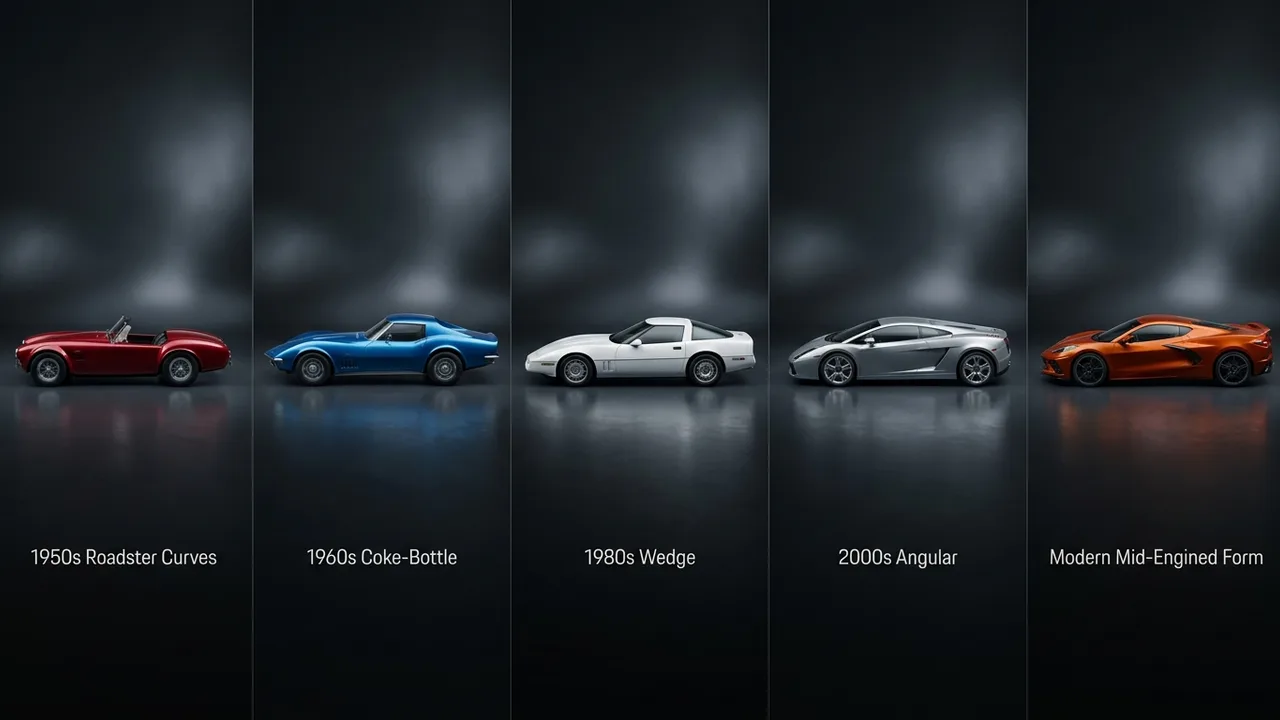
C1 (1953–1962). The original. Fibreglass body, initially underpowered with a six-cylinder engine, and nearly cancelled early. The arrival of V8 power transformed it from a styling exercise into a genuine sports car.
C2 Sting Ray (1963–1967). For many the definitive Corvette — independent rear suspension, dramatic styling, and the split-window coupe that remains among the most coveted American cars ever built.
C3 (1968–1982). The longest generation, spanning the muscle-car peak and the emissions-and-oil-crisis collapse. Late C3s were dramatically less powerful than early ones, and the generation is a clear illustration of how regulation and fuel prices reshaped American performance.
C4 (1984–1996). Substantial modernisation — better chassis, better technology, and a genuine return to capability after the C3's decline.
C5 (1997–2004). A major engineering advance: rear-mounted transaxle for better weight distribution, and the LS engine family that would define GM performance for decades.
C6 (2005–2013). Refinement of the C5 formula, with the Z06 and ZR1 establishing genuine supercar-rivalling capability at a fraction of European prices.
C7 (2014–2019). The last front-engined Corvette, and widely regarded as an excellent one — sharper, better built, and a fitting conclusion to sixty-six years of the layout.
C8 (from 2020) — the transformation. The mid-engine change, after decades of speculation.
C8 E-Ray (from 2023). The first electrified Corvette — a hybrid with an electrically-driven front axle, making it also the first all-wheel-drive Corvette.
The two decisions that mattered
1. Going mid-engined (C8).
This was the most consequential change in the car's history, and it had been rumoured for decades before it happened.
The engineering case was straightforward: the front-engine layout had reached its limit. Putting the engine behind the driver improves weight distribution, traction and handling balance fundamentally — which is why essentially every supercar uses it.
The cultural case against was substantial. The front-engine V8 layout was the Corvette to a large constituency, and abandoning it risked the identity.
GM went anyway, and produced a car that competes credibly with European mid-engined machinery at dramatically lower prices. Our archive coverage of the Ferrari 512TR noted that the famous version isn't always the best version — here the reverse applies: the new layout is measurably better and had to overcome the famous one.
2. Going hybrid (E-Ray).
The E-Ray's electrically-driven front axle delivers all-wheel drive without a driveshaft — a genuinely elegant packaging solution — and instant torque fill.
It's also a signal. As our coverage of the wider market found, electrification is arriving through hybridisation more successfully than through pure-electric replacement in performance and truck segments. The E-Ray is the Corvette's version of the argument the F-150 PowerBoost makes in its own segment.
What the chronology reveals
1. Value has always been the Corvette's weapon. Across generations, its consistent proposition has been supercar capability at substantially lower prices — which is why it survived when American rivals didn't.
2. Regulation reshaped it dramatically. The C3's power collapse is the clearest illustration in American motoring of how emissions rules and oil prices changed performance cars.
3. The mid-engine change proves identity can survive architecture. As our Defender and 911 chronologies both found, purists resist fundamental change and are usually wrong about the consequences.
4. Electrification arrived as assistance, not replacement — consistent with the pattern across American performance and trucks.
The bottom line
The Corvette's eight generations track American performance motoring completely — the optimism of the C2, the regulatory collapse of the late C3, the engineering recovery of the C5, and the transformation of the C8.
Two decisions defined the modern car. Going mid-engined was the most consequential change in seventy years and required overcoming an identity built on the opposite layout. It was measurably right. Going hybrid with the E-Ray delivered all-wheel drive without a driveshaft and signalled how American performance is actually electrifying — through assistance rather than replacement.
The through-line is value. Supercar capability at prices Europe cannot match has been the Corvette's argument since the C2, and it remains the reason it exists.
Key takeaways
- Eight generations, cleanly named C1 to C8 — one of the most legible chronologies in motoring, tracking American performance completely
- The C3's power collapse is the clearest illustration of how emissions rules and oil prices reshaped American performance cars
- Going mid-engined (C8) was the most consequential change in seventy years — resisted on identity grounds and measurably right
- The E-Ray's electrically-driven front axle delivers all-wheel drive without a driveshaft, and signals electrification arriving as assistance rather than replacement
- Value is the through-line: supercar capability at prices Europe cannot match, consistently, since the C2
Sources & further reading
- Chevrolet historical records
Figures, prices and policy details were current at the last-updated date above. Automotive pricing, incentives and regulations change frequently — verify time-sensitive details against the primary sources listed below. Read our editorial policy and fact-checking standards.