📚 MODEL CHRONOLOGY. Details drawn from Land Rover records and established sources.
Nearly eighty years of one idea
As our archive retrospective described, the original Land Rover was sketched in the sand at Red Wharf Bay and shaped almost entirely by post-war constraints — aluminium because steel was rationed, flat panels because tooling was expensive, an interior you could hose out.
Every constraint became a virtue in the field. That's the foundation, and the lineage that followed is the story of an idea that kept working.
The lineage
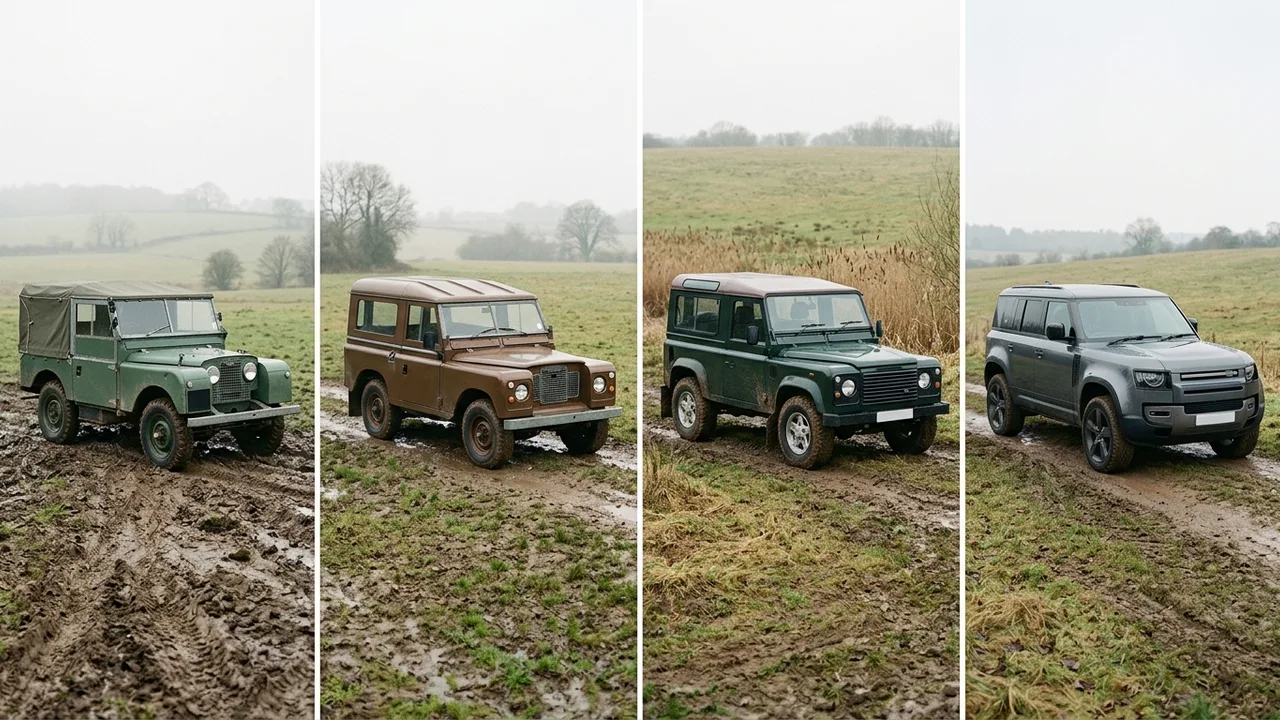
Series I (from 1948). The original. Aluminium body, simple mechanicals, genuine four-wheel drive, and a brief that was agricultural rather than aspirational. Conceived as a stopgap; became one of the longest-lived designs in history.
Series II and IIA (1958–1971). Refinement of the formula — improved bodywork, better engines, and the establishment of the distinctive silhouette that would persist for decades. The IIA in particular became the archetype, and is the shape most people picture.
Series III (1971–1985). Further development, improved transmission and interior, and continued global military and agricultural service.
Ninety, One Ten and One Two Seven (from 1983). The significant modernisation: coil-spring suspension replacing leaf springs, permanent four-wheel drive, and substantially improved ride and capability. Named by wheelbase in inches. This is the architecture that became "the Defender."
Defender (name adopted 1990). The name arrived to distinguish the utilitarian model from the Discovery, and the vehicle continued largely unchanged in character — increasingly anachronistic, increasingly beloved, and increasingly difficult to reconcile with modern safety and emissions requirements.
Production of the classic Defender ended in 2016, after nearly seven decades of continuous descent from the 1948 original.
New Defender (from 2019). A clean-sheet design on a monocoque platform — not a body-on-frame descendant of the original. Genuinely capable off-road, substantially more refined, dramatically safer, and comprehensively more comfortable.
Defender Octa (from 2024). The high-performance flagship — extreme capability, substantial power, and a positioning that would have baffled anyone in 1948.
The argument about the new one
This is the interesting part of the chronology, and it's a genuine disagreement worth setting out fairly.
The case that it isn't a real Defender:
- It's a monocoque, not body-on-frame — a fundamental architectural break
- It's expensive and comfortable, where the original was cheap and utilitarian
- It's bought largely as a lifestyle vehicle, not a working tool
- It cannot be repaired in a field, which as our retrospective argued was the original's defining practical virtue
- The Octa in particular is a performance flagship, which is conceptually distant from an agricultural stopgap
The case that it is:
- It's genuinely, exceptionally capable off-road — not a styling exercise
- The original evolved constantly too; the leaf-to-coil transition was also a fundamental change
- A vehicle that couldn't meet modern safety and emissions standards couldn't be sold at all. The alternative to the new Defender wasn't the old one — it was nothing
- It's commercially successful, which funds the brand that keeps the name alive
- Purism about a vehicle designed as a cheap stopgap is a slightly odd position to hold
Our honest read: the new Defender is an excellent vehicle and a legitimate successor, and something real was lost — specifically the repairability and simplicity our retrospective identified as the original's genuine virtues.
Both things are true, and the disagreement is mostly about which matters more to the person arguing.
Where the original instinct survives
As our retrospective noted, the impulse behind the 1948 car keeps resurfacing.
The Scout Traveler, which our first drive covered, is the clearest current example: body-on-frame construction, physical buttons, real door handles — proven solutions deliberately retained rather than discarded.
That's the Land Rover instinct, appearing in a different brand seventy-five years later. The idea outlived the vehicle.
The bottom line
The Defender lineage runs nearly eighty years from a sand sketch shaped by rationing to a performance flagship — and the through-line is genuine capability rather than styling.
The classic Defender's virtues were simplicity, repairability and honest purpose, and its production could not survive modern safety and emissions requirements. That's a real loss and an unavoidable one.
The new Defender is exceptionally capable and a legitimate successor, and the argument that it isn't a "real" Defender is mostly an argument about what you valued in the original.
The instinct behind the 1948 car is alive — it's just appearing elsewhere, in vehicles like the Scout Traveler that deliberately retain what the industry discarded.
Key takeaways
- Nearly eighty years from a sand sketch shaped by post-war rationing to a performance flagship — with genuine capability as the through-line
- The key architectural moments: coil springs replacing leaf springs (1983) and the monocoque break with the new Defender (2019)
- The argument about the new one is genuine: it isn't body-on-frame and can't be field-repaired — but the alternative wasn't the old one, it was nothing
- Our read: it's an excellent vehicle and a legitimate successor, and something real was lost. Both are true
- The original instinct survives elsewhere — the Scout Traveler's body-on-frame construction and physical controls are the Land Rover impulse, seventy-five years on
Sources & further reading
- Land Rover historical records
Figures, prices and policy details were current at the last-updated date above. Automotive pricing, incentives and regulations change frequently — verify time-sensitive details against the primary sources listed below. Read our editorial policy and fact-checking standards.