📚 MODEL CHRONOLOGY. Details drawn from Porsche records and established sources. 911 chronology is exhaustively documented and closely scrutinised by enthusiasts.
The flaw that became the point
As our oddballs piece noted, rear-engined cars put mass behind the rear axle, producing handling that was, in period, genuinely dangerous. The industry largely abandoned the layout.
Porsche didn't — and spent six decades engineering around the compromise until the 911 became one of the best sports cars in the world.
That is the single most interesting fact in this chronology. Most manufacturers were right to abandon the rear engine. Porsche was right not to, and both statements are true.
The generations
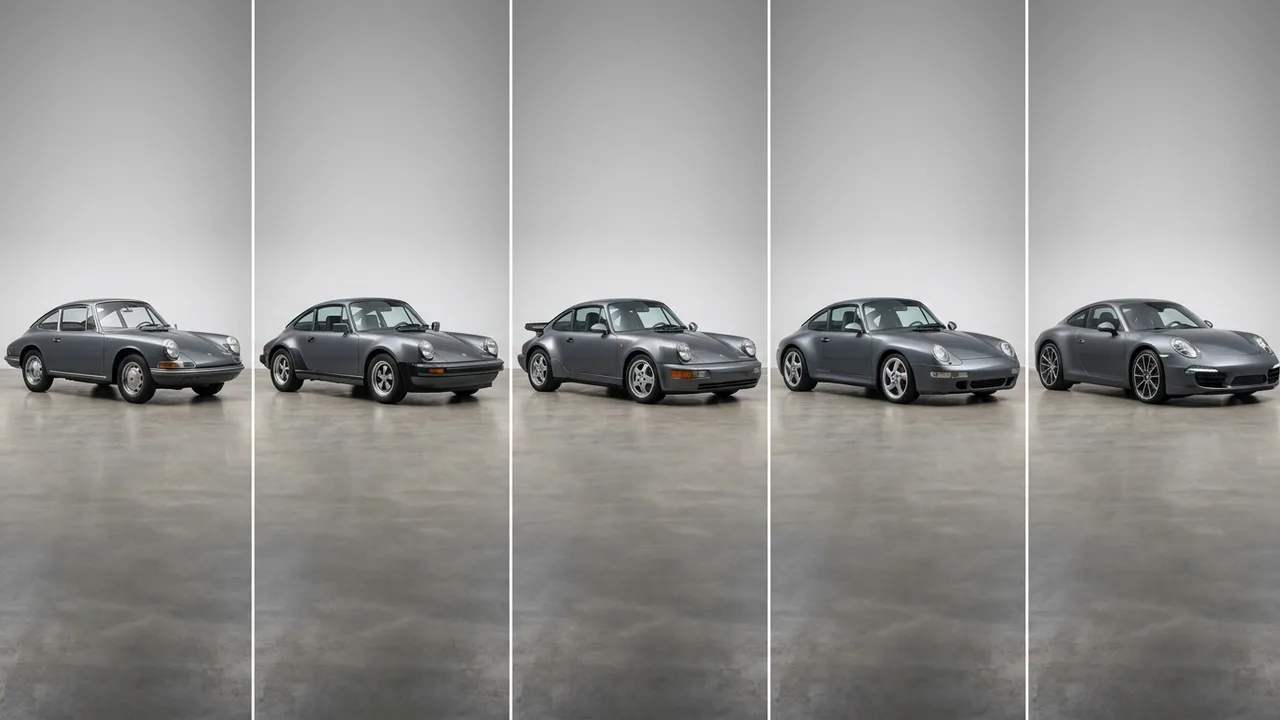
901/911, the original (from 1963/64). Flat-six, rear-engined, air-cooled, and immediately distinctive. The layout's handling characteristics were present from the start — lift-off oversteer became the car's defining hazard and, later, its defining character.
930, the first Turbo era (1975–1989). Turbocharging arrives, and with it the 911's most notorious period. Enormous performance, dramatic power delivery and genuinely demanding handling — the "widowmaker" reputation belongs here, and it wasn't entirely unearned.
964 (1989–1994). Substantial modernisation — coil springs replacing torsion bars, power steering, ABS, and the introduction of all-wheel drive (Carrera 4), which was the beginning of Porsche systematically engineering out the layout's danger.
993 (1994–1998). The last air-cooled generation, and for many enthusiasts the high point. A multi-link rear suspension substantially tamed the handling, and the combination of air-cooled character with genuine sophistication has made it the most coveted classic 911.
996 (1998–2005). The most contentious generation: water-cooling arrives, along with shared front-end styling with the Boxster. Enthusiasts objected loudly, and the 996 spent years as the unloved 911.
It was also the right decision. Air-cooling could not meet modern emissions and noise requirements. The alternative to water-cooling wasn't an air-cooled 911 — it was no 911, which is the same argument our Defender chronology encountered.
997 (2004–2012). Widely regarded as a return to form — better styling, improved interiors, and a broad range of variants. The generation that restored consensus.
991 (2011–2019). Larger, more refined, more capable, with turbocharging extending across most of the range. The efficiency-driven downsizing generation, which prompted another round of enthusiast objection.
992 (from 2018) and current. Further refinement and capability, hybrid assistance appearing in the range, and the continued balancing act between modernisation and identity.
The GT cars, and why they matter
The GT3 and GT-badged models deserve separate mention, because they're where Porsche protects the 911's soul.
Naturally aspirated engines, manual gearbox availability, and a focus on driver connection persist in the GT cars even as the mainstream range turbocharges and softens.
The Manthey Kit, which our performance-data section examined, sits here — and the finding was instructive: it adds no power at all. Its gains are entirely in downforce, high-speed cornering stability and braking, which do essentially nothing at road speeds and a great deal on a fast circuit.
That's a very Porsche kind of upgrade: unglamorous, precisely targeted, and honest about what it does.
What the chronology reveals
1. Persistence redeemed a flawed layout — but only because Porsche committed for fifty years. This is not a repeatable strategy.
2. Every significant modernisation was resisted and mostly correct. Water-cooling, turbocharging, all-wheel drive and PDK were each met with objection. Most were necessary, and the alternative was usually not a purer 911 but no 911 at all.
3. Continuity of shape is the brand. The 911's silhouette has evolved continuously and never been abandoned — a discipline our Corolla chronology also identified, applied to a completely different kind of car.
4. The GT cars are the pressure valve. By concentrating purist virtues — natural aspiration, manuals, driver focus — in specific models, Porsche can modernise the mainstream range without losing the enthusiasts entirely. It's a genuinely clever structural solution.
The bottom line
The 911's chronology is the story of a layout everyone else abandoned, kept alive by a manufacturer willing to spend six decades engineering around its flaws.
Every major modernisation was resisted and most were correct — water-cooling and turbocharging in particular were necessary rather than optional, and the alternative was not a purer car but no car.
The GT models are how Porsche keeps faith with purists while modernising everything else, and the Manthey Kit is a good example of that engineering culture: no added power, precisely targeted aerodynamic gains, and honest about being useless below racetrack speeds.
Most manufacturers were right to abandon the rear engine. Porsche was right not to. Both are true, and only one company could have made the second one work.
Key takeaways
- The 911's rear-engined layout was a genuine flaw that Porsche spent six decades engineering into a strength — most manufacturers were right to abandon it, and Porsche was right not to
- Key moments: 964's coil springs and AWD, the 993's multi-link rear taming the handling, and the contentious 996 water-cooling transition
- Every major modernisation was resisted and most were correct — the alternative to water-cooling wasn't an air-cooled 911, it was no 911
- The GT cars are the pressure valve — concentrating natural aspiration, manuals and driver focus so the mainstream range can modernise
- The Manthey Kit exemplifies the engineering culture: no added power, precisely targeted aero gains, and honest about doing little at road speeds
Sources & further reading
- Porsche historical records
Figures, prices and policy details were current at the last-updated date above. Automotive pricing, incentives and regulations change frequently — verify time-sensitive details against the primary sources listed below. Read our editorial policy and fact-checking standards.